
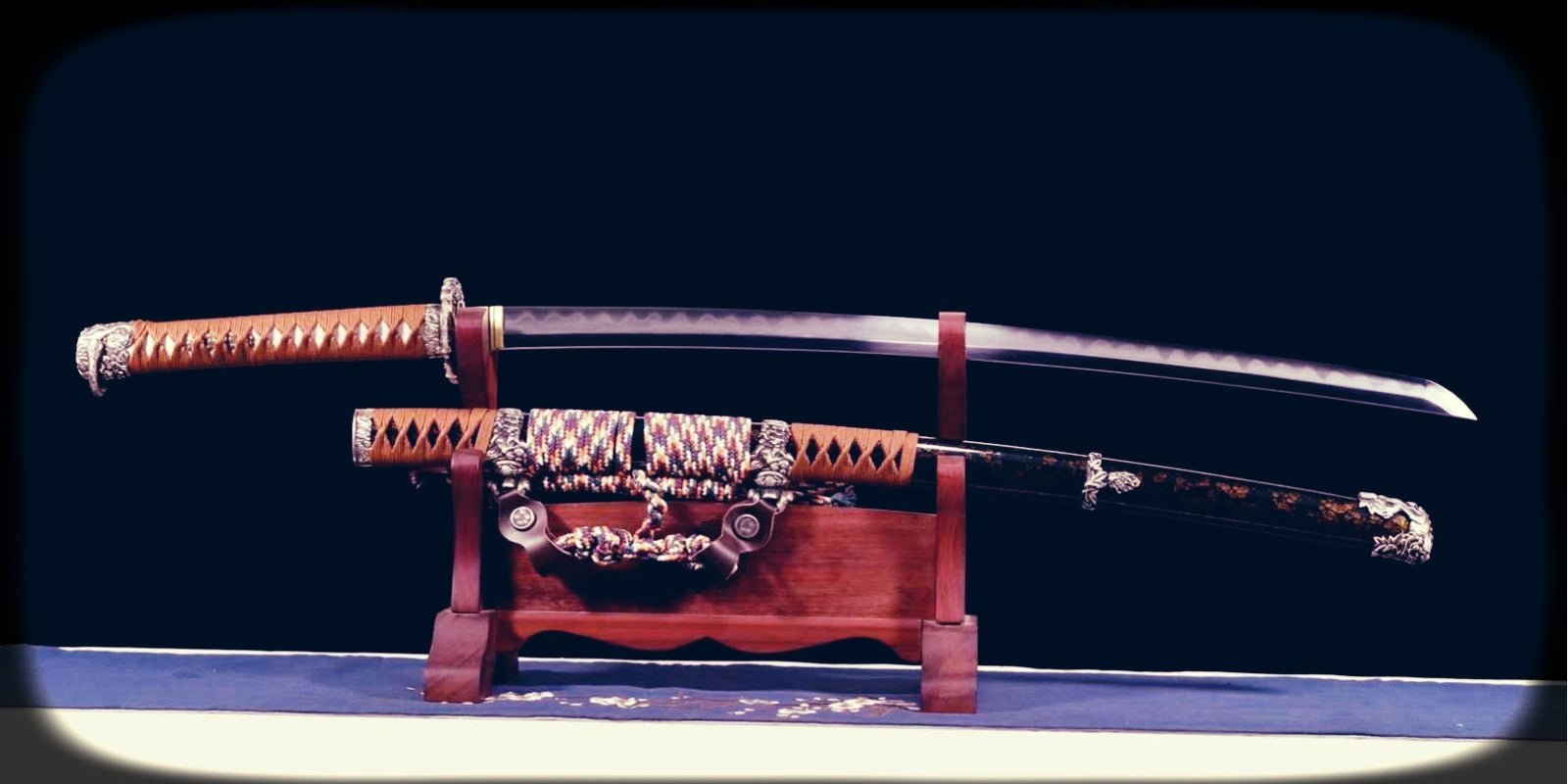
Buying Your First Functional Samurai Sword: What Actually Matters
If you're buying your first functional samurai sword, it's surprisingly easy to focus on the wrong things.
Most beginners are drawn to what looks impressive. They compare hamon patterns, get lost in steel names, and spend far too much time staring at dramatic product photos labelled “battle ready".
It feels like research.
Most of the time, it isn’t.
Because when you're buying a functional sword, the real question isn't
“Which one looks the best?”
It’s:
“What actually matters if I want something structurally sound, safe, and worth the money?”
That shift in thinking changes everything.
For a first-time buyer, your priorities should generally look like this:
- Tang construction
- Overall assembly quality
- Blade steel and heat treatment
- Weight and balance
- Seller credibility
- Intended use
It’s not a glamorous order, but it’s a practical one.
Structure first. Hype last.
Get that right, and you're already ahead of most beginners.
1. Start with the tang — the hidden backbone
If you remember only one thing, make it this:
A functional sword should be judged from the inside out.
That’s why Tang Construction comes first.
The term full tang gets thrown around a lot, often incorrectly. What matters isn’t whether it resembles a knife tang—it’s whether the tang is:
- integral to the blade
- properly proportioned
- securely mounted within the handle
If the tang is weak, poorly shaped, or questionable, everything else becomes irrelevant. No steel type, hamon, or decorative fitting can compensate for a flawed core structure.
Common beginner mistake
Many beginners treat the tang as a minor technical detail.
It’s not.
It’s the structural foundation of the entire sword.
At the same time, don’t assume a good tang guarantees a good sword. It doesn’t.
A sword can still fail you if:
- the handle fit is loose
- the mounting is sloppy
- the geometry is poorly executed
- the heat treatment is inconsistent
So think of it this way:
The tang won’t guarantee quality—but it can immediately disqualify a sword.
2. Assembly quality — where good swords feel “right”
Once the structure checks out, the next question is simple:
Is it actually well put together?
This is one of the most overlooked aspects for beginners.
A sword can look excellent in photos but feel disappointing in hand if the assembly is careless.
A functional sword is not just a blade—it’s a system.
Every part needs to work together:
- blade alignment
- guard and spacers
- handle core and wrap
- scabbard fit
When done well, the sword feels cohesive.
When done poorly, it feels like separate parts pretending to belong together.
What to look for
- Clean alignment
- Tight, natural-fitting components
- No rattling or shifting
- Smooth, controlled draw
Fancy details don’t matter if the basics are sloppy.
Simple and solid beats flashy and loose—every time.
3. Steel and heat treatment — where beginners get lost
This is where most people want to start.
And where most people go wrong.
Yes, steel matters—but heat treatment matters more.
Steel tells you the starting material.
Heat treatment determines how it actually performs.
That’s a crucial difference.
Better question to ask
Instead of:
“What steel is it?”
Ask:
“Was it heat treated well—and can I trust that consistency?”
A modest steel with proper heat treatment will outperform a “premium” steel handled poorly.
Beginner trap
Harder is not always better.
Higher hardness may improve edge retention—but reduces toughness.
A functional sword needs balance, not extremes.
That’s why steel comes after structure and assembly—not before.
4. Weight and balance — how it actually feels
Only after the fundamentals are solid should you ask:
How does it handle?
Many beginners look for a perfect number—weight, balance point, or spec.
That’s not how handling works.
Two swords with identical weight can feel completely different.
What matters is mass distribution, not just numbers.
Better way to think about it
Don’t ask:
“Is this weight good?”
Ask:
“Does this weight make sense for what this sword is designed to do?”
A well-designed sword feels intentional—not just light or heavy.
5. Seller credibility — the invisible factor
At this point, we shift focus—from the sword to the seller.
This is one of the most underestimated factors.
Everything you evaluate depends on the accuracy of the information provided.
A credible seller will:
- clearly explain construction
- show real details (not just marketing shots)
- describe steel and treatment honestly
- provide consistent specs
- answer direct questions without avoidance
Red flags
- Lots of hype, little detail
- Vague construction descriptions
- Overuse of buzzwords
- Avoiding direct answers
For beginners especially, seller quality matters more than you think.
A good seller reduces uncertainty.
A bad one multiplies it.
6. Intended use — last, not first
Finally, ask:
What am I actually going to use this for?
But here’s the key:
This question comes last—not first.
Because intended use cannot fix poor construction or bad assembly.
It only helps you choose between good options.
A common trap
Many beginners buy for the imagined version of themselves:
- serious cutter
- advanced practitioner
- hardcore collector
Instead of their actual use:
- careful handling
- display
- learning fundamentals
- occasional light cutting
That mismatch leads to regret.
A better mindset
Your first sword doesn’t need to be perfect.
It needs to be a good teacher.
The logic behind the order
Think of this process as a ladder:
- Is it structurally sound?
- Is it assembled properly?
- Is the blade competently made?
- Does it handle well?
- Can I trust the seller?
- Does it fit my needs?
Each step earns the next.
This isn’t a checklist—it’s a filter.
From objective risk → personal preference.
Final thoughts
Buying your first functional sword shouldn’t feel like gambling.
It should feel like a series of calm, practical decisions.
Start with structure.
Then assembly.
Then materials.
Then handling.
Then the seller.
Then your use case.
If that feels less exciting than chasing dramatic specs—good.
Because your first sword doesn’t need to impress anyone.
It needs to teach you what real quality feels like.
And once you understand that, every future decision becomes easier.