
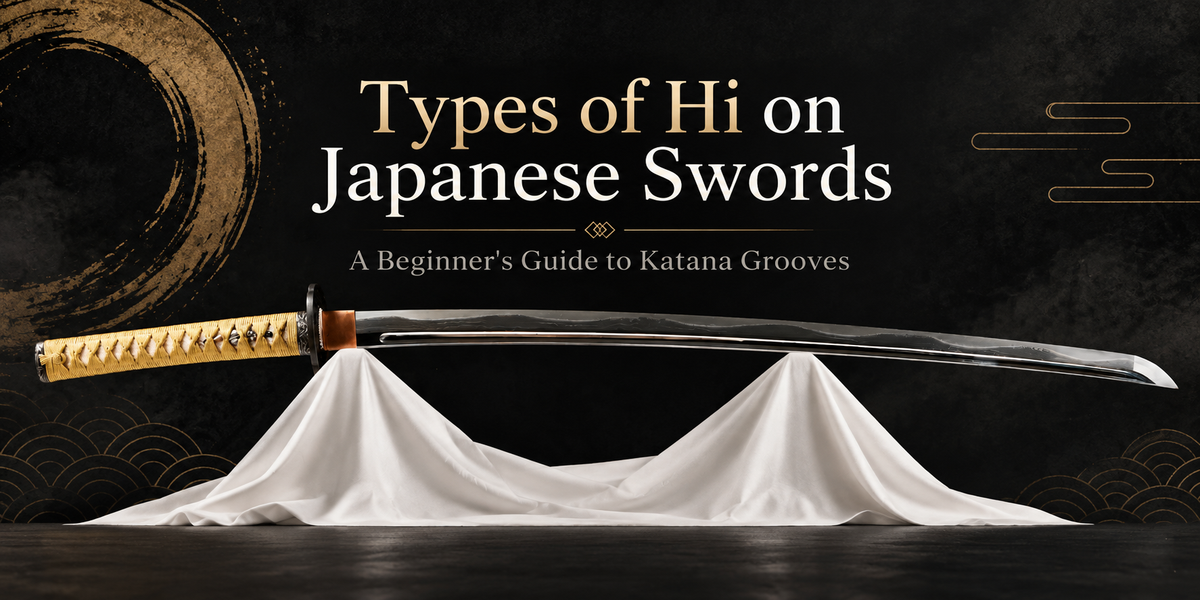
Types of Hi on Japanese Swords: A Beginner’s Guide to Katana Grooves
If you are looking at a katana for the first time, your attention will probably go straight to the curved blade, the hamon along the cutting edge, or the fittings around the handle. But look a little higher on the blade and you may notice another feature: a long groove running along the steel.
That groove is generally called a hi.
For beginners, it is easy to assume that every groove is the same. Online katana listings often make the subject look simple: one sword has a groove, another does not. In reality, traditional Japanese sword terminology describes several different groove arrangements, and even the way a groove ends can have its own name.
This is why terms such as bo-hi, soe-hi, futasuji-hi, koshi-hi, kakinagashi, and kakitoshi can become confusing when you first encounter them.
The good news is that you do not need to become a sword historian to understand the basics. In this guide, we will look at the main types of hi, how to tell them apart in photographs, what they can change about a blade, and what Australian beginners should keep in mind when comparing modern katana online.
What Is a Hi?
A hi is a groove or channel cut into the surface of a Japanese sword blade. On many familiar katana blade shapes, the groove runs lengthwise through the upper portion of the blade, usually closer to the spine than to the cutting edge.
The NBTHK American Branch glossary defines hi simply as grooves carved into a sword and identifies bo-hi as a wide groove and futasuji-hi as two grooves positioned side by side. Historical sword descriptions from the NBTHK also regularly identify bo-hi and different groove endings as important parts of a blade's physical description.
The first important lesson is that hi is the general category, while bo-hi is one particular type of hi.
In other words, calling every groove a bo-hi is a little like calling every car a sedan. A sedan is a car, but not every car is a sedan.
You may also encounter the English term fuller when reading about sword grooves. It is useful as a general comparison, but Japanese sword terminology is more specific, so keeping the word hi is often clearer when discussing katana.
Why Do Some Katana Have Grooves?
One straightforward effect of cutting a groove into a blade is the removal of steel. Less steel means less mass, so a groove can reduce blade weight and change the way that mass is distributed.
Traditional and modern sword references commonly associate hi with reducing weight, while decorative considerations can also play a role.
However, this is an area where beginners should be careful with exaggerated marketing claims.
You will sometimes read that a bo-hi automatically makes a katana stronger because it works exactly like an I-beam. Elsewhere, you may see the opposite claim that any groove automatically makes a sword weak.
Neither statement is a useful universal rule.
Removing steel changes the geometry and mass distribution of a blade. The actual result depends on factors including the dimensions of the blade, the width and depth of the groove, the steel, heat treatment, and overall construction. A groove should therefore be understood as one part of the blade's design rather than a magic feature that guarantees strength or weakness.
There is another myth worth clearing up: the groove is sometimes casually called a blood groove. That is a misleading description. Hi are discussed in sword references in terms of blade geometry, weight, appearance, and traditional form, not as channels designed to drain blood.
For a first-time buyer in Australia, that distinction is useful. If a product listing tries to sell a bo-hi mainly through dramatic stories about a "blood channel," it is better to focus on measurable information about the sword itself.
1. Bo-Hi: The Groove Most Beginners Will See
The bo-hi is probably the most recognisable groove on a katana.
It is a relatively wide, elongated groove running along the blade. Specialist glossaries describe bo-hi as a wide groove, and it appears frequently in professional descriptions of historical swords.
If you have been browsing modern katana from Sydney, Melbourne, or elsewhere in Australia, there is a good chance that most grooved blades you have seen use some version of this design.
Visually, bo-hi is usually easy to identify because it creates a broad recessed channel rather than a thin engraved line.
On a polished blade, light and shadow can make the groove look deeper or shallower depending on the photograph. This is important when shopping online. A dark stripe in a product image is not necessarily enough to tell you how deep a groove actually is.
The bo-hi is therefore best recognised by its overall shape and position rather than by colour alone.
2. Soe-Hi: A Narrow Companion Groove
Once you understand bo-hi, soe-hi becomes much easier to recognise.
A soe-hi is a narrower secondary groove positioned alongside a larger groove. References describing traditional groove forms identify it as an accompanying or secondary groove rather than simply another full-size bo-hi.
Imagine a broad main channel running along the blade with a much thinner line beside it. That thinner groove is the feature you are looking for.
This distinction matters because beginners sometimes see two visible channels and immediately describe the blade as having a "double bo-hi." That is not always correct.
If the grooves are clearly different in width, you may instead be looking at a main bo-hi accompanied by a soe-hi.
From a visual perspective, this combination gives the upper part of the blade more detail without making the two channels look identical.
3. Tsure-Hi: Similar, but Not Quite the Same
Another term that may appear in more detailed sword descriptions is tsure-hi.
Like soe-hi, it is a narrower groove associated with a larger main groove. The distinction is related to how the smaller groove follows the form and termination of the main groove. Specialist descriptions distinguish soe-hi from tsure-hi according to the relationship between the smaller groove and the end of the wider groove.
For a complete beginner, you do not need to memorise this difference immediately.
A better first step is simply to recognise that a wide groove with a narrow companion groove belongs to a different visual arrangement from two equal parallel grooves.
Once your eye becomes more familiar with blade photographs, the finer difference between soe-hi and tsure-hi becomes much easier to understand.
4. Futasuji-Hi: Two Parallel Grooves
A futasuji-hi consists of two grooves running side by side.
Unlike the typical bo-hi-and-soe-hi arrangement, the two channels are understood as a paired groove design rather than one dominant wide groove with a smaller companion beside it. The NBTHK American Branch describes futasuji-hi as two grooves side by side, and the term also appears in the NBTHK's descriptions of important historical swords.
This is one of the easiest distinctions for beginners to remember:
Bo-hi: one broad main groove.
Bo-hi with soe-hi: one broad groove plus a narrower companion.
Futasuji-hi: two parallel grooves forming a paired design.
When looking at product photographs, pay attention to relative width. Two lines do not automatically mean the same thing.
5. Koshi-Hi: A Much Shorter Groove
Not every hi runs along most of the blade.
A koshi-hi is a short groove positioned near the lower portion of the blade. Traditional sword references describe it as a short groove, often with a rounded upper end.
This makes it visually very different from the long bo-hi commonly seen on modern production katana.
If you are used to seeing grooves that travel almost from the base toward the point, a koshi-hi can initially look incomplete. But its short length is part of the design.
For beginners, the simplest way to remember it is:
Long groove: think bo-hi first.
Short groove near the base: consider koshi-hi.
As always, identification should take the entire blade into account rather than relying on a single feature.
6. Naginata-Hi and Other Less Common Forms
As you move beyond basic katana terminology, you may encounter additional forms such as naginata-hi.
The NBTHK American Branch lists naginata-hi as a recognised groove form, while specialist sword references associate it particularly with certain blade shapes rather than treating it as another name for an ordinary bo-hi.
For someone buying their first modern katana, recognising every unusual historical groove form is unnecessary.
What matters more is understanding that hi developed in multiple configurations. Bo-hi may dominate modern retail photographs, but it is only one part of a much broader vocabulary of blade carving.
That becomes particularly important if you later move from modern production swords into museum catalogues, antique sword references, or specialist collector descriptions.
Groove Type and Groove Ending Are Not the Same Thing
This is one of the most important points in the entire guide.
Terms such as bo-hi and futasuji-hi describe the groove arrangement itself.
Other terms describe how or where that groove ends.
These are different classification questions.
A beginner might see the term kakinagashi in a product description and assume it is simply another groove shape comparable to bo-hi. A more accurate way to understand it is as a description of the groove's lower termination.
Once you separate these two ideas, a lot of sword terminology suddenly becomes easier.
Think of it this way:
First ask, "What groove arrangement am I looking at?"
Then ask, "How does that groove end?"
Kakinagashi: When the Groove Continues Past the Blade Base
The NBTHK American Branch defines kakinagashi-hi as a groove that passes the machi area but does not extend all the way to the end of the tang.
For a beginner, the important point is that the groove does not simply stop before the tang. It continues farther down before terminating.
This feature may not be obvious in an assembled sword because the lower area is covered by the blade collar and handle.
That is another reason online photographs can be misleading. A full side view of an assembled katana may tell you very little about what happens to the groove underneath the fittings.
Kakitoshi: A Groove Continuing Through the Tang
Kakitoshi-hi goes farther.
According to the NBTHK American Branch glossary, kakitoshi describes a groove extending all the way to the end of the tang and remaining open at the end.
The difference between the two can therefore be simplified as follows:
Kakinagashi continues into the tang area but stops before the tang ends.
Kakitoshi continues all the way through to the end of the tang.
Historical NBTHK sword descriptions provide real examples of bo-hi carved through the tang, confirming that this is not merely terminology found in modern retail catalogues.
Again, notice that these words tell you about termination, not necessarily whether the main groove is broad, narrow, single, or paired.
Rounded and Square Groove Endings
Grooves can also end in visibly different shapes.
Two useful terms are marudome, describing a rounded stop, and kakudome, describing a more squared termination.
These are documented in professional sword descriptions. For example, NBTHK material describes blades with bo-hi ending in marudome and others with bo-hi ending in kaku-dome.
This gives beginners another useful way to examine a blade.
Do not only look at whether a groove exists. Look at the final few centimetres of the groove.
Does it finish with a rounded shape?
Does it end more abruptly and squarely?
Does it continue beneath the blade collar?
Small details like these are part of what makes studying Japanese sword geometry more interesting than simply ticking a box marked "with bo-hi."
Does a Bo-Hi Make a Katana Better?
No single groove can answer that question.
A katana with bo-hi is not automatically better than a katana without one, and a blade without hi is not unfinished or inferior.
The groove changes the blade's geometry and removes material. That can influence weight and balance, but the overall character of a sword depends on far more than one feature.
For a modern production katana, you should also consider blade dimensions, steel, heat treatment, geometry, construction quality, fittings, assembly, and the intended purpose of the sword.
This is especially important for Australian buyers shopping online, where a dramatic blade photograph can easily receive more attention than the technical specifications.
A clean-looking bo-hi can be attractive, but it should not become a shortcut for judging the entire sword.
What About the Sound of a Grooved Katana?
Grooved swords can produce a noticeable sound as they move through the air, and modern sword references often mention this acoustic effect in connection with bo-hi.
For beginners, however, it is better not to turn that sound into a universal quality test.
The sound can be affected by groove geometry, blade dimensions, movement, speed, and alignment. A loud sound does not prove that the steel is superior, that the heat treatment is better, or that the sword is more valuable.
It is an audible characteristic, not a complete inspection system.
If you are simply buying your first katana for a collection or display, the more useful question is whether you prefer the appearance and weight characteristics associated with a grooved or ungrooved blade.
Traditional Hi and Modern Production Katana
There is another distinction beginners should understand.
Seeing a traditional term in a modern product listing does not automatically mean the blade was produced using the same methods as an antique sword.
Modern manufacturers can create grooves using contemporary workshop equipment and production processes. A modern bo-hi may visually follow a traditional form while being produced in a very different manufacturing environment.
That is not automatically a problem.
A well-made modern katana does not need to pretend to be an antique.
The important thing is to judge it according to what it actually is.
If you are comparing modern swords online in Australia, look for clear photographs and useful specifications. Ideally, the seller should show the blade from multiple angles so you can examine the width, placement, symmetry, and termination of the groove rather than relying on one heavily edited image.
How to Identify Hi in Online Katana Photos
When you first start comparing blades, keep the process simple.
Begin by finding the spine and cutting edge so you understand the orientation of the blade. Then look at the upper face of the blade for a long recessed channel.
If you see one broad channel, it is likely a bo-hi.
If there is a broad channel with a much thinner groove beside it, look more closely at soe-hi or related companion-groove terminology.
If you see two parallel grooves of similar visual importance, futasuji-hi may be the more appropriate description.
If the groove is limited to the lower section of the blade, consider whether you are looking at a short form such as koshi-hi.
Finally, inspect both ends. The shape near the point and the way the groove terminates near the base can provide additional information.
Do not try to identify a sword from the groove alone. Hi are only one part of the blade's overall geometry.
What Should a First-Time Buyer Remember?
For a beginner, the number of terms can seem overwhelming, but you really only need a few ideas to get started.
A hi is the general term for a groove.
A bo-hi is the familiar broad groove seen on many katana.
A soe-hi is a narrower companion groove.
A futasuji-hi uses two parallel grooves.
A koshi-hi is much shorter and sits toward the lower portion of the blade.
Terms such as kakinagashi and kakitoshi describe how far the groove continues toward or through the tang rather than simply naming another basic groove arrangement. Rounded and squared endings add another layer of description.
Once you understand those distinctions, product listings and specialist sword descriptions become much easier to read.
Final Thoughts
The groove on a katana may look like a simple line in the steel, but it can tell you a surprising amount about the blade's design.
For beginners, the biggest mistake is trying to attach one dramatic explanation to every hi. It is not a mysterious blood channel, and its presence does not automatically make a sword stronger, more traditional, or higher quality.
Instead, think of hi as part of the blade's geometry.
Look at how many grooves there are. Compare their width. Notice where they begin and end. Check whether a smaller groove accompanies a larger one. Pay attention to whether the termination is rounded, squared, or continues into the tang.
For someone discovering katana from Australia, whether you are browsing your first sword online from Sydney or gradually building a collection in Melbourne, learning to notice these details changes the way you look at a blade. What once seemed like a simple decorative channel becomes part of a larger design language.
And that is one of the most rewarding parts of learning about Japanese swords: the closer you look, the more details begin to make sense.