
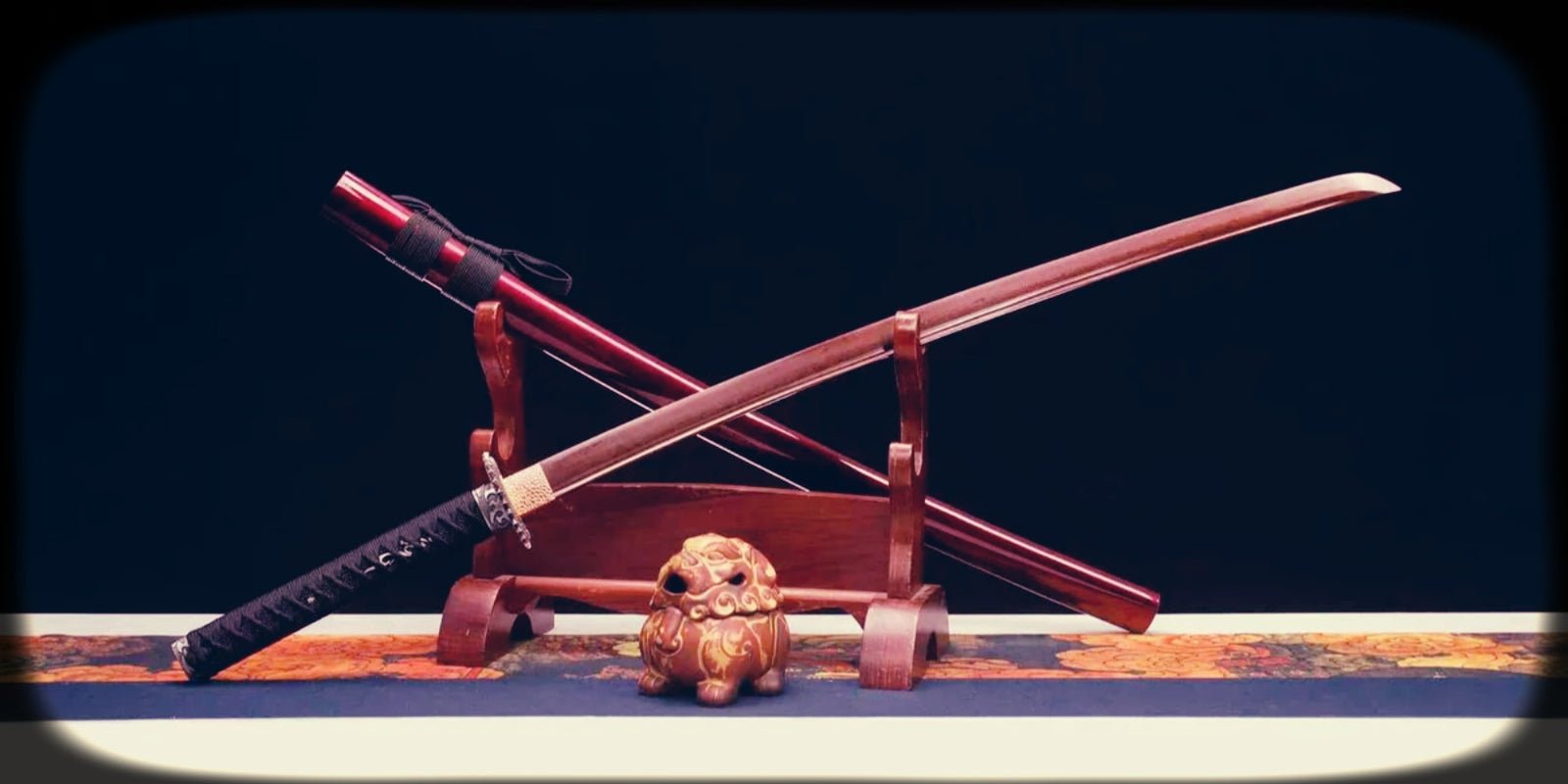
What Is a Damascus Steel Folded Samurai Sword?
A Beginner-Friendly Guide to Meaning, Benefits, and Buying Tips
If you are completely new to samurai swords, the phrase “Damascus Steel Folded Samurai Sword” probably sounds powerful, mysterious, and maybe a little confusing.
You may have seen product titles like
Damascus Folded Steel Katana
Hand-Forged Folded Samurai Sword
Full Tang Damascus Steel Blade
Folded Steel Katana with Visible Grain Pattern
Then you look at the blade: flowing lines, smoky patterns, wave-like textures, and a surface that feels far more dramatic than a plain polished sword.
It is easy to wonder the following:
Is this stronger?
Is it more special?
Is it better than regular carbon steel?
Or is it just a cool-looking pattern with a bigger price tag?
Those are exactly the right questions to ask.
"Damascus steel folded samurai sword" usually refers to a katana-style sword made from layered or folded steel. The steel is forge-welded, folded, shaped, and finished in a way that reveals flowing grain patterns across the blade. At its best, it brings together visual beauty, craftsmanship, and functional structure.
But here is the part every beginner needs to understand:
The pattern alone does not prove quality.
A Damascus-folded blade can be beautiful and functional. It can also be decorative, poorly made, or dressed up with marketing buzzwords. For a first-time buyer, the goal is not to memorize every technical term. The goal is to understand what those terms actually mean before spending your money.
So let’s break it down in plain English.
No complicated metallurgy lecture.
No fantasy storytelling.
Just a clear guide to what this type of sword is, why people like it, and what you should check before buying one.
1. First, What Does the Name Actually Mean?
The phrase “Damascus Steel Folded Samurai Sword” is really a combination of three ideas:
Damascus steel
Folded steel
Samurai sword / katana-style blade
Once you separate these terms, the whole topic becomes much easier to understand.
In most modern sword listings, Damascus steel usually refers to steel with a visible layered or flowing pattern. That pattern may look like water, smoke, wood grain, waves, or fine lines running through the blade.
For modern production swords, Damascus-style blades are usually made from pattern-welded steel. This means different layers of steel are stacked, forge-welded together, worked into a billet, and shaped into a blade. Later, polishing or etching brings out the contrast between the layers.
A simple way to picture it is layered dough or a patterned cake. Different layers are stacked, pressed, folded, and shaped. When the surface is cut or finished, the layers become visible.
Steel is obviously much harder to work than dough, but the visual idea is similar:
Layers create patterns.
"Folded steel," on the other hand, refers more specifically to the process of folding and forge-welding steel repeatedly. Each fold increases the number of layers and creates more complex grain activity.
For katana-style swords, folded steel is often valued because it gives the blade a more handcrafted, layered appearance.
And "samurai sword," in modern product language, usually refers to a katana-style sword with a curved blade, long handle, and recognizable silhouette. For most modern buyers, this means a contemporary production sword inspired by traditional blade form, not an antique historical piece.
So when a product says "Damascus Steel Folded Samurai Sword," it usually means:
A katana-style sword made from folded or pattern-welded layered steel, with visible grain patterns across the blade.
That is the simple version.
2. Is Modern Damascus the Same as Historical Damascus?
This is where many beginners get confused.
The word Damascus has an older historical background, but in today’s sword and knife market, it is often used in a much broader way. Most modern “Damascus” swords are not ancient crucible steel. They are usually pattern-welded or folded steel with visible layered patterns.
That does not automatically make them fake.
It simply means you should understand what the seller is actually talking about.
For modern katana-style swords, Damascus usually means the following:
- Layered steel construction
- A visible pattern created through forging and finishing
- A blade surface with flowing grain activity
- A more artistic appearance than plain monosteel
The problem begins when a seller uses the word “Damascus” without explaining anything else.
A serious product description should tell you more than just “Damascus steel.” It should explain whether the blade is folded steel or pattern-welded steel, what steel is used, whether the sword is functional or decorative, and how it was heat treated.
If a product page only says the following:
“Premium Damascus steel, super sharp, battle ready."
But gives no clear details, slow down.
Good swords do not need vague hype. They need clear information.
3. Why Is Steel Folded?
A common beginner question is:
Why fold the steel at all?
Historically, folding helped refine raw steel. Earlier steel could contain impurities or uneven carbon distribution. Folding helped improve consistency, distribute carbon more evenly, and reduce unwanted inclusions.
In modern production, steel quality is much more controlled. That means folding is not always necessary for basic performance. A well-made monosteel blade can be strong, predictable, and reliable.
So why are folded steel swords still popular?
Because folded steel offers something many collectors and beginners love:
visual depth and craftsmanship appeal.
A folded Damascus blade does not look flat or plain. It has movement. It has layers. It gives the eye something to study. The pattern may flow along the blade, shift near the tip, or show different activity under changing light.
For a beginner, this makes folded steel easy to appreciate visually. You do not need years of experience to notice the difference between a plain polished blade and a blade with layered grain.
But here is the key point:
Folding can add beauty, but it does not automatically guarantee performance.
A well-made folded blade can be impressive.
A poorly made folded blade can still be weak, badly balanced, or purely decorative.
The process matters.
The execution matters even more.
4. Damascus Pattern vs. Real Performance
This is one of the most important points in the whole article.
The Damascus pattern is what you see first.
But the pattern itself is not what makes the sword safe, reliable, or functional.
A blade can have a beautiful folded pattern and still be too soft, too brittle, poorly balanced, or badly assembled. On the other hand, a plain monosteel blade with excellent heat treatment and solid construction can perform extremely well.
So do not think of Damascus as a magic upgrade.
Think of it as a construction and appearance feature.
Real performance comes from the whole sword:
- Steel choice
- Heat treatment
- Blade geometry
- Tang construction
- Handle assembly
- Fittings
- Balance
- Intended use
In simple terms:
Damascus is the pattern you notice. Quality is the whole build behind it.
That is the mindset every beginner should keep.
5. What Are the Advantages of a Damascus Folded Samurai Sword?
Now let’s talk about the real advantages.
A Damascus folded samurai sword can offer several benefits, especially for collectors, display buyers, and beginners who want their first sword to feel visually special.
Advantage 1: A Beautiful Layered Blade Surface
The most obvious advantage is appearance.
A Damascus folded blade has visible grain activity that may look like flowing water, smoke, wood grain, or soft waves. Compared with a plain polished blade, it often feels more alive and artistic.
For display, collection, photography, or product presentation, this is a major appeal. The blade itself becomes a visual feature, not just a cutting surface.
If you want a sword that looks refined, textured, and handcrafted, Damascus folded steel is often more eye-catching than simple monosteel.
Advantage 2: Each Blade Feels More Individual
Because the grain pattern is created through layers and forging, no two folded blades look exactly the same.
Even if two swords follow the same model, the blade patterns may vary slightly. This gives each sword a more individual character.
For collectors, that matters.
A folded Damascus blade feels less like a generic product and more like an object with its own visual identity.
Advantage 3: It Shows Craftsmanship
A folded blade usually requires more work than a plain steel blade. The process may involve stacking, forge-welding, folding, drawing out, shaping, polishing, and revealing the pattern.
When done properly, this gives the sword a stronger sense of craftsmanship.
For beginners, this is also educational. You can study the blade and ask
Does the pattern flow naturally?
Does the grain look even?
Does it follow the blade shape?
Does the surface look clean?
Does the pattern feel deep, or does it look printed on?
This makes folded steel a good entry point for learning how to observe blade surfaces.
Advantage 4: It Can Combine Beauty with Function
A Damascus folded samurai sword is not automatically decorative.
If it has proper steel, correct heat treatment, full tang construction, good geometry, and tight assembly, it can be a functional sword.
But this is where beginners need to be careful.
The Damascus pattern itself does not make the sword functional.
Function comes from the complete build.
A beautiful blade with poor construction is still a poor sword.
So enjoy the pattern, but do not let it distract you from the fundamentals.
6. Is Damascus Folded Steel Stronger Than Regular Carbon Steel?
This is probably the biggest beginner misunderstanding.
Many people assume that Damascus folded steel must be stronger because it sounds more complex.
The honest answer is
Not automatically.
A well-made folded Damascus blade can be strong, attractive, and functional. But a well-made monosteel blade can also be excellent. In some cases, monosteel can even be more predictable because it has fewer forge-welded layers and fewer chances for internal welding flaws.
The real question is not
“Is Damascus stronger?”
The better question is
“Was this blade made well?”
A strong sword depends on the following:
- Suitable steel
- Clean forging
- Proper heat treatment
- Good blade geometry
- Solid tang construction
- Secure assembly
- Correct use
Poorly made folded steel can have problems such as weak welds, layer separation, uneven hardness, or rough finishing. These issues may not always be obvious in product photos.
So here is the simple rule:
Folded steel is a craftsmanship feature, not a shortcut to strength.
If it is done well, it adds beauty and value.
If it is done poorly, the pattern will not save the blade.
7. The Decorative Sword Trap: Pattern Does Not Always Mean Function
Many beginners are attracted by low-priced Damascus-style swords because the pattern looks impressive.
That is completely understandable.
But this is where you need to be careful.
Some swords are made mainly for display. They may look attractive on a wall or stand, but they may not be suitable for cutting, training, or serious handling.
A display sword is not automatically bad. It can be perfectly fine if you only want decoration.
The problem is when a decorative sword is marketed as functional.
Be careful with listings that combine very low prices with very big claims, such as:
hand forged
real Damascus
battle ready
razor sharp
master grade
collector level
The danger is not a low price by itself.
The danger is a low price combined with exaggerated claims.
A functional Damascus folded katana should justify its price with real details: steel, heat treatment, tang, assembly, balance, and seller transparency.
Do not buy only the shine.
Buy the information behind the shine.
8. What Should Beginners Check Before Buying?
If you have never handled a samurai sword before, do not worry. You can still make a smarter buying decision by checking a few basic things.
1. What Is It For?
Before looking at steel or a pattern, ask yourself what you want the sword for.
Is it for display?
Collection?
Photography?
Learning sword parts?
Light handling?
Functional cutting practice?
Your purpose matters because not every sword is made for the same job.
A display sword can focus more on appearance.
A functional sword needs stronger attention to structure, heat treatment, and assembly.
2. Is the Tang Construction Clearly Described?
For serious handling, the tang matters more than the pattern.
Full tang construction is generally preferred for strength, stability, and safer use. If the product does not explain the tang clearly, ask before buying.
A beautiful folded blade with a weak tang is not a good deal.
3. Is the Sword Properly Assembled?
A sword is not just a blade.
The handle, guard, spacers, wrap, fittings, and scabbard all affect the overall experience.
Check whether:
The handle wrap looks tight.
The guard sits cleanly.
The fittings look secure.
The blade appears aligned.
The scabbard fit looks reasonable.
Good assembly should feel cohesive. Poor assembly can make even a beautiful blade feel cheap.
4. What Steel Is Used?
Avoid vague descriptions like the following:
premium Damascus
super steel
ancient forging
ultimate warrior blade
These phrases sound exciting, but they do not tell you much.
Look for real details:
What kind of steel is used?
Is it folded carbon steel?
Is there a core steel?
Is it through hardened or differentially hardened?
Is it suitable for display, handling, or cutting?
Clear information is always better than loud marketing.
5. How Was It Heat Treated?
Heat treatment matters more than many beginners realize.
A blade can look beautiful but perform poorly if it was not hardened and tempered correctly.
Ask whether the blade is through hardened, differentially hardened, or mainly decorative. A trustworthy seller should be able to answer without making things more confusing.
6. Is the Pattern Real Folded Steel or a Surface Decoration?
The pattern should look natural and integrated into the blade.
It should not look like paint, print, sticker, or shallow surface decoration.
A real folded pattern usually has movement and depth. It should follow the blade rather than sit awkwardly on top of it.
Ask for close-up photos if needed.
7. Does the Sword Look Balanced?
A good sword should feel controlled in the hands. It should not feel like all the weight is dragging toward the tip.
Two swords may have similar weights on paper but feel completely different because the mass is distributed differently.
A Damascus blade should not feel heavy just because it looks dramatic.
8. Is the Seller Transparent?
For beginners, seller credibility matters a lot.
A good seller gives clear photos, direct explanations, realistic claims, and after-sales support.
A weak seller uses big words but avoids details.
The best beginner sword is not always the most expensive one. It is the one you can actually understand.
9. Is a Damascus Folded Samurai Sword Good for a First Sword?
Yes, it can be — depending on your purpose.
If your goal is display, collection, photography, or learning blade aesthetics, a Damascus folded samurai sword can be a great first choice. The grain pattern gives you something beautiful to observe and compare.
If your goal is functional use, you need to be more selective. Make sure the sword is clearly described as functional, properly heat treated, full tang, and well assembled.
For a complete beginner, the best mindset is
Buy a sword that teaches you something.
A folded Damascus sword can teach you how to observe steel patterns, polish quality, blade surface activity, and seller descriptions.
But do not let the pattern become a distraction.
Your first sword does not need to be the most expensive.
It does not need to have the loudest pattern.
It does not need to impress everyone online.
It needs to be honest, understandable, safe to own, and suitable for your purpose.
10. Common Beginner Myths About Damascus Folded Samurai Swords
Myth 1: Damascus Always Means Better
Not true.
Damascus folded steel can be beautiful and impressive, but it is not automatically better than plain carbon steel.
Myth 2: More Layers Always Mean Better
Not necessarily.
More layers can create a finer pattern, but layer count alone does not prove quality.
Myth 3: A Beautiful Pattern Means the Sword Is Functional
No.
A sword can look beautiful and still be decorative. Always check the construction and heat treatment.
Myth 4: All Damascus Patterns Are Real
No.
Some patterns come from real folded steel. Others may be surface treatments. Ask the seller directly.
Myth 5: Folded Steel Needs No Maintenance
Wrong.
A Damascus folded blade still needs care. Keep it clean and dry, avoid touching the blade with bare fingers for long periods, and apply a light protective oil when needed.
Final Thoughts: Buy the Craft, Not Just the Pattern
A Damascus steel folded samurai sword can be an excellent choice for beginners and collectors. It offers a blade surface full of movement, depth, and individuality. It makes the steel itself part of the visual experience.
But the most important lesson is simple:
Do not buy the pattern alone.
The folded grain is only one part of the sword. A worthwhile blade should also have clear steel information, proper heat treatment, solid tang construction, clean assembly, good balance, and honest seller descriptions.
For beginners, Damascus folded steel is exciting because it gives you something visible to study. You can see the layers. You can compare the grain. You can begin to understand how craftsmanship appears on the blade surface.
But as you learn more, you will realize that the best sword is not always the one with the loudest pattern.
It is the one where everything makes sense.
The steel makes sense.
The forging makes sense.
The heat treatment makes sense.
The fittings make sense.
The price makes sense.
The seller’s explanation makes sense.
So, what is a Damascus steel folded samurai sword?
It is a katana-style sword made with layered or folded steel, often showing a beautiful flowing grain pattern across the blade. Its advantages are visual depth, individuality, craftsmanship appeal, and — when properly made — the ability to combine beauty with function.
For your first sword, it can be a great choice if you buy it with clear eyes.
Enjoy the pattern.
Appreciate the craft.
But always check the fundamentals.
Because a good sword should be more than beautiful.
It should be honest, well-made, and worth understanding.