
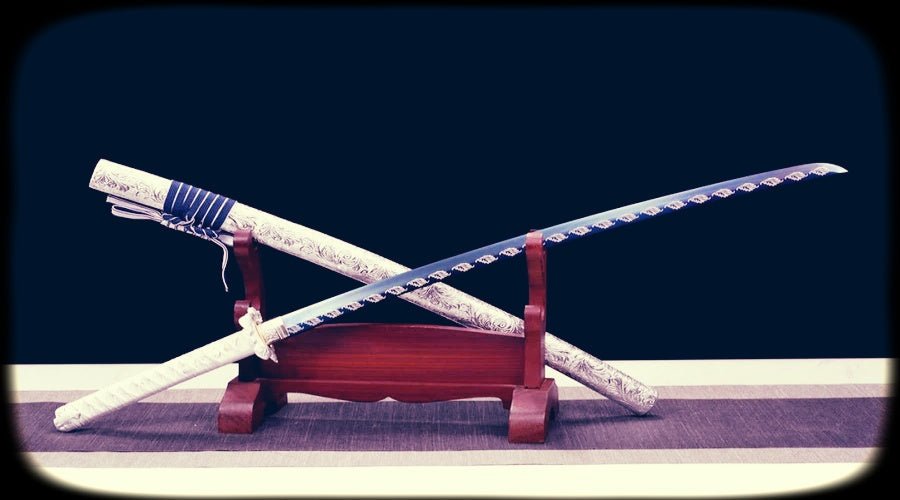
Why Spring Steel Works So Well with Through-Hardened Katana Blades
If you are buying your first katana-style sword, the product descriptions can get confusing fast. One blade is listed as “T10 clay tempered.” Another says “1095 carbon steel with hamon.” Then you come across “5160 spring steel, through hardened” or “9260 spring steel blade", and suddenly it feels less like shopping and more like sitting through a metallurgy lesson.
For a complete beginner, that is a lot to take in.
Maybe you are in Sydney, scrolling through sword listings after work. Maybe you are in Melbourne comparing steel types late at night. Or maybe you are in Brisbane, Perth, Adelaide, Canberra, or the Gold Coast, trying to work out whether “spring steel” is a real performance feature or just another flashy marketing term.
The good news is that the basic idea is not as complicated as it sounds.
Spring steel is often paired with through hardening because both are designed around a similar goal: practical strength. Spring steel is valued for toughness, resilience, and the ability to handle stress. Through hardening gives the blade a more even hardness through its body instead of creating a strong contrast between a very hard edge and a softer spine. When the blade is also properly tempered, this combination can produce a sword that feels more consistent, more forgiving, and more practical for beginners.
That does not mean every spring steel blade is automatically excellent. It also does not mean through hardening is better than every other heat-treatment method. Steel type, heat treatment, blade geometry, polishing, fittings, and assembly all matter.
But if you are new to katana-style blades and want a practical first sword, spring steel with through hardening is one of the most sensible combinations to understand.
What Is Spring Steel in Simple Terms?
Spring steel is not one single steel. It is a general name for steels designed to flex under stress and return close to their original shape. As the name suggests, spring steel is often used in parts that need resilience, such as springs and other components that face repeated loading.
In modern katana-style swords, the two spring steels you will often see are 5160 and 9260.
These steels are not usually chosen because they create dramatic blade patterns. They are not mainly selected for a flashy surface finish or a natural hamon. They are chosen because they can be tough, resilient, and practical when heat treated correctly.
That last part matters when heat treated correctly.
A steel name alone does not make a good blade. A poorly heat-treated 5160 blade can still perform badly. A poorly made 9260 blade can still disappoint. The steel gives the maker potential, but the final result depends on how that potential is handled.
A simple way to think about spring steel is this: it is a material family chosen when the maker wants the blade to handle stress well. For a beginner, that matters because a first sword should usually be forgiving rather than overly delicate.
What Does Through Hardening Actually Mean?
Through hardening is a heat-treatment method that aims to harden the blade more evenly through its body. Instead of making only the edge very hard and leaving the spine much softer, through hardening creates a more consistent hardness across the blade.
This does not mean the blade becomes extremely hard from edge to back. That would not be ideal. A blade that is too hard everywhere can become brittle, and brittleness is not something you want in a long blade.
This is why tempering is so important.
After steel is hardened, it is usually tempered. Tempering reduces brittleness and helps bring the steel into a more useful balance of hardness, toughness, and resilience. In plain English, hardening gives the steel strength, while tempering helps stop that strength from becoming fragile.
So when we say a katana-style blade is through hardened, we are not saying it is simply “hard all the way through” in a careless way. A good through-hardened blade should be hardened and tempered in a controlled process so that it becomes practical, not brittle.
For a first-time buyer, the result is usually easier to understand: the blade is designed to behave more consistently as one structure.
Why Spring Steel and Through Hardening Make Sense Together
Spring steel and through hardening work well together because their goals match.
Spring steel is valued for toughness and resilience. Through hardening is used to create more even hardness and strength through the blade. When those two ideas are combined correctly, the blade is not trying to be the most decorative option. It is trying to be practical.
Think about it like choosing a vehicle for everyday Australian driving. If you are moving through Sydney traffic, dealing with Melbourne’s changing weather, or taking longer drives outside Perth or Adelaide, you probably want something reliable and stable before you worry about flashy extras. You want something that can handle real conditions.
A through-hardened spring steel blade follows a similar idea. It may not have the most dramatic hamon. It may not have the layered look of folded steel. But if it is made properly, it can offer the kind of practical durability that many beginners actually need.
This is the main reason spring steel is so often used with through hardening. The steel already leans toward toughness and resilience. Through hardening supports that direction by helping the whole blade act in a more consistent way.
Toughness Matters More Than Beginners Often Realize
When people first look at swords, they often focus on sharpness. That makes sense. A sword is a blade, so sharpness naturally feels like the most important feature.
But sharpness is only one part of the story.
A blade also needs toughness. Toughness is the ability to absorb stress without cracking or failing too easily. In practical terms, a tough blade is better at handling impact, vibration, and small mistakes.
For beginners, this matters a lot.
A new buyer may not yet understand blade alignment, edge geometry, proper handling, or maintenance habits. A very hard edge may sound attractive, but if the blade is less forgiving, mistakes can become expensive. A through-hardened spring steel blade is often a better starting point because it is usually designed around durability and resilience rather than delicate edge contrast.
This does not mean the sword can be abused. No real blade should be treated carelessly. A tough blade still has limits. It can still bend, chip, rust, or become damaged if used incorrectly.
But a forgiving blade gives beginners more room to learn.
That is one of the strongest arguments for through-hardened spring steel: it offers practical toughness without asking the beginner to understand every detail of advanced blade behavior from day one.
Flexibility Does Not Mean Weakness
A common misunderstanding is that if a blade can flex, it must be weak. That is not true.
In many steel applications, controlled flexibility is a sign of resilience. A blade that can take a reasonable amount of stress and recover is often more practical than a blade that is extremely hard but brittle.
This is where spring steels such as 5160 and 9260 become useful.
5160 is often appreciated for toughness and shock resistance. It is a chromium spring steel, but that does not make it stainless steel. The chromium content helps with certain steel properties, but it is not high enough to make the blade rust-proof.
9260 is often associated with flexibility and resilience because of its silicon content. Silicon is one of the reasons 9260 is commonly linked with spring-like behavior. This does not mean every 9260 sword is better than every 5160 sword. It simply means 9260 is often chosen when the maker wants strong elastic response and resilience.
The key point is simple: spring steel is not “soft” in the way beginners might imagine. It can still be hardened and sharpened. Its appeal is that, when treated properly, it can offer a useful balance between hardness and the ability to handle stress.
5160 Spring Steel: Practical and Tough
5160 is one of the most common spring steels used in modern sword making. It has a strong reputation for practical toughness and shock resistance.
In katana-style blades, 5160 is often paired with through hardening because this heat treatment supports its main strengths. The goal is not to create a dramatic visual line along the blade. The goal is to create a blade that feels solid, consistent, and dependable.
For a beginner, that can be a major advantage.
A through-hardened 5160 blade may not look as visually complex as a folded steel or Damascus-style blade. It may not have a natural hamon. But if the heat treatment and construction are done well, it can be a very sensible first sword for someone who values function over decoration.
If your priority is a tough, reliable blade rather than a blade chosen mainly for visual drama, 5160 is worth considering.
9260 Spring Steel: Resilient and Forgiving
9260 is another popular spring steel used in katana-style swords. It is especially known for resilience and flexibility.
This steel is often chosen when a maker wants a blade that can better tolerate bending stress and return close to its original shape. That makes 9260 attractive to buyers who want a blade that feels lively, durable, and beginner-friendly.
Like 5160, 9260 is commonly paired with through hardening. This is because the goal is usually overall resilience, not a natural hamon or dramatic hardness contrast between edge and spine.
For a new buyer, 9260 can be appealing because it sounds practical, and in many cases, it is. But the same rule still applies: the steel name does not guarantee the final result.
A well-made 9260 blade can be excellent. A poorly made one is still a poorly made blade.
So when looking at 9260, do not stop at the steel name. Look for clear information about heat treatment, blade construction, fittings, and intended use.
Why Spring Steel Is Usually Not Chosen for a Natural Hamon
Many beginners are drawn to the hamon, the visible line that can appear along the blade after differential hardening. It can look beautiful, and it is often one of the most attractive visual features on a katana-style blade.
But spring steel is usually not chosen mainly for this effect.
A natural hamon is generally associated with differential hardening, where the edge becomes harder while the spine remains softer. This process depends on creating a clear difference in cooling and hardness across the blade.
Spring steels such as 5160 and 9260 are often valued because they harden more deeply and support a more resilient blade after tempering. That is useful for through hardening, but it is not always ideal if the main goal is a dramatic hard-edge and soft-spine contrast.
This is why many through-hardened spring steel blades do not have a natural hamon. If you see a visible line on a through-hardened blade, it may be polished, etched, or decorative rather than the result of true differential hardening.
That does not automatically make the sword bad. It just means the buyer should understand what they are seeing.
If your main goal is a natural hamon, you may prefer a differentially hardened blade made from a steel chosen for that purpose. But if your main goal is toughness, consistency, and resilience, a through-hardened spring steel blade may be the better choice.
Through Hardening vs. Differential Hardening: Which Is Better for Beginners?
There is no universal winner.
Differential hardening and through hardening are different design choices. They are not simple quality rankings.
Differential hardening is often chosen when the maker wants a harder edge, a softer spine, and a visible hamon. This can be beautiful and functional when done well. However, it also creates a more specialized blade. The harder edge may require more careful use, and beginners may not yet have the experience to understand its limits.
Through hardening is often chosen when the goal is consistency, toughness, and practical durability. It may not produce the same visual character, but it can be easier for a beginner to understand and maintain.
For someone buying their first katana-style sword in Australia, the practical question is not “Which method is more impressive?” The better question is: “Which method matches my purpose?”
If you want visual character and a natural hamon, differential hardening may be more attractive. If you want a practical first blade that focuses on toughness and resilience, through-hardened spring steel often makes more sense.
Australian Climate and Blade Care
Australia is a useful place to talk about blade care because the climate varies so much.
If you live near Sydney Harbour, the Gold Coast, Brisbane, Perth, Adelaide, or anywhere close to salty coastal air, corrosion is something to take seriously. Even if you are in Melbourne or Canberra, fingerprints, moisture, and poor storage can still cause problems over time.
Spring steel is tough, but it is not stainless steel.
This is especially important for 5160. Some beginners see the word “chromium” and assume it must resist rust like stainless steel. That is not correct. Stainless steel needs much higher chromium content than 5160 has. Both 5160 and 9260 should still be treated as steels that require regular care.
Basic maintenance is not complicated. Keep the blade dry. Wipe away fingerprints after handling. Store it away from moisture. Apply a light protective oil when needed. Do not leave it in a damp room, near salty air, or in a place where condensation can form.
A tough blade can still rust. Durability and corrosion resistance are not the same thing.
For beginners, learning this early is important. Owning a katana-style sword is not only about choosing the steel. It is also about caring for the blade responsibly.
Should a First-Time Buyer Choose Through-Hardened Spring Steel?
For many beginners, yes.
A through-hardened spring steel blade can be a smart first choice if you want something practical, durable, and forgiving. It is especially suitable if you care more about function than decorative details.
Choose through-hardened spring steel if you want a blade that focuses on toughness, resilience, and consistent behavior.
Choose differential hardening if your main goal is a visible hamon and a harder cutting edge.
Choose folded steel or Damascus-style steel if visual pattern is your top priority, but do not assume the pattern automatically means better performance.
This is where many beginners make mistakes. They buy the blade that looks the most dramatic or has the most exciting description. But the most exciting description is not always the most suitable choice.
A first sword should be understandable. It should match your actual purpose. It should not rely only on marketing terms.
If you are buying from Sydney, Melbourne, Brisbane, Perth, Adelaide, Canberra, or anywhere else in Australia, the same principle applies: start with your use case, then choose the steel and heat treatment that fit it.
Do Not Buy by Steel Name Alone
One of the biggest mistakes new buyers make is treating steel names like rankings.
They assume 9260 must always be better than 5160, or 1095 must always be better than 1060, or folded steel must always be stronger than plain steel. That is not how blades work.
A sword is a complete system.
Steel type matters, but so does heat treatment. Heat treatment matters, but so does blade geometry. Blade geometry matters, but so does polish, assembly, handle fit, fittings, and overall quality control.
A well-made through-hardened 5160 blade can be far more useful than a poorly made blade with a more impressive-sounding steel name. A well-made 9260 blade can be resilient and practical, but a poorly heat-treated 9260 blade can still fail to meet expectations.
So instead of asking only, “What steel is this?” ask a better question:
“Does this steel match the heat treatment, and does that match my purpose?”
That one question can help you avoid a lot of beginner mistakes.
Final Thoughts
Spring steel suits hardening because both are built around practical strength.
Spring steel brings toughness, resilience, and the ability to handle stress. Through-hardening gives the blade more even hardness through its body. Tempering then helps reduce brittleness and bring the steel into a more useful balance.
Together, they can create a katana-style blade that feels dependable, consistent, and beginner-friendly.
This does not make through-hardened spring steel the best choice for everyone. If you want a natural hamon, you may prefer differential hardening. If you want layered visual patterns, you may prefer folded steel or Damascus-style steel. But if you want a practical first blade that is easier to understand and more forgiving, spring steel with through hardening is a strong place to start.
For new buyers in Australia, whether you are browsing from Sydney, Melbourne, Brisbane, Perth, Adelaide, Canberra, or the Gold Coast, do not let the steel name do all the talking. Look at the full picture: material, heat treatment, tempering, construction, care requirements, and intended use.
A good katana-style sword is not defined by one impressive term. It is defined by how well all the parts work together.
And when the goal is toughness, resilience, and beginner-friendly practicality, spring steel and through hardening are a combination that makes real sense.