
Choosing Between the Wakizashi and the Tantō: A Modern Collector’s Perspective
Introduction
For today’s collectors and enthusiasts of fine blades, the Wakizashi and the Tantō stand out as two of the most compelling forms within the traditional Japanese swordmaking tradition. While the Katana is widely recognized, these shorter blades offer a more intimate look at the discipline, metallurgy, and aesthetic refinement of the craft. In many ways, they express the same artistry—simply in a smaller, more focused format.
Understanding the difference between the Wakizashi and the Tantō goes beyond comparing blade length. It requires examining their design intent, blade geometry, balance, and visual character. This article is written for collectors, craftspeople, and martial arts practitioners who appreciate these blades as functional works of steel artistry—without relying on cultural symbolism or romanticized historical narratives.
1. The Wakizashi: A Short Sword with Fluid Motion
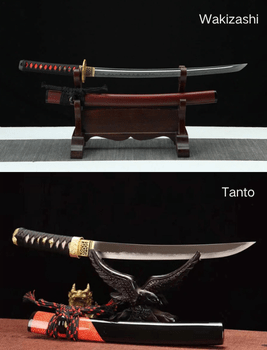
The Wakizashi generally features a blade length of 30 to 60 cm, placing it squarely in the short-sword category. Visually and structurally, it shares much with the Katana, most notably its gentle curvature and the presence of a defined ridgeline along the blade.
Key Characteristics
-
Fully capable of cutting performance
-
Supports both draw-cutting and thrusting
-
Offers a balanced middle ground between dagger and full sword
In the hand, a Wakizashi often feels responsive and light, with a balance point typically positioned near the guard. This makes changes in angle, direction, and grip fluid and natural, allowing graceful cutting motions even in limited space.
Modern Appeal
-
Used in dual-sword martial arts practice
-
Appreciated by collectors who enjoy sword-like handling in a compact size
-
Displays elegantly, especially when mounted with traditional fittings
A Wakizashi often serves as a centerpiece on a display stand, showcasing the harmony of blade curvature, handle wrapping, and lacquer work.
2. The Tantō: Purpose-Built Precision
The Tantō, by contrast, is typically under 30 cm in blade length and is best understood as a dagger. Many Tantō blades are forged in the hira-zukuri geometry, meaning the blade transitions directly from spine to edge without a distinct ridge. The result is a clean, triangular profile optimized for stability and piercing strength.
Key Characteristics
-
Designed for precise thrusting
-
Reinforced tip for penetration and durability
-
Ideal for fine control at very close range
Where the Wakizashi favors movement, the Tantō favors intention. Its compact size makes it steady and predictable in hand—each motion direct and deliberate.
Why Collectors Appreciate the Tantō
-
Its simplicity highlights the quality of craftsmanship
-
The smaller blade surface intensifies the visibility of hamon and grain patterns
-
It offers an elegant, manageable entry point into blade collecting
Many collectors enjoy examining a Tantō under soft light, rotating it slowly to watch the steel’s texture shift like flowing water.
3. Form and Function: A Side-by-Side Comparison
| Feature | Wakizashi | Tantō |
|---|---|---|
| Blade Length | 30–60 cm | Under 30 cm |
| Shape | Slightly curved | Often straight or minimally curved |
| Category | Short sword | Dagger |
| Best Motion | Draw-cutting + thrusting | Precise, linear thrusting |
| Handling Feel | Light and fluid | Steady and controlled |
The Wakizashi allows continuous, sweeping motion, while the Tantō emphasizes focused, direct action. Their differences are intentional—and meaningful.
4. Steel Artistry: Hamon and Hada
Both blades, when traditionally forged, display two visual hallmarks of Japanese sword craftsmanship:
| Feature | Meaning | Visual Character |
|---|---|---|
| Hamon | Boundary from differential hardening | Wavy or smoky line along the edge |
| Hada | Grain pattern from folding steel | Swirls, lines, or textures in the steel |
On the Wakizashi, these patterns span a wider surface area, giving them a sense of flow and movement.
On the Tantō, they become concentrated and more pronounced, often appearing sharper and more dramatic.
This is why many collectors refer to short blades as “steel you can study up close.”
5. Handling Experience
Wakizashi
-
Balance near the hand
-
Encourages smooth directional transitions
-
Moves like a brushstroke—fluid and graceful
Tantō
-
Compact weight distribution
-
Encourages precise, minimal movement
-
Moves like a carving tool—focused and exact
One invites gesture and motion; the other invites concentration and control.
6. Why These Blades Matter Today
In modern contexts, the Wakizashi and Tantō are valued as:
-
Collectible steel artworks
-
Martial arts training tools
-
Handcrafted objects worthy of contemplation
Their appeal lies in the maker’s imprint: the decisions in heat, hammer stroke, cooling speed, polish direction, and edge shaping.
No two traditionally made blades are ever identical.
Owning one is not about reenacting history—it’s about recognizing and appreciating mastery.
Conclusion
The Wakizashi and the Tantō are not interchangeable. They represent two different philosophies of design:
-
The Wakizashi, balancing reach and agility, is defined by motion.
-
The Tantō, compact and focused, is defined by precision and clarity of intent.
Choosing between them is not about better or worse—it is about what kind of beauty you connect with.
If you appreciate:
-
Flow, curve, and continuous movement → The Wakizashi will speak to you.
-
Minimalism, sharp definition, and intimate detail → The Tantō may be the better match.
Both, however, stand as enduring examples of how discipline, material knowledge, and artistry can be shaped into steel.