
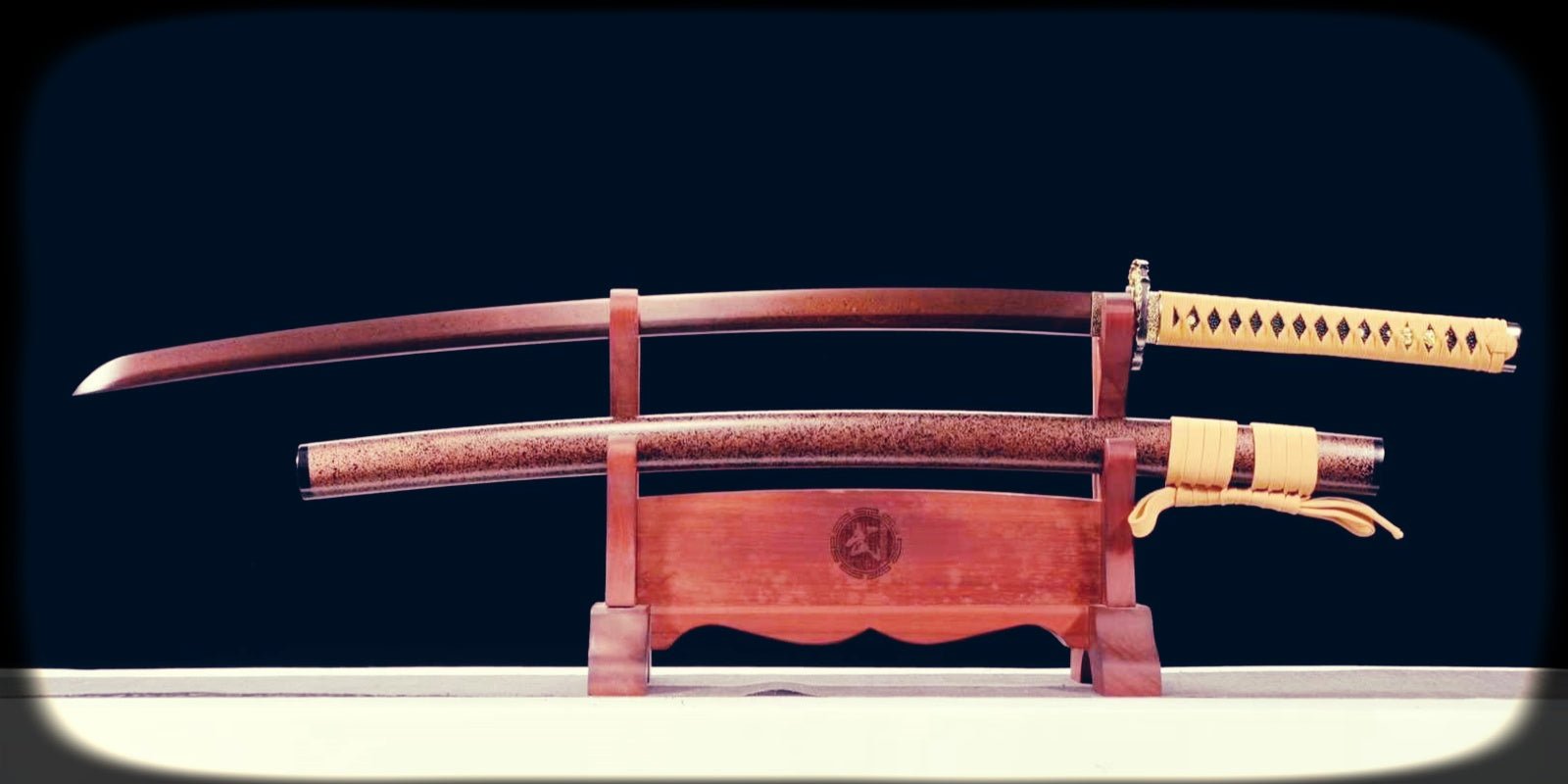
Dry, Stable Storage vs. Humid Neglect: What Really Happens to a Sword Over Time
A sword usually does not deteriorate all at once. The damage tends to build quietly: a little trapped humidity, a room that feels “fine enough,” a scabbard that was put away slightly damp, or a display setup that looks clean but creates a stale microclimate. Months later, the blade may still look acceptable at a glance, while corrosion, swelling, or mold risk has already begun in places you do not routinely inspect. Conservation guidance is consistent on this point: relative humidity, temperature stability, airflow, and regular inspection are some of the biggest factors in whether metal objects stay stable or slowly degrade.
For most carbon-steel swords, the practical goal is not “as dry as possible” in the abstract. It is a dry, stable, monitored environment. Museum and preservation guidance commonly places mixed-material collections in a moderate RH range around 45% to 55%, while warning that sustained humidity above about 65% raises mold risk and that very high RH accelerates metal corrosion. For metals specifically, some conservation guidance notes that corrosion speeds up dramatically above about 75% RH.
That distinction matters because a sword is not just a polished piece of steel. It is a mixed-material assembly. The blade may be steel, but the rest often includes wood, wraps, lacquer, adhesives, pegs, and other organic materials. Those materials do not respond to moisture in the same way. Steel corrodes. Wood swells and shrinks. Organic materials can mold, stiffen, crack, or loosen. So when storage conditions go wrong, the damage is rarely limited to a few visible rust spots.
Why “Dry and Stable” Is the Real Standard
A lot of owners say they keep their sword in a “dry place,” but that phrase is often too vague to be useful. A room can feel dry to a person and still swing enough in temperature and humidity to create problems for steel and wood over time. Preservation sources repeatedly stress that stability matters almost as much as the average humidity level. Seasonal shifts, damp nights, cold exterior walls, and poorly ventilated cases can all create localized moisture problems even when a room seems acceptable overall.
In practical terms, “dry and stable” usually means a storage environment with relative humidity around 45%–55%, minimal day-to-day fluctuation, reasonable airflow, and no long periods in the mold-risk zone. It also means not relying on guesswork. A hygrometer is far more useful than a subjective impression that the room “doesn’t seem humid.” Microclimate storage, such as a reasonably sealed cabinet or case with silica gel and a hygrometer, is a well-established conservation approach when the room itself is not stable enough.
This is the big practical difference between good storage and bad storage. Good storage does not eliminate all risk, but it keeps the risk low, predictable, and visible. Bad storage usually combines two problems at once: too much moisture and too little inspection. That combination is what turns small, manageable issues into expensive damage.
A Sword Is a Mixed-Material Object, Not Just a Blade
Many storage articles focus almost entirely on the blade, which makes the advice feel simpler than it really is. The blade is important, of course, but it is only one part of the system. The wooden core of the scabbard, the handle materials, the wrapping, and the fit between components all respond to humidity. Conservation literature on wood and mixed collections consistently warns that repeated moisture exchange causes swelling and shrinkage, and those dimensional changes can stress joints, change fit, and gradually destabilize an object.
That is why a sword stored in a damp room may develop problems that have nothing to do with dramatic red rust on the visible blade face. A scabbard may tighten as the wood takes on moisture. Later, when conditions swing again, it may loosen. The handle may feel subtly different in the hand. Fit around pegs, collars, or mounting points may shift over time. If humidity remains high enough for long enough, mold can also begin to threaten the organic components of the mounting. Continuous RH above about 65% is commonly cited as a mold activation range, especially in stagnant air.
This is one of the most important points for owners to understand: a sword does not need to look visibly damaged for the environment to be causing harm. Mixed-material objects often deteriorate through small, cumulative changes.
What Humid, Idle Storage Actually Does
Humid neglect is rarely dramatic at first. Most of the time it looks harmless: a sword left in a spare room for months, a display case without humidity control, a cabinet against a cold wall, a basement that feels only slightly damp, or a sheathed blade stored away after handling without being checked again. None of those choices look disastrous in the moment. Over time, though, they create the conditions for concealed trouble.
On the steel itself, humidity encourages corrosion by allowing moisture to form on the surface. If there are fingerprints, salts, dust, or old residue left behind, the risk increases. Even before visible rust appears, humid air can support thin moisture films that promote tarnish, haze, speckling, and eventually active rust. Conservation guidance for metals repeatedly points to moisture control as the central preventive measure because once corrosion becomes active, the object often needs more intervention and more frequent monitoring.
The “idle” part makes the problem worse. A sword that is not being checked regularly can develop early corrosion in places that are easy to miss: near the scabbard mouth, around fittings, in shadowed transitions, or in areas where the eye does not naturally linger. One of the biggest preservation mistakes is assuming that “unused” means “safe.” In reality, unused but unchecked storage is often riskier than careful handling followed by proper wiping and protection.
Humidity also affects the organic parts of the sword. Wood absorbs moisture from the air and releases it when conditions become drier. That repeated exchange causes movement. In a scabbard, it can change how the blade seats and draws. In the handle area, it can affect tightness and long-term structural fit. If conditions stay very humid and airflow is poor, mold becomes an additional threat. Once mold enters the storage environment, the issue is no longer just cosmetic. It becomes a preservation problem for every organic material involved.
What Dry, Stable Storage Protects
A sword stored in a stable, moderate environment has a much easier life. The blade’s protective film lasts longer. Corrosion risk stays lower. Wood movement is reduced. Organic materials are less likely to enter the mold-risk zone. The whole assembly remains more dimensionally consistent, which is exactly what you want for a sword intended to age well.
This does not mean perfect storage requires a museum budget. It means the environment should be predictable. If your room naturally stays within a moderate humidity range, has decent airflow, and does not suffer from sharp daily swings, that is already a strong starting point. If the room is less reliable, then a cabinet or hard case with silica gel and a hygrometer can create a safer microclimate. Microclimate storage is widely used in conservation because it is practical, scalable, and effective when managed properly.
There is also an important psychological benefit to stable storage: it makes inspection meaningful. When you know the environment is under control, any change you notice stands out sooner. That helps you catch haze, spots, odor, or fit changes before they become serious. Good storage does not replace maintenance, but it makes maintenance much more effective.
Why “The Drier, the Better” Is Too Simple
One weak argument that appears in some sword-care writing is that lower humidity is always better. That is true for bare metal only up to a point of practical handling, but it is not the best conclusion for a mixed-material sword assembly.
Preservation guidance for wood and organic materials warns that very low RH and repeated environmental swings can lead to shrinkage, desiccation, cracking, and embrittlement. So while metal generally benefits from lower humidity, the sword as a whole benefits from moderate dryness and stability, not an extreme environment that dries out everything else.
The smarter conclusion is this: for swords that combine steel, wood, and organic materials, stable moderate dryness is safer than dampness, but it is also safer than chasing extremely dry conditions without considering the rest of the structure.
What a Good Home Storage Setup Looks Like
Most owners do not need specialized conservation equipment. They need better control over a few basics.
A sound home storage setup usually avoids bathrooms, laundry-adjacent spaces, kitchens, damp basements, and placement against cold exterior walls. Those are all common trouble spots because they either create humidity spikes or encourage temperature differences that can lead to condensation.
If the room itself is stable, open display on a stand may be acceptable. If the room is inconsistent, a cabinet or hard case is usually better, provided it includes a hygrometer and some form of humidity buffering such as silica gel. The key is that the system must be monitored. Silica gel is useful, but only when there is enough of it for the space, the enclosure is reasonably well sealed, and the owner reconditions or replaces it when needed.
In practice, a sensible target is:
- RH around 45%–55%
- minimal day-to-day fluctuation
- avoid sustained RH above 65%
- reasonable, stable room temperature
- no trapped damp air in enclosed storage.
That is not complicated, but it is much more reliable than storing a sword in a random corner and hoping for the best.
Oil, Wiping, and Inspection Still Matter
Even the best room conditions do not replace basic blade care. Sword-care guidance commonly recommends wiping the blade after handling and maintaining a thin protective film during storage. The word “thin” matters. Too much oil can migrate into the scabbard and affect the wood. A barely visible film is usually the goal, not a wet coating.
Inspection matters just as much as oil. A quick weekly look and a more deliberate monthly check are usually enough for most owners. During those checks, you want to read the hygrometer, note any musty smell, inspect exposed steel under strong light, refresh the oil if needed, and pay attention to any change in fit or tightness. That simple routine is what prevents idle storage from turning into neglect.
This is where many owners go wrong. They think maintenance is something you do only after use. In reality, maintenance is also what protects a sword during periods of inactivity.
The Difference, Put Simply
If you want the core idea in one clean comparison, it is this:
A sword stored in a dry, stable, monitored environment stays healthier because corrosion risk stays low, wood movement stays smaller, and mold is less likely to activate. A sword stored in a humid, idle, unchecked environment faces the opposite pattern: moisture increases corrosion risk, wood and organic materials begin to move or mold, hidden trouble spots go unnoticed, and small issues are allowed to grow into structural ones.
So the real contrast is not simply “dry is good, wet is bad.” The deeper difference is that one environment helps preserve the whole assembly, while the other slowly destabilizes it.
Final Thoughts
If you want a sword to age well, think less like someone putting an object away and more like someone managing an environment.
Do not ask only, “Does it look clean today?”
Ask:
- Is the humidity being measured?
- Is the room stable?
- Is moisture being trapped where I cannot see it?
- Have I checked the blade recently?
- Are the wood and organic parts staying stable as well as the steel?
For most owners, the best rule is simple:
Store the sword in a dry, stable environment. Keep a light protective film on the steel. Check it regularly. And never mistake “unused” for “safe.”
Because when swords deteriorate in storage, the most damaging problems are usually the quiet ones.