
Why Full Tang Should Be Near the Top of Your Checklist When Buying a Sword
When people shop for a sword, they usually start with the obvious things: blade shape, steel type, fittings, finish, or overall appearance. That’s understandable. Those details are visible, easy to compare, and often heavily featured in product listings.
But one of the most important parts of a sword is also the part many buyers think about the least: the tang.
If you’re buying a sword for training, handling, or serious collecting, tang construction deserves far more attention than it usually gets. A sword can look impressive in photos and still hide a weak internal structure. And when that happens, surface appeal stops mattering very quickly.
That is why full tang construction matters. It is not just a technical specification buried in a product description. It affects safety, durability, handling, and long-term reliability. For martial arts enthusiasts, that can mean the difference between a dependable training tool and a risky purchase. For collectors, it can mean the difference between a structurally sound piece and a sword that offers little beyond visual appeal.
Put simply, the tang is the part of the blade that extends into the handle. It forms the internal connection between the blade and the grip. If that connection is strong, the sword feels solid and trustworthy. If it is weak, the entire build is compromised.
Why the Tang Matters More Than Many Buyers Realise
Every time a sword is swung, stopped, or brought into contact with a target, force travels through the whole structure. That force does not stop at the blade. It continues into the handle.
If the tang is properly made, that stress is spread through a larger and more stable internal structure. If the tang is narrow, short, or poorly attached, stress concentrates in a much smaller area. That is where weakness begins to show.
This is the real reason full tang construction matters so much. More steel inside the handle usually means more support, better stability, and fewer structural weak points. It creates a stronger connection between blade and grip, improves confidence in use, and helps the sword hold up over time.
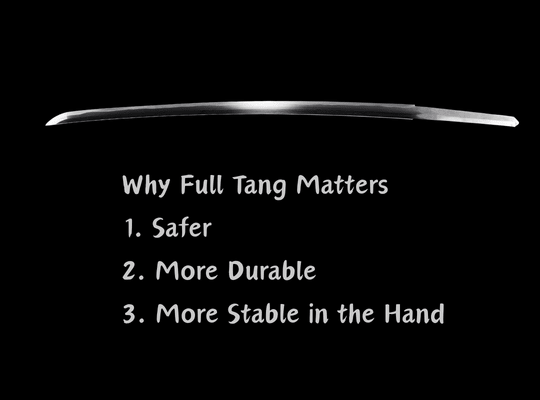
For the buyer, that translates into three practical advantages: better safety, better durability, and more predictable handling.
What Most Buyers Mean by “Full Tang”
In the sword market, “full tang” usually means that the tang runs the full length of the handle. It does not necessarily mean that the steel is visible from the outside, as it often is with certain knives.
That distinction matters.
A lot of buyers assume that a “true” full tang must always be exposed around the grip. In swords, that is not always the case. Many well-made swords use enclosed construction, where the tang remains hidden inside the handle while still extending all the way through it.
So when buyers talk about full tang swords, what they usually care about is not whether the tang is visible, but whether the blade continues deeply and securely through the entire handle as one solid piece.
That is the part that matters in practical terms.
A properly made full tang sword offers a stronger internal foundation than a short or narrow tang. It is less likely to loosen during repeated use, less likely to fail under stress, and generally more dependable over the long run.
Why Full Tang Is the Better Choice for Practical Use
For martial arts enthusiasts, the appeal of full tang construction is straightforward: it is safer, stronger, and more reliable.
A sword used for drills, controlled cutting, or repeated handling needs to cope with accumulated stress. Every swing, every stop, and every impact sends force through the structure. A full tang helps distribute that force through the entire handle instead of concentrating it at one narrow connection point.
That matters because swords rarely fail all at once without warning. More often, the first signs are subtle:
-
slight movement in the handle
-
increased vibration
-
fittings beginning to loosen
-
a loss of stability in the hand
A stronger tang helps prevent those issues from developing early.
It also improves consistency in handling. A sword with a solid internal structure usually feels more stable in motion. The balance is more predictable, and the user feels less disconnect between blade and grip. That matters in training, because consistency helps build cleaner mechanics and better habits.
A full tang does not automatically make a sword “high-end,” but it gives the sword a much better structural starting point.
Why Full Tang Also Matters to Collectors
Collectors are not always buying swords for active use, but that does not make tang construction irrelevant.
A sword with sound internal construction usually reflects a higher standard of manufacturing overall. It suggests that the maker paid attention not only to outward appearance, but also to the engineering of the piece. For serious collectors, that matters.
A well-built sword is also more reassuring to own, inspect, move, and occasionally handle. Even display pieces are rarely left untouched forever. They are taken off the stand, shown to others, photographed, repositioned, and in some cases lightly handled for appreciation. A weak tang turns even simple handling into unnecessary risk.
There is also the issue of long-term confidence. A collector may not use a sword the way a martial artist does, but a structurally sound sword is almost always more satisfying to own than one that only looks convincing from a distance.
In other words, full tang is not just about hard use. It is also about quality, peace of mind, and credibility.
Comparing Full Tang with Other Common Tang Types
To understand why full tang is usually preferred, it helps to compare it with the alternatives.
Partial Tang
A partial tang extends only partway into the handle. That means there is less internal support and more dependence on the surrounding handle construction.
That does not automatically make every partial tang sword useless. Some lighter-duty pieces may function adequately within narrow limits. But from a buyer’s perspective, partial tang almost always represents compromise. Less tang usually means less structural margin.
For decorative or very light-use swords, that may be acceptable. For training, repeated handling, or any serious practical use, it usually is not.
Rat-Tail Tang
A rat-tail tang is one of the clearest warning signs in a cheap decorative sword. It is typically very narrow, rod-like, and in low-quality examples may even be welded onto the blade rather than forged as part of it.
This creates an obvious weak point. Under stress, that narrow section is far more likely to bend, crack, or fail. These swords may be acceptable as wall display pieces, but they should not be trusted for real cutting or serious handling.
For practical buyers, rat-tail tang should usually be treated as a deal-breaker.
Hidden Tang
Hidden tang is a more nuanced category. A hidden tang is not automatically weak. In fact, many well-made swords use hidden tang construction very successfully.
The issue is not visibility. It is quality.
A hidden tang can be strong if it is long, properly fitted, and thoughtfully integrated into the handle. The difficulty for buyers is that poor hidden tang construction is harder to judge from the outside. That is why many beginners use “full tang” as a simpler buying standard: it is easier to understand, easier to compare, and easier to trust.
So the real point is this: hidden tang is not inherently bad. The problem is that cheap hidden-tang designs can make it much harder for inexperienced buyers to know what they are actually getting.
Where the Argument Often Feels Too Thin
One weakness in a lot of sword-buying articles is that they say “full tang is stronger” without really explaining why.
The conclusion is correct, but it becomes more persuasive when the mechanical logic is clear.
A better explanation would be this:
A sword experiences force through the entire structure, not just at the blade. A longer, broader tang gives that force more area to spread through. A short or narrow tang creates concentration points where stress is more likely to cause movement, loosening, or failure. A better tang also supports more stable handling and better weight distribution, which improves the user’s sense of control.
Once you explain it this way, “full tang” stops sounding like a marketing buzzword and starts sounding like what it really is: a structural buying priority.
How to Identify a Full Tang Sword When Shopping
For new buyers, this is where the article needs to become practical. Good theory is useful, but buyers also need to know what to look for.
Here are several useful checks:
1. Look for clear construction details
If the product page explicitly states full tang construction, that is a good sign. If it never mentions tang construction at all, take that seriously. Important structural features are usually not omitted by sellers who are confident in what they are offering.
2. Check how the seller talks about assembly
A serious seller will often mention how the handle is secured and may show close-up photos or even disassembly images. A vague listing that talks only about style, polish, or decorative elements deserves caution.
3. Be suspicious of listings that rely on decorative language
If a product page spends most of its time describing visual details but avoids meaningful structural information, it may be aimed more at display buyers than serious users.
4. Watch for unrealistic pricing
Extremely low prices often mean corners were cut somewhere, and tang construction is one of the most common places manufacturers save money.
5. Read reviews from people who actually use swords
Training-focused buyers and experienced collectors usually notice weak construction much faster than casual buyers. Their reviews are often more useful than generic star ratings.
What New Buyers Should Prioritise
If you are buying your first functional sword, your priority list should probably look something like this:
-
Tang construction
-
Overall assembly quality
-
Blade steel and heat treatment
-
Weight and balance
-
Seller credibility
-
Intended use
That order surprises some people. Many assume steel type should come first. But a well-made blade attached to a weak tang is still part of a weak sword. Structural integrity comes before refinement.
If the internal build is not trustworthy, everything else becomes secondary.
Final Thoughts
A sword is only as trustworthy as the structure holding it together. The tang may be hidden from view, but it plays a central role in whether the sword feels stable, stays safe, and performs the way it should.
For martial arts enthusiasts, full tang offers the reliability needed for repeated training and confident handling. For collectors, it provides a stronger foundation for long-term ownership and a more convincing sign of quality.
The simplest conclusion is also the most practical one:
If a sword is meant to be more than decoration, full tang should be near the top of your checklist.
Not because the term sounds impressive, but because the structure behind it directly affects how safe, durable, and dependable the sword will be.