
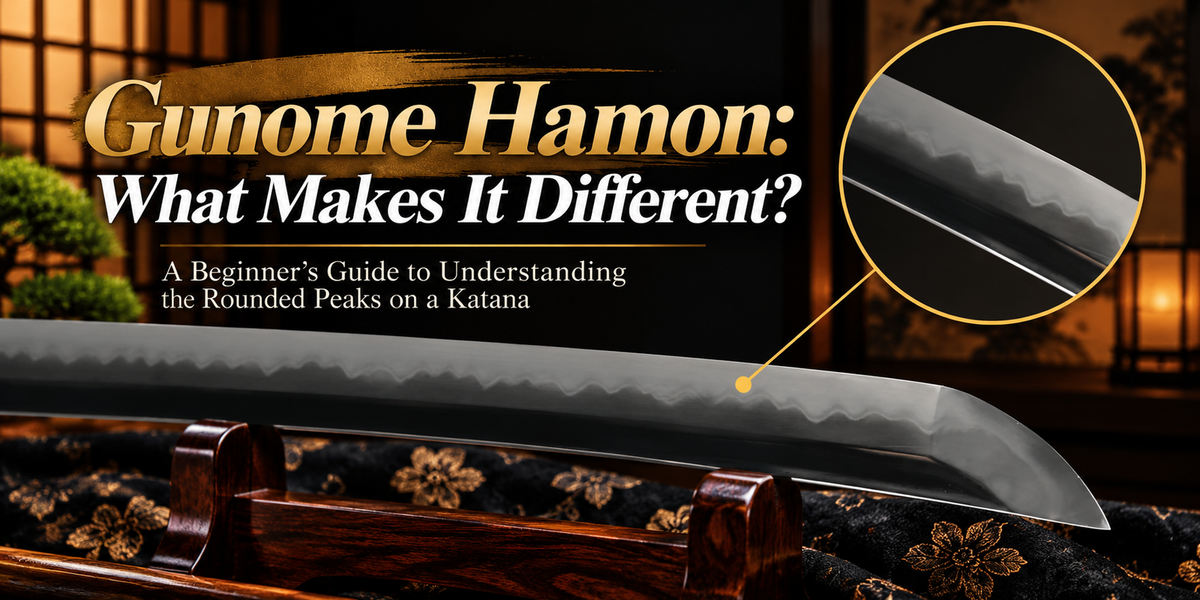
Gunome Hamon: What Makes It Different?
If you are new to katana, hamon terminology can feel like a lot to take in.
One blade may be described as Suguha. Another may feature Notare. Then you come across Gunome, and the line along the cutting edge suddenly looks much more active.
Rounded rises appear again and again, creating a rhythm that is easy to notice once you know what to look for.
That is why Gunome is worth learning early.
Not because it is automatically stronger, sharper, rarer, or better.
Gunome is useful because its repeated rounded rhythm gives beginners one of the clearest ways to start reading hamon patterns.
Suguha stays relatively straight.
Notare moves in broad, flowing waves.
Gunome tends to repeat rounded peaks.
Once you can see those three differences, hamon terminology becomes much easier to understand.
First, What Is a Hamon?
Before focusing on Gunome, it helps to understand what a hamon actually is.
A hamon is the visible pattern associated with the hardened cutting-edge region of a differentially hardened blade.
It is not the physical shape of the cutting edge.
It is not a groove carved into the blade.
And it is not simply a decorative line painted onto the steel.
During differential hardening, different parts of the blade cool under different conditions during quenching. This creates differences in the steel structure between the cutting-edge region and the rest of the blade. After suitable polishing, the hardened-edge pattern becomes visible as the hamon.
You do not need to understand the metallurgy in detail to recognise Gunome.
The important point is simple:
Gunome describes the visible shape and rhythm of the hamon.
It is a pattern name, not a steel type and not a performance rating.
What Does Gunome Look Like?
Gunome is usually recognised by repeated rounded or half-round forms.
The easiest way to picture it is as a row of low, rounded hills running along the cutting side of the blade.
The line rises, forms a rounded peak, falls, and then rises again.
Visually, the rhythm often looks something like this:
rise — rounded peak — fall — rise again
Those peaks do not need to be identical.
Some may be wider.
Some may be taller.
Some may sit closer together.
That variation is normal.
This matters because beginners sometimes expect a hamon type to look like a perfectly repeated graphic pattern.
Real blades are not that neat.
What matters is the overall visual character.
With Gunome, that character usually comes from repeated rounded rises and falls across the blade.
Gunome vs Suguha vs Notare
This is the quickest way to understand where Gunome fits.
Suguha
Suguha stays relatively straight overall.
It may show small local changes, but its main path remains calm and steady.
Notare
Notare moves through broad, gradual waves.
The line rises and falls slowly, with a more flowing rhythm.
Gunome
Gunome repeats rounded peaks.
Instead of one long flowing wave, you tend to notice recurring rounded forms.
A simple visual shortcut is:
Suguha holds its line.
Notare rolls.
Gunome repeats rounded peaks.
That is not a complete appraisal system, but it is an excellent starting point for beginners.
Why Gunome Is So Useful for Beginners
Gunome teaches you something more useful than a vocabulary word.
It teaches you to look at rhythm.
When beginners first study hamon, they often focus on one small section of the blade.
They see one bump.
One curve.
One bright patch.
Then they try to identify the whole hamon from that tiny area.
That is usually where confusion begins.
A better question is:
“What pattern keeps repeating across the blade?”
That change in perspective matters.
With Gunome, the answer is often repeated rounded movement.
Once you learn to recognise that rhythm, it becomes much easier to compare Gunome with other hamon forms.
You stop matching isolated shapes and start reading the line as a whole.
Three Common Beginner Mistakes
There are three mistakes that come up again and again.
1. Calling Every Wavy Hamon Gunome
Gunome is not just any hamon that moves.
Notare also moves, but its waves are broader and more gradual.
Gunome usually has a stronger sense of repeated rounded units.
If the line simply rolls slowly up and down, Notare may be the better fit.
If rounded humps repeat again and again, Gunome becomes more likely.
2. Judging the Whole Hamon From One Close-Up
A close-up can be useful for detail, but it can also be misleading.
You may see two rounded peaks and assume the whole blade is Gunome.
But what happens outside that small section?
The larger pattern may change.
The blade may have mixed characteristics.
Or those rounded forms may only appear locally.
Always look at a longer section before deciding.
3. Assuming More Regular Means Better
A neat row of rounded peaks may look impressive, but visual regularity is not a quality score.
Gunome can be regular or irregular.
What matters for identification is the repeated rounded character, not perfect symmetry.
Gunome Is a Family, Not a Perfect Stencil
This is where real blades become more interesting than diagrams.
Gunome does not always appear as evenly spaced semicircles.
Some examples are more regular.
Others are more irregular.
You may also see Gunome mixed with other hamon characteristics.
That is why it is better to think of Gunome as a family of rounded forms rather than one fixed shape.
For beginners, there is no need to memorise every specialised variation straight away.
Start with the basic pattern.
Look for repeated rounded movement.
Once that becomes familiar, you can begin noticing whether the peaks are regular, irregular, mixed, more pointed, or combined with other features.
Learning the main rhythm first makes everything else easier.
Why Real Gunome Can Look Different From Diagrams
Simple diagrams are useful because they exaggerate defining features.
A Gunome diagram may show a neat row of evenly spaced rounded peaks.
A real blade may look less tidy.
Some peaks may merge.
Some may be smaller.
One area may look more active than another.
Lighting can also change what you see.
Polished steel is highly reflective. A strong light source may make one section of the hamon stand out while another almost disappears.
The viewing angle matters too.
A pattern that looks obvious in one photograph may appear much weaker in another.
So if a product page shows only one dramatic close-up, do not rush to a conclusion.
The overall rhythm matters more than the most photogenic section.
How Is Gunome Formed?
Gunome is associated with the same broader differential-hardening process that produces other genuine hamon patterns.
During heat treatment, the blade is heated and then quenched under controlled conditions. Clay application can influence how different parts of the blade cool, but the result is more complex than simply drawing rounded shapes on the blade and getting an exact copy afterward.
Temperature, cooling behaviour, blade geometry, and the way the steel responds during quenching all play a role.
Polishing then helps make the hardened-edge pattern visible.
For beginners, the key takeaway is straightforward:
Gunome is connected to heat treatment. It is not simply engraved or painted onto the blade.
That is enough technical background to understand what you are looking at.
Does Gunome Mean Better Performance?
No.
A Gunome hamon does not automatically mean the blade is stronger.
It does not automatically mean it is sharper.
And it does not automatically mean it is tougher or more durable.
The shape of the hamon is only one visible characteristic of the blade.
Steel composition, blade geometry, heat treatment, dimensions, construction, and quality of execution all matter.
So claims such as:
“Gunome cuts better because the hamon is rounded”
or
“Gunome is stronger than Suguha”
should be treated cautiously unless there is specific evidence about the actual blade.
A useful rule is:
Hamon shape is a blade characteristic, not a performance score.
That applies to Gunome, Notare, Suguha, and other hamon types.
Why Gunome Still Deserves Attention
If Gunome is not automatically better, why should you care?
Because it is visually useful.
Gunome teaches you to notice:
-
repetition
-
rounded movement
-
changes in height
-
spacing between peaks
-
overall rhythm
That skill transfers directly to other hamon patterns.
Once you can recognise Gunome, Notare becomes easier to distinguish because you stop calling every moving hamon “wavy.”
Suguha becomes easier too, because you develop a clearer sense of what a relatively steady line looks like.
In other words, learning Gunome improves your eye.
That is its real value.
How to Identify Gunome in Product Photos
If you are comparing katana online, start with the whole visible blade.
Do not zoom in straight away.
Follow the hamon from the base toward the tip.
Ask yourself what the line does over distance.
If it stays mostly straight, think Suguha first.
If it moves through long, broad waves, Notare becomes more likely.
If it repeatedly rises into rounded humps and falls again, Gunome is worth considering.
Then look for repetition.
Do those rounded forms keep returning?
Do they create a recognisable rhythm?
Remember that they do not need to be identical.
If possible, compare several photographs.
One image may exaggerate the hamon because of lighting.
Another angle may show the pattern more clearly.
For Australian buyers comparing katana online in Sydney, Melbourne, Brisbane, or elsewhere, a full-length blade image combined with several close-ups is much more useful than one heavily edited hero shot.
If You Have to Convince Yourself, Step Back
Here is a useful rule.
If you have to stare at one tiny section and convince yourself that the hamon must be Gunome, step back.
Gunome is usually easier to recognise from its repeated rhythm across a longer section of the blade.
That does not mean every example will be obvious.
But looking at the whole pattern is almost always more useful than obsessing over one isolated bump.
Close-ups show detail.
Longer views show structure.
You need both, but structure should come first.
Can a Photo Prove the Hamon Is Genuine?
Not completely.
A photograph can show you the visible pattern.
It can help you say:
“This looks like Gunome.”
But it cannot verify every technical claim about the blade.
A photo does not tell you exact hardness.
It does not provide microscopic analysis.
And it does not give you the complete history of the heat-treatment process.
So it helps to separate two questions:
What does the hamon look like?
and
How was the blade actually made?
Good photographs can often help with the first.
The second depends on reliable product information and evidence beyond normal product photography.
For an online buyer, the best situation is when the photographs and specifications support each other.
Gunome at a Glance
| Feature | Gunome | Notare | Suguha |
|---|---|---|---|
| Overall appearance | Repeated rounded forms | Broad, gradual waves | Relatively straight |
| Visual rhythm | Repetitive | Long and flowing | Calm and steady |
| Typical movement | Rounded rises and falls | Wide rolling movement | Minimal overall movement |
| Can vary? | Yes | Yes | Yes |
| Can mix with other patterns? | Yes | Yes | Yes |
| Automatically higher quality? | No | No | No |
This comparison is deliberately simple.
Real blades may show mixed characteristics, subtle transitions, and more complex details.
The table is a starting point, not a substitute for looking at the whole blade.
Should Gunome Influence Which Katana You Choose?
It can influence your visual preference.
That is completely reasonable.
Some people prefer the restrained look of Suguha.
Others like the broader movement of Notare.
Gunome has a different character: more active than a straight hamon, but with a repeated rhythm that can feel structured rather than random.
If that look appeals to you, Gunome may be exactly what catches your eye.
But choose it because you enjoy the pattern, not because a product description suggests it is automatically superior.
That distinction matters, especially when you are buying your first katana.
Final Thoughts
You do not need to memorise every Gunome variation.
Start with the rhythm.
Look for repeated rounded rises across the blade.
Then compare that movement with the broader flow of Notare and the steadier line of Suguha.
Do not worry if every peak is not identical.
Real hamon can vary, mix, and change from one section to another.
And do not turn the name into a quality ranking.
Gunome is not automatically stronger, sharper, or better.
Its real value is much simpler.
It teaches you how to stop staring at one bright line and start reading the blade as a whole.
Once you can recognise that repeated rounded rhythm, Gunome stops being another technical term.
It becomes something you can actually see.