
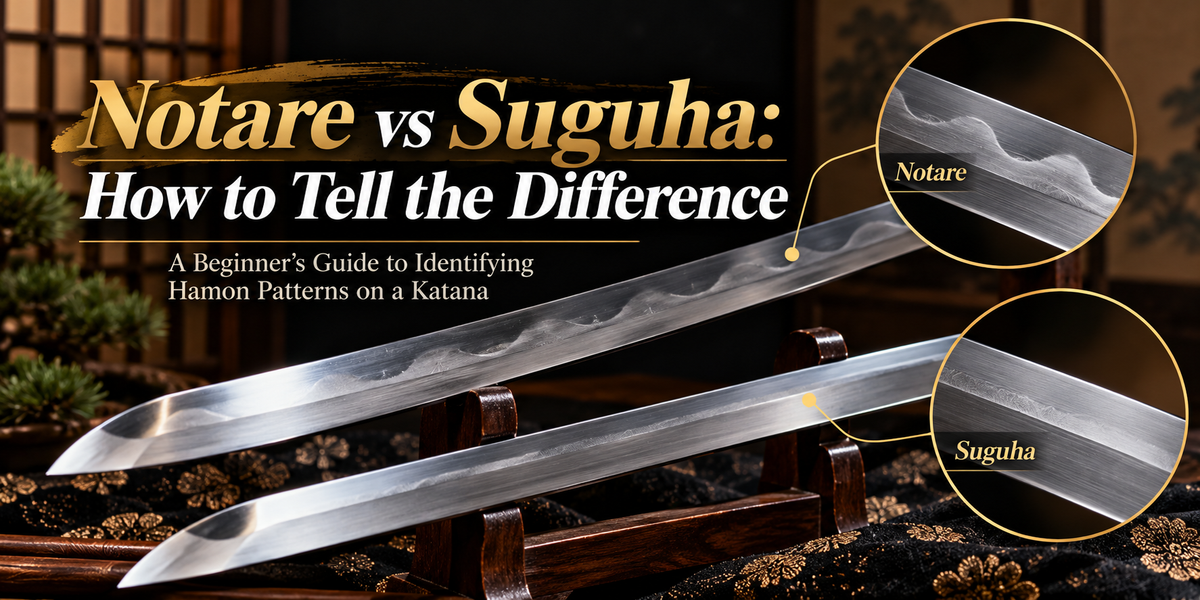
Notare vs Suguha: How to Tell the Difference
If you are new to katana, hamon terminology can make a simple blade look surprisingly complicated.
One product might mention Suguha. Another might highlight a Notare hamon. Then you start seeing terms such as Gunome, Midare, and other variations, and suddenly that bright line along the cutting edge feels like something you need a glossary to understand.
You do not.
For Notare and Suguha, the easiest place to start is simply to look at the overall flow of the hamon.
Suguha stays relatively straight. Notare rises and falls in broad, gentle waves.
That is the basic difference.
The catch is that real hamon are not always as neat as diagrams. A Suguha can show slight movement. A shallow Notare can look almost straight in a photograph. And mixed patterns can blur the boundary even further.
So rather than memorising definitions, it is more useful to learn how to read the blade.
First, What Are You Actually Looking At?
Before comparing Notare and Suguha, it helps to clear up one basic point.
The hamon is the visible hardened-edge pattern running along the cutting side of a differentially hardened blade.
It is not the physical cutting edge itself.
It is not a groove carved into the steel.
And it is not simply a decorative line painted onto the blade.
In differential hardening, different parts of the blade cool at different rates during quenching. This creates different structures within the steel. After suitable polishing, the transition associated with the hardened edge becomes visible as the hamon.
You do not need to understand the metallurgy in detail to recognise the pattern.
For this article, the important point is simple:
Suguha and Notare describe the overall shape and movement of the hamon.
Once that is clear, the rest becomes much easier.
What Does Suguha Look Like?
Suguha is usually the easier pattern to recognise.
Its hamon follows a relatively straight path along the cutting edge, giving the blade a calm, steady appearance.
The word relatively matters.
Suguha does not need to look like a line drawn with a ruler. Real examples may widen slightly, narrow in places, or show subtle local movement.
What matters is the overall direction.
If you step back and look at the whole blade, the hamon should still feel predominantly straight rather than rolling through broad waves.
A useful way to picture it is a road running through open country. It may shift gently here and there, but it continues in roughly the same direction.
That is a much better way to think about Suguha than expecting a perfectly straight white stripe.
What Does Notare Look Like?
Notare has more movement.
Instead of following a mostly steady path, the hamon gradually rises and falls in broad curves.
The key words are:
broad, gentle, and gradual.
Think of slow ocean swells rather than sharp waves.
The pattern may rise, reach a soft crest, fall again, and then gradually begin another rise. The movement usually feels flowing rather than repetitive or abrupt.
Some Notare patterns are easy to spot.
Others are much shallower.
A very subtle Notare may look nearly straight if you only see a short section of the blade. That is why one close-up photograph can sometimes be misleading.
Step back and look at the rhythm across a longer section.
That is where Notare usually reveals itself.
The Easiest Way to Tell Them Apart: Follow the Rhythm
A common beginner question is:
“Is the hamon straight or wavy?”
That is useful, but there is an even better question:
Does the pattern stay steady, or does it roll?
Suguha has a steadier rhythm.
The hamon generally stays at a more consistent distance from the cutting edge.
Notare changes that rhythm.
The hamon gradually moves farther from the edge and then closer again, creating broad rises and falls.
This is important because one small bump does not suddenly turn Suguha into Notare.
Likewise, one flatter section does not stop a larger Notare pattern from being Notare.
A common mistake is to zoom in on one dramatic section of the blade and try to identify the entire hamon from that tiny crop.
That is usually where the confusion starts.
Whenever possible, look at the whole visible hamon first.
Why Real Hamon Rarely Look Like Textbook Diagrams
This is where things get more interesting.
Illustrations are useful because they exaggerate the main characteristics of a pattern. Real blades are more subtle.
A Suguha can show slight movement.
A Notare can be shallow.
And one hamon can contain characteristics associated with more than one pattern.
So the comparison is not always:
perfectly straight versus obviously wavy.
Sometimes it is closer to:
mostly steady versus gradually rolling.
That distinction is far more useful when looking at actual blades.
You may also come across descriptions that combine terms. That does not necessarily mean the description is inconsistent.
It may simply mean one pattern dominates while another appears in certain sections.
When that happens, start with the main visual character.
Ask yourself:
Does the hamon mainly stay straight?
Or does it mainly move through broad, gradual waves?
Identify the dominant rhythm first. Smaller details can come later.
Notare Is Not Every Wavy Hamon
Once people learn that Notare is wavy, there is a temptation to call every non-straight hamon Notare.
That does not work.
Other hamon patterns can also show movement.
One particularly useful comparison is Gunome.
Notare generally shows broader, more flowing undulation.
Gunome tends to show more repeated rounded forms or hump-like shapes.
For a beginner, a simple visual shortcut is:
Notare: slow rolling waves.
Gunome: repeated rounded peaks.
That is not a complete appraisal method, but it is useful for avoiding one of the most common mistakes.
If the hamon looks highly repetitive, tightly curved, sharply pointed, or much more complex than a series of broad waves, it is better not to label it Notare too quickly.
There is nothing wrong with saying:
“I can see that this is not Suguha, but I am not sure of the exact pattern.”
That is better than forcing the wrong name onto the blade.
What Notare Is Not
Three misunderstandings are especially common.
Notare Is Not the Shape of the Cutting Edge
A katana blade can be curved while the hamon follows its own pattern within the blade surface.
The physical edge profile and the hamon are separate features.
This sounds obvious once you know it, but they are easy to confuse when you first start looking at sword diagrams.
Notare Is Not a Groove
A groove such as bo-hi is physically cut into the blade.
A hamon is associated with heat treatment and becomes visible through the finished surface.
They may both appear as long features running along a blade, but they are completely different.
Notare Is Not Automatically Higher Quality
A dramatic Notare hamon can look impressive in a photograph.
That does not automatically mean the blade is better.
The overall quality of a sword depends on much more than the hamon pattern alone.
So when you see a product description emphasising an elaborate hamon, treat that as information about the blade's appearance, not as an automatic quality ranking.
How Do Notare and Suguha Form?
This is the point where explanations often become far more technical than they need to be.
The short version is that both patterns are associated with differential hardening.
During heat treatment, different parts of the blade cool under different conditions. The hardened cutting-edge region develops differently from the rest of the blade, and suitable polishing makes the resulting hamon visible.
That does not mean the final pattern is as simple as drawing a line before quenching and getting an exact copy afterward.
Heat treatment involves several interacting factors, including temperature, cooling behaviour, blade geometry, and the way the steel responds during quenching.
So it is safer to think of Notare and Suguha as visible outcomes within a controlled heat-treatment process, rather than as decorative lines added afterward.
For someone learning to identify hamon, that is enough technical background to understand what you are seeing.
Does Notare Perform Better Than Suguha?
This question comes up often, especially in product descriptions.
The safer answer is no: hamon shape by itself should not be treated as a performance ranking.
A Notare hamon is not automatically stronger, sharper, tougher, or more durable simply because its pattern is more visually active.
The same applies to Suguha.
A relatively straight hamon does not automatically mean the blade performs better either.
Blade geometry, steel, heat treatment, dimensions, polish, and overall construction all matter.
So if you see claims such as:
“Notare cuts better because the hamon is wavy”
or
“Suguha is stronger because the line is straight”
it is worth being cautious unless the claim is supported by specific evidence about the actual blade.
For beginners, the better approach is to treat hamon shape primarily as a visible blade characteristic.
How to Read Notare and Suguha in Product Photos
If you are comparing katana online, this is probably the most useful part.
Start with the full blade.
Do not immediately zoom into the brightest part of the hamon.
Follow the pattern from the lower part of the blade toward the tip.
If it remains fairly steady and roughly parallel to the cutting edge, Suguha becomes more likely.
If it gradually rises and falls in broad curves, you may be looking at Notare.
Then look at the scale of those changes.
Are the waves wide and slow?
Or are they short, repetitive, and strongly rounded?
Broad movement is more consistent with Notare.
Repeated rounded shapes may suggest another hamon type.
It also helps to compare several photographs.
Polished steel reflects light very strongly. A hamon can appear more obvious from one angle and much weaker from another.
Strong contrast, dark reflections, or aggressive image editing can also change how the pattern appears.
For Australian buyers comparing katana online from Sydney, Melbourne, Brisbane, or elsewhere, clear blade photography from several angles is far more useful than one dramatic hero image.
Can You Confirm a Genuine Hamon From a Photo?
Not always.
A photograph can help you identify the visible pattern.
It cannot necessarily tell you everything about how the blade was made.
That distinction matters.
You may be able to look at a photograph and reasonably say:
“That looks like Notare.”
But that does not mean the image alone proves every technical claim associated with the blade.
A photograph does not give you hardness measurements, microscopic information, or a complete record of the heat-treatment process.
So product images are useful for visual identification, but they should not be treated as the only evidence of manufacturing method or overall quality.
Ideally, the photographs and written specifications should support each other.
Which Pattern Is Easier to Recognise?
Usually, Suguha.
Its relatively straight path gives beginners a simpler visual reference.
Notare takes a little more practice because shallow waves can be subtle, and other hamon styles may also include curved or irregular forms.
That does not make Notare more advanced or more valuable.
It simply means you need to look at a larger section of the blade before deciding.
After you have compared a few clear examples, the difference becomes surprisingly easy to see.
You stop asking:
“Is that line perfectly straight?”
and start asking:
“Does it stay steady, or does it roll?”
That is when the terminology starts to feel useful rather than intimidating.
Notare vs Suguha at a Glance
| Feature | Suguha | Notare |
|---|---|---|
| Overall appearance | Relatively straight | Broad, gentle waves |
| Visual rhythm | Steady | Gradually rising and falling |
| Distance from cutting edge | More consistent | Changes gradually |
| Typical beginner difficulty | Easier to recognise | Requires more observation |
| Can show subtle variation | Yes | Yes |
| Can appear in mixed patterns | Yes | Yes |
| Indicates higher quality by itself | No | No |
The table is useful, but remember that real blades are not diagrams.
These terms describe dominant visual characteristics rather than rigid geometric templates.
Which One Should You Choose?
There is no correct answer.
If you prefer a restrained, clean-looking blade, Suguha may appeal to you more.
If you like more movement along the cutting edge, Notare may stand out.
Neither preference is more knowledgeable than the other.
If you are choosing your first katana, the better question is not:
“Which hamon sounds more impressive?”
Ask:
“Which one do I actually enjoy looking at?”
That is a much more useful way to approach the decision.
Final Thoughts
Notare and Suguha sound technical when you first encounter the names, but the visual difference is fairly simple.
Suguha holds a relatively steady line.
Notare moves through broad, gentle waves.
The part that takes practice is recognising that real hamon are not always textbook-perfect.
Suguha can move slightly. Notare can be shallow. Different patterns can mix, and lighting can make the same hamon look different from one photograph to another.
So do not rush to label the first small curve you see.
Look at the whole blade.
Follow the rhythm.
And remember that hamon shape is only one part of understanding a katana.
You do not need to memorise every technical term at once. The goal is simply to learn how to look more carefully.
Once you can see the difference between a steady line and a broad rolling one, Notare and Suguha stop sounding like specialist jargon.
They become two clear, recognisable ways of reading the blade.