
Notare Hamon Explained
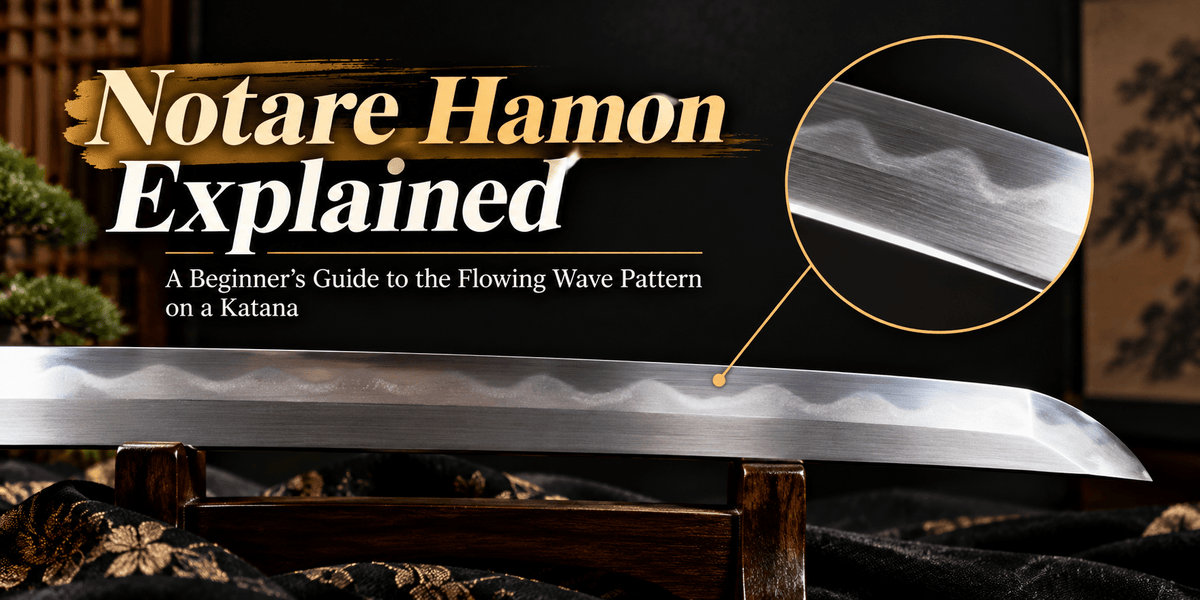
If you are browsing katana listings from Sydney, Melbourne or elsewhere in Australia, you may come across the term Notare hamon. In the photographs, you might notice a pale, flowing pattern near the cutting edge. It rises and falls gently, almost like a rolling wave.
It looks appealing, but what does it actually mean? Is it decoration? Does it make the blade sharper? And how much can you learn about a sword from that pattern alone?
You do not need to have handled a sword to understand the basics.
Notare describes a hamon with gentle, flowing undulations. A genuine hamon is associated with changes in the steel caused by heat treatment. The word “Notare”, however, describes the pattern’s shape—not the quality of the entire sword.
With that distinction in mind, let’s start with what you can see and work towards what it means.
1. What Is a Hamon?
A hamon is a visible blade pattern associated with the hardened cutting-edge region of the steel.
For a beginner, its location is the easiest place to start. Look at the blade surface near the cutting edge, rather than at the handle, the spine or the blade’s overall outline.
There are three separate features to keep in mind:
- The blade outline: the physical shape of the blade.
- The cutting edge: the edge prepared for cutting.
- The hamon: the visible pattern associated with the hardened edge region.
These features are related, but they are not interchangeable.
A blade with a Notare hamon does not have a wave-shaped cutting edge. The pattern rises and falls across the blade surface; it does not turn the edge into a series of scallops.
Likewise, the blade’s overall curve is a different feature. A curved blade can have a relatively straight hamon. When a listing mentions both blade curvature and Notare, it is describing two separate characteristics.
2. What Makes a Hamon Notare?
Notare is recognised by its gentle, wave-like movement.
Instead of following a mostly straight course, the pattern gradually rises and falls. The overall impression is flowing rather than sharply jagged.
Picture a gentle swell moving across Sydney Harbour. That gives you a useful everyday comparison for the visual rhythm. It is simply an analogy, not an explanation of the name’s origin.
The key is to look at the overall contour. Does it move through broad, relaxed undulations? Can your eye follow a flowing rise and fall?
You do not need to identify every tiny feature straight away. Start with the larger pattern, then look more closely as your understanding develops.
Also, avoid expecting every Notare example to match a perfect wave diagram. An introductory illustration simplifies the shape to make it easy to recognise. An actual blade may contain variations and additional features.
3. How Does a Genuine Hamon Form?
A genuine hamon is connected to differential hardening.
In plain English, differential hardening creates different hardness characteristics in different regions of a blade.
In traditional blade manufacture, a clay mixture is applied more thickly over the body and spine and more thinly near the edge. The blade is then heated and quenched. Differences in cooling produce different structures within the steel.
The result is a harder cutting-edge region and a comparatively softer body. The changes associated with this process also produce the hamon, which subsequent polishing helps reveal.
You do not need to memorise temperatures or metallurgical terms to grasp the main point: the visible pattern has a connection to changes within the material.
That is what distinguishes a genuine heat-treatment hamon from a surface pattern created solely for appearance.
However, a product description and a verified manufacturing process are two different things. Seeing “Notare hamon” in a listing does not, by itself, establish how that particular blade was made.
4. Why Does the Pattern Rise and Fall?
The hamon’s shape is influenced by how the blade is prepared and heat-treated.
Clay application contributes to the result, but the finished pattern is not simply an exact copy of the clay boundary. The material, heating conditions and cooling behaviour also affect the outcome.
Think of it as a process in which preparation and material behaviour work together. The maker influences the result, while the steel responds to the conditions it experiences.
This helps explain why the pattern should not be treated as a mechanically repeated graphic.
For a beginner, the practical lesson is straightforward: a wave-shaped appearance and the process that produced it are separate questions.
You can appreciate the visible shape immediately. Understanding how it was made requires further information.
That distinction is useful whenever a listing places more emphasis on an attractive photograph than on a clear manufacturing description.
5. How Does Notare Compare with Other Hamon Patterns?
Comparing a few common patterns is often easier than learning each term in isolation.
| Pattern | Beginner-friendly description |
|---|---|
| Suguha | A relatively straight contour |
| Notare | Gentle, flowing undulations |
| Gunome | A succession of rounded peaks or alternating forms |
| Chōji | Clustered forms named for their resemblance to clove buds |
These descriptions are starting points, not a complete identification guide.
When comparing photographs, look at the rhythm and spacing. Does the contour remain fairly level? Does it move through broad swells? Are the forms more closely grouped?
Those questions help you connect the terminology with something visible.
Try describing the difference in your own words before reaching for more technical language. “This one looks fairly straight; that one has broader waves” is a useful observation.
There is also no need to rank the patterns by appearance. You may prefer the restrained look of Suguha or the movement of Notare. A visual preference does not establish a difference in performance or overall quality.
6. Can Notare Appear with Other Shapes?
Yes. A hamon may have an overall Notare character while also containing other features.
This is why a real example may look more complicated than the basic illustration you expected. A simple diagram isolates one characteristic. An actual blade can combine several.
When a description uses more than one pattern term, read the whole sentence. The additional words may explain details within the broader flowing contour.
If the terminology is unclear, ask the seller to point out the features in a photograph. That turns an abstract description into something you can actually examine.
You can also describe what you see without forcing a precise classification. For example:
“The pattern has broad waves, with smaller rounded forms between them.”
That is a sensible starting observation. Learning the vocabulary should improve your ability to describe a blade, rather than make you feel obliged to label every detail.
7. What Does Notare Tell You About Quality?
A genuine hamon has technical significance because it is connected to heat treatment.
But Notare is a shape description, not a quality rating.
The term alone does not tell you how sharp the blade is, how durable it will be or how well the complete sword has been assembled. Those are separate matters requiring separate information.
Both points deserve attention. Dismissing the hamon as meaningless would overlook its manufacturing connection. Treating its shape as proof of superior performance would go too far.
When reading a listing, separate the claims:
- The hamon description concerns appearance.
- The manufacturing details concern the stated process.
- The condition report concerns the particular item.
- The suitability statement concerns its proposed use.
A clear product description should address each relevant point directly.
For example, “Notare hamon” does not tell you whether the blade is sharpened. It also does not establish that the sword is suitable for a particular training class.
8. Is Every Wave-Like Line a Genuine Hamon?
A wave-like line in a photograph is not enough to establish how the pattern was produced.
The important question is whether it corresponds to actual differential hardening or whether a surface treatment creates a similar visual effect.
You do not need to solve that question from a small image. Start by asking for a clear explanation:
“Does this blade have a genuine differential-hardening hamon, and how was the visible pattern finished?”
This separates two issues that are easy to confuse: what happened within the steel during heat treatment, and what was done to the surface afterwards.
Terms such as “etched”, “enhanced” or “authentic-looking” need context. On their own, they do not provide a complete account of the blade.
Avoid treating a single word as a shortcut to a verdict. Ask what the seller means and what information supports the description.
The aim is to understand the product, not to guess its manufacturing history from marketing language.
9. How to Study Notare Before Handling a Blade
You can start learning with clear photographs and reliable descriptions.
Choose an example that is explicitly identified as Notare. Locate the cutting-edge region, then follow the pattern along the blade. Notice the larger rises and falls before concentrating on smaller features.
Next, compare it with a clearly labelled example of another pattern. Write a short description of the difference:
“The first contour stays relatively level, while the second moves through broad, gentle waves.”
This exercise encourages observation before classification. You are connecting a term with a feature you have noticed, rather than simply repeating a definition.
After that, widen your attention to the whole blade. Consider its outline and proportions as well as the hamon.
If a photograph does not show enough detail, leave the question open. “I cannot tell from this image” is a reasonable conclusion. Learning to recognise the limits of a photograph is part of learning to assess descriptions carefully.
10. Reading Katana Listings in Australia
Whether you are comparing products in Melbourne, Brisbane, Perth or Adelaide, the same principle applies: the listing should help you understand the actual item being offered.
First, check whether the photographs show that particular sword or a representative sample.
Then ask about the details that matter to your decision. For a listing featuring Notare, you could write:
“Could you confirm how this blade was heat-treated, explain how the visible pattern was finished, and provide close-up photographs of the item being sold?”
Your intended use matters too.
If you are considering a display piece, appearance and condition may be your main concerns. If you plan to attend a sword-training class, speak with the instructor about suitable equipment before choosing a product.
Do not assume that different purposes have identical requirements.
Your location does not change what Notare means. What matters is receiving clear information about the particular blade and the claims made about it.
11. Common Beginner Misunderstandings
“A more dramatic pattern must mean better performance.”
An eye-catching pattern can explain why you like a blade. It cannot establish performance without additional evidence.
Enjoy the appearance, then assess the other claims separately.
“Notare tells me what steel was used.”
It does not. Notare describes the hamon’s form. The blade material needs its own specification.
“The name proves where the sword was made.”
A pattern term does not verify manufacturing location. Ask for supporting information if origin matters to your decision.
“I need expert vocabulary before I can ask questions.”
You can ask useful questions in ordinary language.
Point out the feature you mean, request an explanation and compare the answer with a reliable reference. You do not need specialist terminology to ask how a blade was made or whether the photographs show the actual item.
“I should be able to authenticate it from the photograph.”
A photograph may help you understand the claimed pattern. It does not necessarily provide enough evidence to authenticate the blade or confirm every manufacturing claim.
Conclusion: Look at the Shape, Then Ask About the Process
Notare becomes easier to understand once you separate its visual meaning from the claims sometimes attached to it.
It describes a gently undulating hamon. A genuine hamon is connected to heat treatment, while the name alone cannot verify the manufacturing process or establish the quality of the complete sword.
That gives you a practical way to learn: observe the shape, understand the basic process and ask for supporting information when a listing makes a claim.
You can begin without owning or handling a blade. A clear photograph, an accurate explanation and a few thoughtful comparisons are enough to start developing your eye.
Recognising Notare is more than learning a new word. It is a first step towards understanding what you are looking at—and knowing what you still need to ask.