
Hamon Katana: The True Blade Line of Steel Artistry
When we admire a katana, it’s often the graceful curve or the elegance of its fittings that first catches our eye. But for true enthusiasts, it’s the Hamon—the shimmering line that runs along the blade—that reveals the true spirit of the sword.
What Is a Hamon?
The Hamon (刃文) is a visible temper line created through the differential hardening process during katana forging. A swordsmith applies a special clay mixture to the blade, heats it to high temperatures, and then rapidly quenches it. This causes the edge to cool faster than the spine, producing a hard, razor-sharp edge (martensite) and a tougher, more flexible spine (pearlite). The contrast in cooling rates forms both a resilient structure and the striking line known as the Hamon.
Types of Hamon Patterns
Hamon patterns vary widely, each reflecting the swordsmith’s skill and artistic vision:
-
Suguha (Straight Line): Clean and minimal, requiring precise heat control.
-
Midare (Irregular Waves): Dynamic and unpredictable, often resembling flames or clouds.
-
Notare (Wavy): Smooth, undulating curves that evoke the flow of water.
-
Gunome (Peaked): Resembling serrations or rolling hills.
-
Choji (Clove): A floral-like pattern, often found on decorative blades.
These patterns are not purely ornamental—they reflect the blade’s internal structure and how it was tempered.
Case Study: A Katana with a Notare Hamon
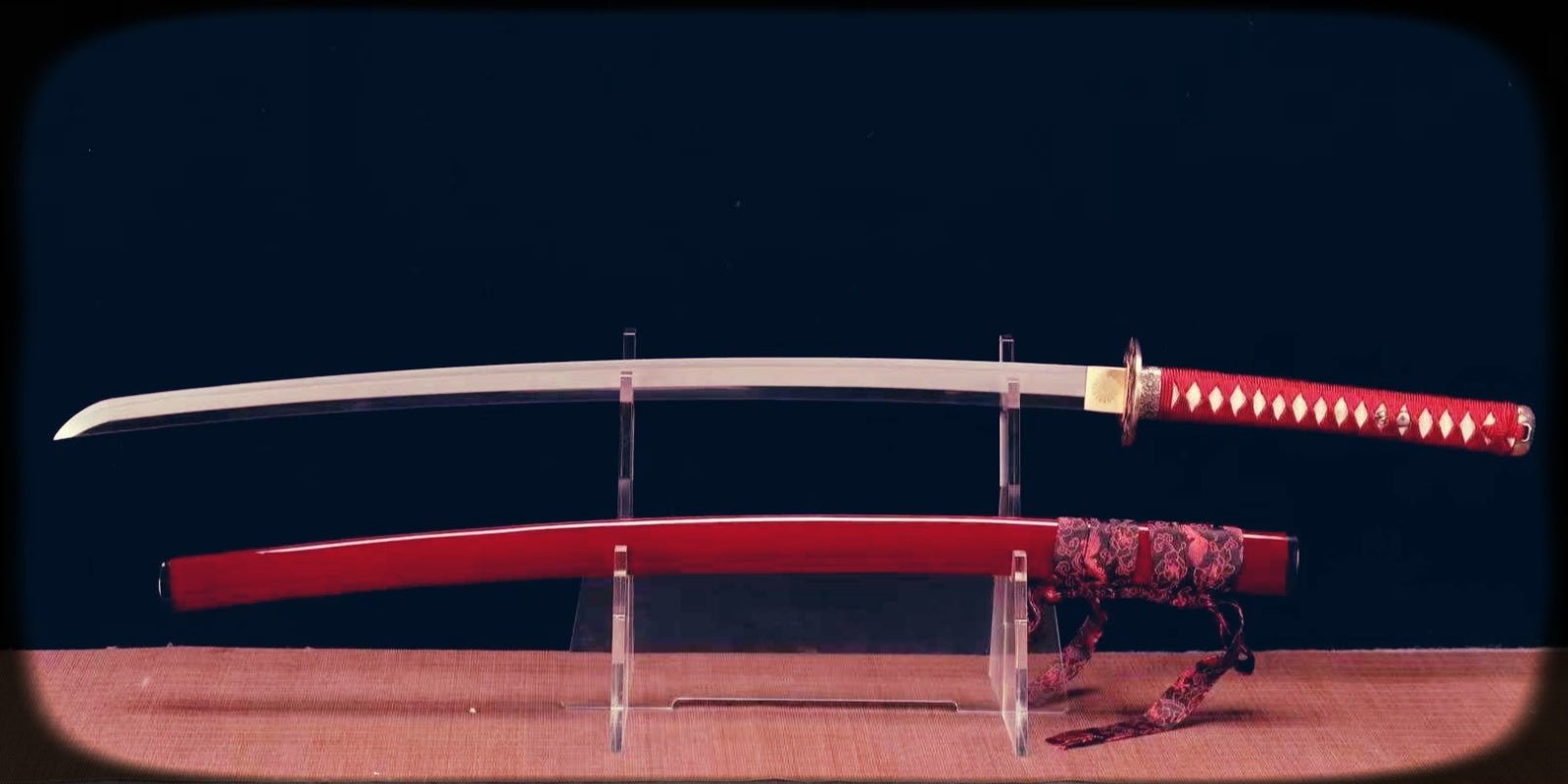
Let’s take a closer look at a striking katana featuring a red-wrapped handle (tsuka) and a matching red lacquered scabbard (saya). This blade clearly displays a Notare Hamon, gracefully flowing along the edge like gentle ripples on water.
In this example, the wavy temper line is not just surface decoration—it’s the result of precise clay application and heat treatment. Under angled light, you can see the Nioi, a fine crystalline structure within the Hamon that creates a soft, mist-like glow. This is a hallmark of a genuine Hamon, setting it apart from etched imitations.
The craftsmanship goes beyond the blade itself:
-
A brass tsuba (guard) adds warmth and contrast to the steel.
-
The tightly wrapped red ito (handle cord) complements the saya, leading the eye toward the blade.
-
A floral-patterned red sageo provides aesthetic balance and a ceremonial feel.
This katana is a perfect example of form meeting function. Its hardened edge and flexible spine make it ideal for tameshigiri (test cutting), while its design and detailing make it a standout collector’s piece.
How to Identify a True Hamon
With many modern swords using acid etching or sandblasting to imitate a Hamon, how can you tell if it’s authentic?
-
Look for Nioi or Nie: tiny crystalline particles that shimmer along the line.
-
Examine the transition zone: genuine Hamon lines are organic and asymmetrical, while fake ones often look too uniform.
-
Use angled lighting or gentle polishing to highlight the blade’s internal structure.
Conclusion: More Than Just a Line
The Hamon is more than a decorative feature—it’s the visible imprint of craftsmanship, thermal precision, and metallurgical skill. Whether understated like Suguha or dramatic like Midare, it’s a quiet signature of the blade’s soul.
For collectors and martial artists alike, understanding the Hamon deepens the appreciation of the katana—not just as a weapon, but as a work of steel-born art.