
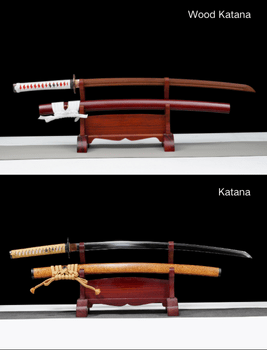
Katana vs. Wood Katana: A Clear, Practical Guide for Learners and Buyers
Technical Comparison
1) Core Definitions
-
Katana (Uchigatana)
A traditionally forged steel sword: single-edged, gently curved, with a two-handed grip. You’ll most often encounter:-
Antique katana (collectible historic blades)
-
Shinsakutō / gendaitō (newly made art swords by licensed smiths)
-
Iaitō / blunt training katana (alloy or through-hardened steel; not for cutting)
-
-
Wood katana (wooden practice sword; sometimes called bokken/bokutō)
A hardwood training tool carved to katana-like proportions with no live edge. Used for kata (forms), paired drills, distance/timing, and contact practice that would be unsafe with steel.
2) How They Evolved
-
Katana grew out of earlier long swords; its curvature, two-handed leverage, and blade geometry favor draw-cuts and stable edge alignment. Today it’s used for form practice (usually blunt), test cutting (live edges, controlled settings), and collecting/display.
-
Wood katana arose because schools needed a durable, safer stand-in for live blades. Wood tolerates contact and repetition, simplifies maintenance, and protects training partners. It remains essential for alignment, posture, footwork, distance, and timing.
3) Materials & Build
-
Katana (steel)
Forged, shaped, heat-treated, polished. Two user-relevant pillars:-
Blade geometry: spine (mune), ridgeline (shinogi), edge (ha), tip (kissaki), curvature (sori) → handling and cutting behavior.
-
Heat treatment: differential hardening (hard edge + tougher spine) vs. through-hardening (durability/cost for trainers).
-
-
Wood katana (hardwood)
Common woods: red/white oak, hickory, ash, jatoba; sometimes denser exotics like ipe or ebony. Density, straight grain, and moisture control drive durability and weight. Usually oil- or varnish-finished. Key variables:-
Profile & balance: how closely it mimics a katana’s distribution/point of balance.
-
Shock resistance: tight, straight grain and proper moisture help prevent splintering.
-
4) What They’re For (modern roles)
-
Katana (today)
-
Iaidō/iaijutsu forms (typically with an iaitō or blunt steel for safety)
-
Tameshigiri / cutting practice (live blades; strict supervision, approved targets)
-
Collecting & display (antiques and contemporary art swords)
-
-
Wood katana (today)
-
Kata & solo basics: posture, grip pressure, blade path, hip use
-
Paired drills: distancing, timing, parries, entries—without a live edge
-
Impact conditioning: controlled partner contact, pell/bag work
-
5) Handling & Safety
-
Katana handling
Curvature supports draw-cuts; an appropriate point of balance (often ~13–17 cm from the guard on many practice blades) helps the sword “track.” Because it’s steel, range discipline is non-negotiable. Beginners should start with non-sharpened blades under qualified coaching. -
Wood katana handling
Typically lighter (wood-dependent) and edge-safe, allowing high-rep practice and earlier paired drills. Dense hardwoods can still injure—control and protective spacing remain essential.
6) Symbolism
-
Katana: a benchmark of refined blade craft—balance, geometry, edge discipline.
-
Wood katana: a symbol of training and refinement—a tool for learning alignment, not status.
Buyer’s Guide
Laws and logistics vary by region. Confirm local regulations before buying, importing, transporting, or carrying any blade or training tool.
1) Match the Tool to the Goal
| Goal | Better Fit | Why |
|---|---|---|
| Safe foundational training | Wood katana | Lower risk, partner drills allowed, easy to replace |
| Drawing/sheathing forms | Iaitō / blunt katana | Metal length/weight mimicry without a live edge |
| Cutting practice | Live katana | Proper geometry & heat-treat for approved targets |
| Collecting/display | Antique or art katana | Craftsmanship, provenance, aesthetics |
| Dojo loaners/fleet | Wood katana + a few iaitō | Durable, budget-efficient, fits most students |
Practical path: Start with a wood katana and a reputable dojo. Add a non-sharpened iaitō once basics are solid. Consider a live blade only after your instructor signs off.
2) Price Ranges (typical)
-
Wood katana
-
Entry practice (oak, beech, hickory): US$20–60
-
Dojo-grade hardwood, clean finish: US$60–120
-
Premium/exotic woods or custom balance: US$120–300+
-
-
Katana
-
Iaitō / blunt alloy or steel: US$200–1,200 (tuned for forms; not for cutting)
-
Production live blades: US$300–1,500 (light–moderate cutting if QC is sound)
-
Mid/high-tier semi-custom & custom: US$1,500–5,000+
-
Licensed smiths / art swords / antiques: US$5,000–six figures
-
Budget tip: Coaching yields more progress than flash. Don’t trade instruction time for ornate fittings.
3) Where to Buy & How to Vet
-
Wood katana
-
Martial-arts suppliers, dojo bulk orders, reputable online shops.
-
Check: straight/tight grain, no knots across stress lines, symmetrical profile, even finish, no soft spots.
-
-
Katana
-
Dedicated sword retailers, established iaitō suppliers, transparent forges/smiths, reputable auction houses (antiques).
-
Red flags: vague steel/heat-treat info, sharpened “wall-hangers,” welded tangs, rattling fittings, mirror finishes hiding geometry, empty “battle-ready” claims.
-
Green flags: published weight & point of balance, full one-piece tang, honest heat-treat description, fair return policy, community reviews, sellers who understand dojo requirements.
-
4) Legal & Logistics (quick overview)
-
Wood katana: usually unrestricted to buy and store. Some venues (airlines, events, public buildings) regulate all stick-like items. Public use may require permission.
-
Katana: rules vary widely: ownership often legal with conditions; public carry frequently restricted; importing may require paperwork; shipping needs robust packaging, tip guards, adult signature.
Good practice: Lock steel swords in storage, transport unsharpened when possible, and travel directly to/from training or display. Ask your dojo/retailer about local specifics.
5) Maintenance & Lifecycle Costs
-
Wood katana care
-
Keep dry; avoid extreme humidity/heat swings.
-
Wipe sweat with a soft cloth after sessions.
-
Refresh with light oil/wax every few months.
-
Inspect edges for crush damage/splinters; smooth with fine sandpaper if needed.
-
Replace on cracks, raised grain, deep dents.
-
-
Katana care
-
Remove fingerprints/moisture after handling.
-
Apply a thin protective oil film (neutral mineral/choji oil).
-
Don’t touch the polished edge; etching risk.
-
Check mekugi (pegs) and fittings periodically; replace crushed pegs.
-
Use professionals for polish/fit on antiques/art swords.
-
Display away from direct sunlight and humidity swings.
-
Economics: A good wood katana can last years with minimal cost. Katana ownership adds oil, storage, occasional refit—and, for high-end pieces, professional services.
6) Safety & Training Progression
-
Begin with a wood katana → footwork, guard transitions, blade path, distance.
-
Add an iaitō → safe draw/sheath, refine edge alignment (hasuji) and timing.
-
Advance to live cutting only under qualified supervision with proper targets, clear range protocols, eye protection, and a maintained blade.
-
Even with a wood katana, keep control and consent in paired work; consider impact-reduction gear.
-
Quarterly gear audit: cracks/splinters in wood, loose tsuba, crushed mekugi, warped scabbard throats.
7) Choosing Your First Piece (quick decision paths)
-
Zero experience:
Buy one dojo-grade wood katana (US$40–80). Join a dojo and follow their sizing standard. -
Doing forms, want metal feel:
Choose a non-sharpened iaitō that matches your height (common start: navel-to-floor blade length). Prioritize balance and fit over ornaments. -
Approved for cutting:
Select a production live blade with conservative geometry (not overly thin), reliable heat-treat, and a secure scabbard. Have your instructor inspect it before first use. -
Collector path:
Pick your lane—historic, licensed art smiths, or high-finish moderns. Focus on provenance, papers, polish, and condition. Work with specialist dealers and get independent opinions.
Summary Table (At a Glance)
| Aspect | Katana (Uchigatana) | Wood katana |
|---|---|---|
| Core nature | Steel sword, curved, single-edged; two-handed | Hardwood training sword; no live edge |
| Primary modern role | Iai forms (blunt), cutting (live), collecting/display | Forms, paired drills, safe contact work |
| Materials & build | Forged steel; heat-treat defines performance | Hardwood; grain/density/profile define durability |
| Handling feel | Tracks in draw-cuts; strict safety discipline required | Forgiving, high-rep practice; control still essential |
| Typical price | Iaitō US$200–1,200; live production US$300–1,500; customs/antiques higher | US$20–120 dojo-grade; premium woods US$120–300+ |
| Legal considerations | Vary by region; carry often restricted; importing may need paperwork | Usually unrestricted; some venues regulate training implements |
| Maintenance | Wipe + oil, check pegs/fittings; pro care for valuable pieces | Keep dry, occasional oil/wax, inspect for cracks/splinters |
| Risk profile | High consequence if mishandled | Lower consequence; still capable of injury |
| Best first buy | Non-sharpened iaitō after wood katana time | Dojo-grade wood katana |