
Introduction: “Big–Small,” No Myth Required
In sword circles, daishō gets mentioned a lot. Strip away the mystique and it simply means “big–small”—a long sword and a short sword worn together as a coherent set. In modern training and collecting, that almost always means katana (the long blade) plus wakizashi (the short blade).
This guide explains why the pairing makes sense, what separates a true set from two mismatched blades, and how to train, display, buy, and maintain a daishō with clear, technical logic. We’ll stay away from cultural or political symbolism and focus on geometry, fittings, draw mechanics, range, and practical use.
Part 1: Clear Definitions
-
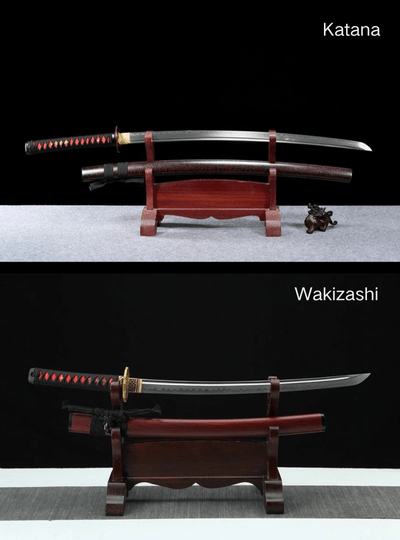
Katana (long sword) — A curved, single-edged steel sword carried edge-up through the sash. It balances reach with draw speed, rewards crisp edge alignment (hasuji), and serves as the primary technique blade in most curricula.
-
Wakizashi (short sword) — A compact steel short sword, typically 30–60 cm in blade length, also carried edge-up. It shines in confined spaces and serves as a backup when the long blade is unavailable or inappropriate.
A daishō is a set. It’s not just “two different lengths,” but two blades that belong together—in how they handle and in how they look.
Part 2: How the Pairing Evolved (Function First)
Earlier long–short combinations existed—most notably a tachi (a suspended, edge-down long sword) paired with a tantō (a dagger) for emergencies. As everyday fighting shifted toward streets, doorways, and rooms, the edge-up sash draw of the katana proved faster and more ergonomic than a suspended edge-down carry. Meanwhile, the wakizashi matured as the always-there sidearm: on the hip even when the long blade was set aside.
Over time, katana + wakizashi crystallized as the most practical “big–small” format.
Key idea: The daishō endures because of complementary roles—the long blade governs range, the short blade governs access—and because the carry system is compatible for both (edge-up in the sash).
Part 3: Complementary Roles That Actually Matter
Long (Katana): Control and Leverage
-
Range management: Takes command of the mid-line and keeps opponents at decision distance.
-
Cut dynamics: Curvature supports clean draw-cuts and stable edge tracking.
-
Draw: Edge-up carry enables a smooth, single-motion draw into a cut.
Short (Wakizashi): Maneuverability and Access
-
Confined spaces: Doorways, corridors, seated positions, and clinch-range—places where a full draw is awkward or slow.
-
Continuity: If the long blade is unavailable (stowed, surrendered, entangled), the short blade preserves fighting capability.
-
Speed: Shorter draw stroke and faster path changes.
A daishō does not automatically imply dual-wielding. In most training lines, the short blade is contextual—backup, indoor, or transitional.
Part 4: What Makes Two Blades a Set (and Not a Mash-Up)
A real daishō reads as a coherent pair.
-
Matched fittings (koshirae)
Harmonized tsuba (guard), menuki (ornaments), fuchi-kashira (collar/pommel), samegawa (rayskin), tsuka-ito (wrap), and saya (scabbard) finish. Motif, metal tone, and lacquer should converse rather than clash. -
Proportional harmony
The wakizashi echoes the katana’s curvature (sori), tip style (kissaki), and thickness distribution, scaled so the handling feels related—not random. -
Shared handling logic
Both carry edge-up; draw and recovery paths feel like variations on a theme rather than competing systems.
If the two blades don’t read as siblings, be honest and call the arrangement a comparative display, not a daishō.
Part 5: Geometry & Heat Treat—Why the Pair Feels Right
-
Curvature (sori) — Moderate curvature helps the katana track draw-cuts; a wakizashi with related curvature keeps the “family resemblance” in both feel and line.
-
Ridgeline (shinogi) & spine (mune) — These govern stiffness and weight distribution. A wakizashi often retains a robust spine to inspire confidence at close range.
-
Tip (kissaki) geometry — Consistency between the two blades makes thrust alignment predictable.
-
Heat treatment — Differential hardening (hard edge, tougher spine) produces a visible hamon (temper line). On short blades, the “canvas” is smaller, so fine hamon work can be striking.
For heavy reps and frequent handling, through-hardened modern blades can be more forgiving. For visual artistry, differentially hardened blades reward close study.
Part 6: Wearing & Displaying—Neutral, Professional Conventions
You can present a daishō tastefully without ritual language:
-
Rack order: long above, short below.
-
Hilt direction: left-facing hilts read non-aggressive and keep visual flow consistent.
-
Edge orientation: edge-up for both reflects sash-draw logic.
-
Labels: Be technical and clear:
“Long sword (katana) and short sword (wakizashi), matched fittings and proportional geometry; displayed to illustrate size, mounting, curvature, and draw mechanics.”
Include blade lengths, weights, points of balance, and materials.
Lighting makes or breaks presentation: soft, directional light reveals hamon and hada without glare; a dark backdrop keeps polished steel crisp.
Part 7: Training With a Daishō—What Actually Helps
Solo Foundations
-
Build consistent grip, posture, footwork, and edge alignment with a metal iaitō (non-sharpened) in the katana role.
-
Use a wood katana for high-rep blade-path drills without fatigue or maintenance anxiety.
Short-Blade Work
-
Add a wakizashi trainer (wood or blunt metal) to explore seated draws, threshold entries, and clinch-range transitions.
-
In partner practice, emphasize control and consent; short doesn’t mean harmless.
Cutting (Tameshigiri)
-
Only with appropriate targets, qualified supervision, and range protocols.
-
The long blade is the primary cutter; short-blade cutting is niche and not a substitute for long-blade development.
Two-Sword Drills
-
Great for transition timing (long → short) and retention scenarios.
-
Most curricula keep the short blade contextual rather than default off-hand.
Part 8: Buying a Pair—Function Before Flash
Decide Your Primary Goal
-
Training-first: handling, balance, durability, transparent specs.
-
Display-first: matched fittings, proportional harmony, clean polish.
-
Collecting-first: documentation, condition, credible provenance.
Indicative Price Ranges
-
Wakizashi
-
Modern production steel: $300–$800
-
Mid/high production or semi-custom: $800–$2,500+
-
Antique with decent polish: $2,000–$10,000+
-
-
-
Iaitō / blunt trainers: $200–$1,200
-
Production live blades: $300–$1,500
-
Semi-custom / custom: $1,500–$5,000+
-
Antique/art-grade: $5,000–five figures+
-
Spend first on integrity—tight mountings, honest geometry/heat treat, sound scabbard fit. Ornate fittings can wait.
Vendor Vetting
-
Green flags: published weight & point of balance, true photos (not renders), honest heat-treat notes, fair return policy, community references.
-
Red flags: welded tangs, rattling fittings, “battle-ready” hype with no data, mirror polishes that hide geometry.
What “Matched” Means in Practice
-
Same-smith, same-period pairs are rare and expensive.
-
A modern “matched” set can still be excellent if motif, metal tone, lacquer, and proportions are thoughtfully harmonized.
Legal & Logistics (Neutral Reminder)
-
Ownership, import, and carry rules vary by region.
-
Use robust packaging, tip guards, adult signatures, and lockable storage.
Part 9: Maintenance—Make the Pair Last
-
After handling: remove prints and moisture; apply a thin protective oil to steel.
-
Storage: stable humidity, away from direct sun; oiled blades, dry fittings.
-
Quarterly checks: scabbard retention, mekugi (pegs), wrap seams, and any movement in fittings.
-
Professional work: antique polish and major fitting jobs belong with qualified specialists; DIY “improvements” erase value.
Part 10: Common Misunderstandings—Clear, Simple Answers
“Daishō means dual-wielding.”
Not necessarily. The short blade is primarily backup and close-quarters. Dual-wield systems exist but aren’t the default.
“Any two different lengths count as a daishō.”
No. The term implies a coherent pair—related fittings, sensible proportions, and a long–short logic that makes sense together.
“Tachi + wakizashi is a daishō.”
As a comparative display, sure. The familiar long–short pair is katana + wakizashi because both share edge-up sash carry and compatible draw paths.
“A tantō can stand in as the ‘short’.”
Daggers historically accompanied long swords, but in the widely recognized daishō context the short sword is the wakizashi.
Part 12: Quick Reference—What “Good” Looks Like
-
Handling: katana tracks cleanly; wakizashi changes direction quickly without feeling toy-light.
-
Fit: silent mountings, smooth draw, no scabbard chew, pegs intact.
-
Look: fittings and finishes harmonize; the small blade echoes the big one.
-
Docs: clear specs for modern pieces; provenance for significant older blades.
-
Care: wipe, light oil, stable storage—no fingerprints, no humidity spikes.
Conclusion: “Big–Small” as Practical Engineering
The daishō works because it’s practical engineering expressed as a pair: a long blade that governs range and leverage, and a short blade that ensures access and continuity. The carry systems match, the draw paths make sense, and the aesthetics can be tuned so two forms express one idea. Keep your focus on function, geometry, fittings, and safety, and your katana + wakizashi will deliver exactly what “big–small” promises—they work together.