
Kobuse Katana Construction Explained
Two katana blades can look almost identical on the outside while being built very differently on the inside.
One might be made from a single body of steel. Another might combine several pieces of steel, with different materials positioned in specific parts of the blade.
At first glance, you probably wouldn't notice the difference. After all, a polished blade doesn't come with a window showing you what's inside.
That's where Kobuse construction comes in.
Kobuse is a method of building a blade using an outer section of steel and a separate inner core. The idea is to combine materials with different properties within one finished blade.
It sounds complicated, but the basic concept is easier to understand than you might think.
Why would a swordmaker use different steels instead of just one? What makes Kobuse different from other blade constructions? And, perhaps most importantly, does it actually make a katana better?
Let's start with the basics and work our way through what Kobuse construction really means.
What Is Kobuse Construction?
Kobuse is a type of composite blade construction. Rather than making the entire blade from one principal piece of steel, the maker joins separate steel components to create a single structure.
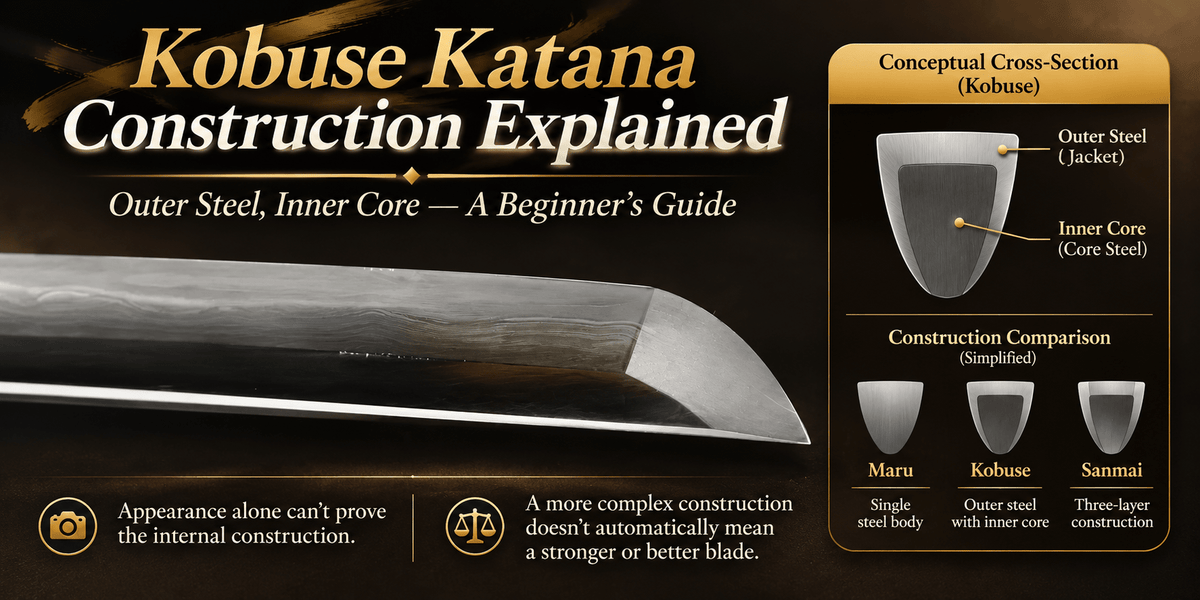
In a common Kobuse arrangement, an outer section of steel wraps around an inner core. The outer material forms much of the blade's exterior, including the cutting-edge region, while the core sits inside the assembled structure.
You may see this described as a harder outer steel surrounding a softer inner steel.
That's a useful starting point, although the exact materials, arrangement and finished properties can vary.
The important distinction is that Kobuse describes how the steel components are arranged and joined.
It doesn't tell you everything about the finished blade.
For example, knowing that a katana uses Kobuse construction doesn't automatically tell you its exact hardness, how sharp it is or how well it will withstand a particular load.
Those characteristics depend on other decisions made during manufacturing.
Think of Kobuse as a description of the blade's internal construction, not a complete performance specification.
Why Combine Different Steels?
This is the question that makes Kobuse interesting.
When making a cutting tool, the properties you want in one area may not be identical to those you want elsewhere.
The cutting edge has its own requirements. The rest of the blade must also deal with the stresses placed on it.
Material selection therefore involves trade-offs.
One approach is to choose a single steel and process it to achieve the desired properties. Another is to combine different steels, placing each material where the maker intends it to serve a particular role.
Kobuse follows the second approach.
In a typical arrangement, the outer steel is selected with the blade's surface and cutting-edge requirements in mind. The inner core is made from steel chosen for different characteristics.
The goal is to make use of those differences within one blade.
But here's an important detail: the design intention isn't the same as a guaranteed result.
A softer core doesn't automatically make a blade resistant to every kind of damage. A harder outer section doesn't automatically produce a better cutting edge.
How the finished sword behaves depends on the steels used, their final properties, the quality of the bond between them and the rest of the manufacturing process.
So the special thing about Kobuse isn't that it promises perfect performance.
It's that it gives the maker a way to combine different materials within a deliberately arranged structure.
How Is a Kobuse Blade Made?
You don't need to understand every stage of forging to grasp the basic process.
Imagine the steel components before they have been shaped into a finished blade.
The maker prepares material for the outer section and a separate piece for the inner core. These are arranged according to the intended construction, with the outer steel positioned around the core.
The pieces are then joined through forge welding.
Forge welding involves heating the steel and applying pressure so that the prepared surfaces bond together.
Once the components have been successfully joined, the combined material can be worked into the blade's intended shape.
Further manufacturing stages include shaping, heat treatment, grinding and polishing.
Of course, this is a simplified overview. Specific methods and construction details can differ between makers.
What matters is that the separate pieces must become a sound, joined structure.
Simply placing two steels together isn't enough.
The quality of the bond is an important part of the finished construction. Poor joining can introduce weaknesses, regardless of how impressive the blade's specifications might sound.
This is one reason a more elaborate construction method shouldn't automatically be treated as a sign of better workmanship.
The technique matters, but so does how well it's carried out.
Kobuse vs Maru: What's the Difference?
If you've been browsing katana product pages, you've probably come across the term Maru.
Maru-gitae and Kobuse describe two different approaches to blade construction.
A Maru blade is made from one principal body of steel rather than a deliberately assembled outer jacket and separate inner core.
That doesn't necessarily mean the steel was never folded or worked during production. It simply means the finished blade doesn't use the separate core-and-jacket arrangement that defines Kobuse.
Kobuse, on the other hand, combines different steel components within the blade.
Here's a straightforward comparison:
| Feature | Maru | Kobuse |
|---|---|---|
| Basic structure | One principal steel body | Outer steel joined around an inner core |
| Separate inner core | No | Yes |
| Main construction idea | A unified steel structure | Different steels positioned within one blade |
| Joining requirements | No separate core-to-jacket bond | Requires a sound bond between components |
| Automatically better performance? | No | No |
It's tempting to assume that Kobuse must be better because it involves more components and additional manufacturing steps.
But that isn't how blade quality works.
A carefully made Maru blade can be an excellent finished product. A poorly executed Kobuse blade doesn't become superior simply because its construction is more complicated.
The better question is whether the materials, heat treatment, geometry and workmanship suit the blade's intended purpose.
In other words, more complicated doesn't necessarily mean better.
What About Sanmai Construction?
Another term worth knowing is Sanmai.
Like Kobuse, Sanmai refers to a composite construction that combines different steel components.
The main difference lies in how those components are arranged.
Sanmai is commonly associated with a sandwich-style arrangement, with different steels positioned alongside one another across the blade's thickness.
Kobuse is more commonly described as an outer section of steel wrapping around an inner core.
Specific arrangements can vary, so these descriptions are best treated as introductions rather than complete manufacturing diagrams.
For beginners, the easiest way to understand the distinction is to focus on where the materials are positioned.
Maru uses one principal steel body.
Kobuse uses an outer section around a separate core.
Sanmai commonly uses a layered, sandwich-like arrangement.
These are construction categories, not quality grades.
There is no reliable rule that says one must always outperform the others.
Is Kobuse the Same as Folded Steel?
No, and this distinction is worth getting right.
Kobuse and folded steel describe different aspects of how a blade is made.
Kobuse refers to the arrangement of separate steel components.
Folding refers to a method of working steel during its preparation.
A blade may involve both processes, but the terms aren't interchangeable.
For example, a product listing might describe a katana as having folded steel and Kobuse construction.
If both claims are accurate, they're telling you two different things: something about how the steel was worked and something about how the blade's components were assembled.
Likewise, a blade advertised as folded steel doesn't automatically have a separate inner core.
This also explains why visible surface patterns aren't enough to identify Kobuse construction.
You might see grain-like details across a polished blade, but those patterns don't necessarily reveal what's happening inside.
To understand the internal construction, you need reliable information about how the blade was made.
Does Kobuse Make a Katana Stronger?
This is where it's worth being careful with product descriptions.
The word stronger sounds straightforward, but it can mean different things.
Are we talking about resistance to bending? Resistance to fracture? Edge durability? The ability to withstand a particular type of load?
Those aren't all the same property.
Kobuse is intended to combine materials with different characteristics, but that doesn't mean every Kobuse blade will perform better in every situation.
Several factors influence the behaviour of a finished katana:
-
Steel selection: Different steels have different properties and respond differently to processing.
-
Heat treatment: Heating and cooling procedures affect the final characteristics of the blade.
-
Blade geometry: Thickness, cross-sectional shape and edge geometry influence how the blade behaves.
-
Workmanship: Forging, joining, shaping and finishing all matter.
-
Intended use: Performance needs to be considered in relation to what the blade is designed to do.
These factors interact with one another.
That's why a statement such as "Kobuse blades are always stronger than Maru blades" goes too far.
A meaningful comparison would require reliable information about the specific blades and the conditions under which they were evaluated.
For most people shopping online, that information simply isn't available.
A more useful approach is to view Kobuse as one part of the overall design, rather than as proof of superior strength.
Does Kobuse Make a Blade Sharper?
Not automatically.
Sharpness and construction are related to different aspects of a blade.
A cutting edge's immediate sharpness depends heavily on its geometry and how it has been finished.
The steel and its heat treatment also influence how that edge behaves during use.
Kobuse construction doesn't specify the exact edge angle, sharpening method or final edge finish.
It doesn't tell you whether a particular sword has been sharpened well, either.
Two blades made using Kobuse construction could have very different edge characteristics.
Similarly, a Maru blade and a Kobuse blade could both have carefully finished cutting edges.
So if you see a product listing that uses "Kobuse forged" as proof of exceptional sharpness, take a closer look at the explanation.
Construction alone doesn't establish sharpness.
It's one feature of the blade, not a shortcut to judging every aspect of its performance.
Is Kobuse More Difficult to Make?
Kobuse introduces manufacturing requirements that aren't present in a blade made from one principal steel body.
The maker must prepare separate components, arrange them correctly and join them into a sound structure.
That adds complexity to the process.
But complexity and quality aren't the same thing.
A demanding technique performed poorly doesn't become valuable simply because it was difficult.
Likewise, a simpler construction carried out with care shouldn't be dismissed as inferior.
The important question is whether the maker has successfully turned the chosen materials and construction method into a well-made finished blade.
This is also why vague marketing language deserves a closer look.
Terms such as "hand-forged," "layered steel," "folded steel" and "Kobuse" can all appear in the same product description, but they don't mean the same thing.
Each describes a different aspect of production, and each claim should be understood separately.
Can You Identify Kobuse From a Photo?
Usually, not with confidence.
A good product photo can tell you plenty about a katana's visible features.
You may be able to examine the blade's profile, surface finish, fittings and overall appearance.
Its internal construction is another matter.
In a typical Kobuse arrangement, the core sits within the surrounding steel. That structure isn't necessarily visible on the polished blade.
Some surface features may relate to the manufacturing process, but an ordinary photograph generally can't confirm a specific internal arrangement.
Lighting makes this even trickier.
Reflections can highlight or conceal details. Polishing affects how the surface appears, and image editing can make subtle patterns look much more dramatic.
A striking close-up might be visually impressive, but it isn't proof that the blade contains a Kobuse core.
If a retailer advertises Kobuse construction, look for a clear explanation of the arrangement and credible manufacturing information.
A cross-sectional diagram can help you understand the design, but a generic illustration isn't independent proof of how a particular sword was made.
The distinction is simple:
Photos help you assess appearance. Reliable manufacturing information helps you understand construction.
What Should You Look for When Buying a Kobuse Katana?
If you're researching your first katana in Sydney, Melbourne or elsewhere in Australia, it's easy to get caught up in technical terms.
A product listing might mention steel grades, folded steel, Kobuse construction, differential hardening and several other features.
That's a lot to take in when you're new to the subject.
The trick is to separate those claims instead of treating them as one big promise of quality.
Start with the construction.
Does the seller explain which steels are used for the outer section and the core? Is the arrangement clearly described? Is the information specific to that particular blade?
Then look at the heat treatment.
Is it explained separately from the construction method? Does the description make clear what process the maker claims to have used?
Next, examine the photographs.
Do they show the blade clearly from several angles? Are there useful close-ups of the visible finish?
Remember that photographs can help you assess appearance, but they generally can't verify hidden construction.
Finally, consider the source of the information.
A detailed specification is useful, but it's still a claim unless supported by reliable documentation.
The most helpful product pages are those that explain their terminology clearly rather than relying on impressive-sounding labels.
And don't assume that price settles the question.
A higher price may reflect materials, labour, finishing or other factors, but it doesn't automatically prove that the construction was executed better.
The goal is to understand what you're being offered, not simply to choose the product with the longest list of technical terms.
Three Common Misunderstandings About Kobuse
Before we wrap up, let's clear up three misconceptions that can make Kobuse sound more mysterious than it really is.
1. More Steel Layers Mean a Better Blade
Not necessarily.
The number of components doesn't tell you whether the finished sword is well made.
Steel selection, heat treatment, joining quality and overall workmanship still matter.
Kobuse is distinctive because of how its materials are arranged, not because using multiple components guarantees better performance.
2. A Softer Core Makes the Blade Unbreakable
No construction method makes a sword unbreakable.
Combining steels is intended to make use of different material properties, but the finished blade can still be damaged under unsuitable conditions or excessive loads.
A softer core shouldn't be presented as a guarantee against bending, cracking or fracture.
3. Visible Steel Grain Proves Kobuse Construction
Not reliably.
Surface grain and internal construction are different things.
A polished blade may show visible grain-like patterns without revealing whether it contains a separate inner core.
That's why manufacturing information matters more than dramatic surface photography when you're trying to verify a construction claim.
Is Kobuse Worth Choosing?
Kobuse can be an appealing option if you're interested in a katana made using a composite steel arrangement.
Its defining feature is the deliberate placement of different steels within one blade, along with the workmanship required to join them successfully.
But whether it's the right choice depends on what you're looking for.
If you're interested in learning about blade construction, Kobuse is a useful example of how different materials can be combined to serve different roles.
If you're comparing products to buy, the construction method should be considered alongside the blade's other specifications, the clarity of the maker's information and the quality of the finished product.
There's no reason to dismiss a Maru blade simply because it doesn't have a separate core.
Equally, a Kobuse blade shouldn't receive an automatic quality advantage just because its internal structure is more elaborate.
A construction method is a design choice.
What matters is how successfully that choice is carried through into the finished blade.
Final Thoughts
What makes Kobuse special isn't a promise of extraordinary sharpness, strength or durability.
It's the idea of combining different steels within one blade, with an outer section surrounding a separate inner core.
That arrangement gives the maker a way to use materials selected for different roles. It also introduces manufacturing requirements that must be handled carefully.
But the construction name alone can't tell you everything about the finished sword.
Steel selection, heat treatment, blade geometry and workmanship all contribute to the final result.
So when you're comparing katana, keep three things in mind:
Construction tells you how the materials are arranged.
Photographs show you the blade's visible features.
Neither one, on its own, proves overall quality or performance.
Once you understand those distinctions, terms such as Kobuse, Maru and Sanmai become much easier to navigate.
Instead of wondering which construction sounds the most impressive, you can focus on better questions: How was the blade made? What materials were used? And what reliable information supports the seller's claims?
That's the real value of understanding Kobuse. It helps you look beyond the terminology and make a more informed assessment of the blade in front of you.