Hada vs Hamon: What's the Difference?
If you are new to katana, "hada" and "homon" are two terms that are surprisingly easy to mix up.
Both can appear as visible patterns on a polished blade. Both can become much clearer under the right lighting. And both are often highlighted in close-up product photos.
But they are not the same thing.
The easiest way to remember the difference is this:
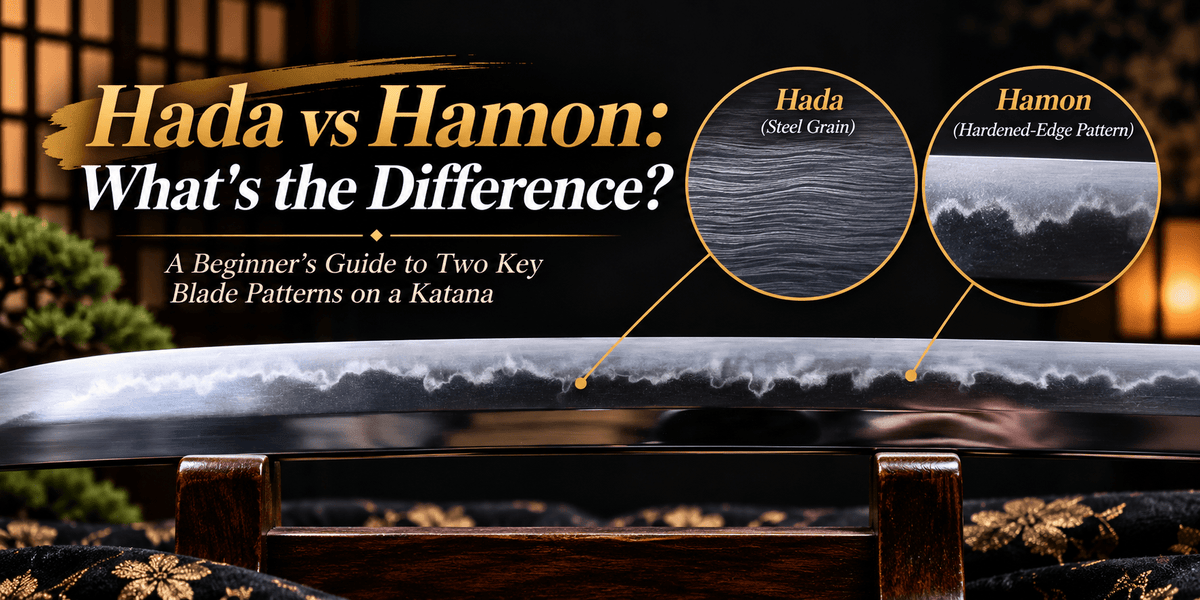
Hada is the grain you read through the steel. Hamon is the hardened-edge pattern you follow along the blade.
Hada is associated with the worked structure of the blade steel and appears as grain-like detail across the blade surface.
Hamon is associated with differential hardening and follows the cutting-edge side of the blade.
Once you separate those two ideas, a lot of katana terminology starts to make much more sense.
For anyone comparing katana online in Sydney, Melbourne, or elsewhere in Australia, that distinction is especially useful because product photos often show both features at the same time.
So rather than memorising definitions, let’s look at where each feature appears, how it behaves visually, and what you can realistically learn from a photograph.
What Is Hada?
Hada is the visible grain or pattern within the worked steel of the blade.
The easiest way to think about it is as the blade’s steel grain.
On blades where the forging process produces visible layered structure, polishing can reveal patterns that appear straight, flowing, irregular, circular, or somewhat like wood grain.
That is why hada is often described using visual comparisons to natural grain.
The important point is that hada belongs to the steel surface itself.
It is not a single line running along the edge.
It is not a groove.
And it is not simply a decorative pattern applied to the blade.
When visible, hada tends to appear across the broader surface of the blade rather than following one narrow path.
That makes location one of the easiest ways to tell it apart from hamon.
What Does Hada Look Like?
There is no single hada pattern.
Some examples look fairly straight.
Others appear irregular, swirling, or more organic.
For beginners, three common names are useful to recognise.
Masame
Masame tends to show straighter grain lines running along the blade.
The overall effect often looks more linear and organised than other hada patterns.
Itame
Itame tends to look more irregular.
The grain can resemble flowing or uneven wood grain, with lines shifting direction rather than staying perfectly straight.
Mokume
Mokume can show more circular or burl-like forms.
It often looks more rounded and complex than the straighter movement associated with Masame.
You do not need to memorise all three right away.
The useful idea is simply this:
Hada behaves like grain.
It appears through the blade surface rather than as one continuous border running along the cutting edge.
Hada Does Not Have to Be Obvious
This is where product photography can make things tricky.
Some blades show very bold grain.
Others show much finer surface activity.
A subtle hada does not automatically mean there is no visible steel structure, and a dramatic grain pattern does not automatically mean the blade is better.
Lighting matters.
Polishing matters.
Camera angle matters.
Image contrast matters.
A blade photographed under strong angled light may show its grain very clearly, while the same blade under flatter lighting may look almost plain.
So do not expect hada to behave like a printed graphic that looks identical from every angle.
It is part of the polished steel surface, and reflections can change how clearly you see it.
What Is Hamon?
Hamon comes from a different part of the blade-making process.
A hamon is the visible hardened-edge pattern associated with differential hardening.
During differential hardening, the cutting-edge region and the rest of the blade cool under different conditions during quenching.
That creates differences in the steel structure across the blade.
After suitable polishing, the hardened-edge region becomes visually readable as the hamon.
You do not need to dive deeply into metallurgy to understand the basic idea.
The key point is:
Hamon follows the cutting-edge side of the blade.
That is what makes it visually different from hada.
Hada spreads through the blade surface like grain.
Hamon follows the edge as a continuous pattern or band.
What Does Hamon Look Like?
Just like hada, hamon does not have one fixed shape.
It can be relatively straight.
It can form broad waves.
It can repeat rounded peaks.
It can also show irregular or mixed movement.
Three beginner-friendly examples are especially useful.
Suguha
Suguha stays relatively straight.
The pattern generally follows the cutting edge in a calm, steady path.
Notare
Notare rises and falls in broad, gradual waves.
Its movement tends to feel smooth and flowing.
Gunome
Gunome tends to show repeated rounded rises or hump-like forms.
Compared with Notare, the rhythm usually feels more repetitive.
These are all hamon patterns.
They are not hada patterns.
That distinction matters.
A wavy hamon is not “wavy hada.”
A straight hamon is not “straight hada.”
They belong to two different visual systems.
Hada vs Hamon: The Quick Difference
| Feature | Hada | Hamon |
|---|---|---|
| What it describes | Visible steel grain | Hardened-edge pattern |
| Where you usually see it | Across the blade surface | Along the cutting-edge side |
| Visual behaviour | Grain, lines, swirls, mottling | Straight, wavy, rounded, or irregular pattern |
| Main process associated with it | Worked steel and forging structure | Differential hardening |
| Example terms | Masame, Itame, Mokume | Suguha, Notare, Gunome |
| Is it a groove? | No | No |
| Does it automatically prove quality? | No | No |
This table is deliberately simple.
For a first-time buyer, you do not need a complicated classification system.
You mainly need to know where to look and how the pattern behaves.
Three Ways to Tell Hada and Hamon Apart
If you are looking at a product photo and are not sure what you are seeing, ask three questions.
1. Where Is the Pattern?
Start with location.
If the pattern appears across the broader body of the blade, you may be looking at hada.
If it follows the cutting-edge side, you are more likely looking at hamon.
This is the quickest first check.
Hada tends to live through the blade surface.
Hamon tends to track the edge.
2. How Does the Pattern Behave?
Next, look at movement.
Hada usually behaves like texture.
You may see fine lines, flowing grain, loops, irregular marks, or mottled surface activity.
Hamon behaves more like a continuous band or boundary running along the edge.
It may stay straight.
It may roll in waves.
It may repeat rounded peaks.
This difference in visual behaviour is often easier to recognise than the terminology itself.
3. What Process Does It Relate To?
Finally, think about origin.
Hada is associated with the worked structure of the steel.
Hamon is associated with differential hardening.
That does not mean you can prove the entire manufacturing process from a photograph.
But understanding the different origins helps explain why the two features look different.
Hada Is Not Hamon
This sounds obvious once you know the difference, but the two are often mixed up in product discussions.
A blade may show both at the same time.
You might see grain running across the steel surface and a separate wavy pattern following the cutting edge.
The grain is hada.
The edge pattern is hamon.
One does not replace the other.
A blade can show visible hada and visible hamon at the same time because they describe different features.
Hada Is Not a Groove
Another common mistake is confusing hada with a physical groove.
A groove such as bo-hi is recessed into the blade.
Hada is not.
It is a visible pattern in the steel.
If lighting creates a dark line in a product photo, that does not automatically mean you are looking at hada.
Always ask whether the feature is actual surface geometry or simply a visual pattern within the polished steel.
Hamon Is Not the Physical Cutting-Edge Shape
This is another important distinction.
Terms such as Notare, Gunome, and Suguha describe hamon patterns.
They do not describe the physical outline of the cutting edge.
A curved blade can have a relatively straight Suguha hamon.
Likewise, a Notare hamon can move in broad waves even though the actual cutting edge follows a much smoother curve.
The hamon sits within the blade surface.
It is not the edge profile itself.
Does Visible Hada Prove the Blade Was Folded?
Not from appearance alone.
This is where modern product photography can tempt beginners into overconfident conclusions.
Traditional hada is closely associated with worked and forge-welded steel structure.
However, seeing a grain-like pattern in an online photograph does not automatically prove a specific folding method, a particular folding count, or the exact internal construction of the blade.
A photograph shows appearance.
It does not provide a complete manufacturing record.
That leads to one of the most useful rules in this entire guide:
Use photos to understand appearance. Use specifications to understand process.
If a seller states that a blade is folded and forged, that claim should come from reliable production information rather than from a customer simply guessing based on surface pattern.
Does Strong Hada Mean Better Quality?
No.
A dramatic grain pattern can certainly be visually appealing.
But visibility alone is not a quality ranking.
Bold hada does not automatically mean:
-
better steel
-
more folding
-
better forging
-
better heat treatment
-
better performance
The reverse is also true.
A blade with subtle or restrained grain is not automatically inferior.
Visible hada is one characteristic of the blade, not a complete judgement of its quality.
Does a Strong Hamon Mean Better Quality?
The same rule applies.
A very obvious hamon may photograph beautifully.
But the shape or visibility of the hamon alone does not prove that the blade is better.
A dramatic Gunome or Notare pattern is not automatically superior to a quieter Suguha.
The hamon tells you about the visible hardened-edge pattern.
It does not, by itself, tell you everything about hardness, geometry, steel quality, construction, polish, or overall performance.
A useful rule is:
Neither visible hada nor visible hamon should be treated as a quality score.
Can Photos Tell You Whether a Hamon Is Genuine?
Not always.
A good photograph can help you describe what the pattern looks like.
For example, you may reasonably say:
“This looks like a Notare-style hamon.”
But that is different from proving exactly how the pattern was produced.
Some cosmetic surface treatments can imitate a hamon-like appearance.
Ordinary product photographs are not always enough to establish the complete manufacturing method.
So avoid making absolute technical conclusions from one image.
Check the product’s heat-treatment specification.
If the seller states that the blade is differentially hardened or clay tempered, that information should come from production records or reliable specifications.
The distinction is simple:
Photos tell you what you can see. Specifications tell you what the maker claims was done.
Both matter.
Why Lighting Can Change Everything
Polished steel is highly reflective.
That makes both hada and hamon sensitive to lighting.
A feature can look very strong from one angle and almost disappear from another.
Strong contrast may make grain look deeper.
A bright reflection may hide part of the hamon.
Image editing can also make subtle patterns appear much stronger than they do under ordinary lighting.
That is why one hero image should never be your only reference.
For Australian buyers comparing katana online, clear blade photos from several angles are far more useful than one dramatic close-up.
Ideally, you want a full-length blade image, several close-ups, different lighting angles, and clear product specifications.
The full-length view shows where the pattern runs.
The close-up shows texture.
You need both.
How to Read a Product Photo Step by Step
When you open a katana listing, do not immediately zoom in on the brightest part of the blade.
Start with the whole blade.
First, find the cutting edge.
Then look just above it.
Do you see a continuous line or patterned band following the edge?
That is where you should look for hamon.
Next, move your attention farther into the broader blade surface.
Do you see grain, fine lines, swirling marks, or wood-like texture?
That is where visible hada may appear.
Then compare multiple photos.
If the pattern only appears under one extreme reflection, be cautious.
Finally, read the specifications.
Does the product description mention folded or forged steel?
Does it mention visible hada?
Does it specify differential hardening?
Does it name the hamon type?
Does it identify the steel grade or construction method?
The photographs and written specifications should support each other.
A Simple Example
Imagine a blade with faint flowing lines across much of the polished surface.
Near the cutting edge, there is also a separate series of rounded peaks.
You are probably looking at two different features.
The flowing grain across the blade body may be hada.
The repeated rounded pattern near the cutting edge may be a Gunome hamon.
This is exactly why learning the distinction matters.
Without that framework, it is easy to describe everything visible on the blade as one pattern.
Once you know where to look, the surface starts to make much more sense.
Why Beginners Often Confuse Them
The confusion is understandable.
Both features become visible through polished steel.
Both can look different under changing light.
Both come with specialised terminology.
And product photography often highlights them at the same time.
The solution is surprisingly simple.
Do not start with the name.
Start with location.
Then look at behaviour.
Then check the specifications.
That sequence is much more useful than trying to memorise every sword term first.
Hada and Hamon at a Glance
Here is the simplest memory aid:
Hada = grain through the steel.
Hamon = hardened-edge pattern along the blade.
Or, even shorter:
Hada is grain. Hamon is edge pattern.
That is not a complete technical definition, but it is an excellent beginner shortcut.
What Should You Look for When Buying Online?
If you are comparing two katana and one product page says:
Visible Hada
while another says:
Real Hamon
do not treat those phrases as alternatives.
They describe different features.
For hada, ask:
-
Is visible steel grain shown clearly?
-
Does the seller provide information about forging or folding?
-
Are there close-up photos from more than one angle?
For hamon, ask:
-
Does the pattern follow the cutting edge?
-
What hamon type is claimed?
-
Is the blade described as differentially hardened?
-
Do the photos and specifications agree?
This approach is far more useful than chasing whichever technical term sounds most impressive.
Final Thoughts
Hada and hamon can both make a polished katana blade visually interesting, but they tell you different things.
Hada is the grain you read through the steel.
Hamon is the hardened-edge pattern you follow along the cutting side.
Hada may look straight, irregular, swirling, or wood-grain-like.
Hamon may stay relatively straight, move in broad waves, or repeat rounded peaks.
The goal is not to memorise every term at once.
Start with three questions:
Where is the pattern?
How does it behave?
What process does it relate to?
Once you start looking at the blade that way, the difference becomes much easier to see.
And if there is one rule worth remembering, it is this:
Use photos to understand appearance. Use specifications to understand process.
That simple habit will help you read katana product pages more accurately, avoid common beginner mistakes, and understand what you are actually looking at instead of treating every visible pattern on the steel as the same thing.