
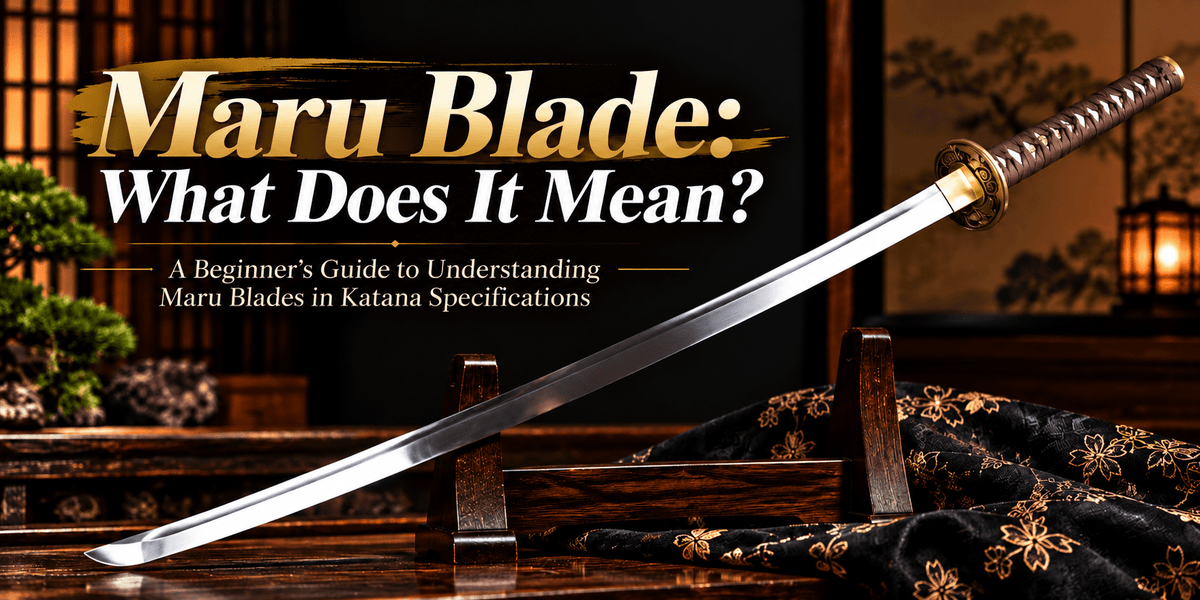
Maru Blade: What Does It Mean?
If you are shopping for your first katana, product specifications can become confusing surprisingly quickly.
One listing may say Maru Blade. Another may mention Shinogi-zukuri. A third may highlight differential hardening.
At first glance, they can all sound like different ways of describing the same thing.
They are not.
The easiest way to make sense of a Maru blade is to separate three different questions:
How is the blade constructed?
What shape does the blade have?
How was the blade heat-treated?
These are three separate parts of a katana specification.
In modern katana listings, Maru blade usually refers to a single-steel-body construction. A more precise construction term is Maru-gitae.
By contrast, terms such as Shinogi-zukuri and Hira-zukuri describe blade geometry. Terms such as differentially hardened or through-hardened describe heat treatment.
Once you separate those categories, the terminology becomes much easier to follow.
What Is a Maru Blade?
In modern sword-shopping language, a Maru blade generally means that the main body of the blade is made from one principal steel material rather than being deliberately assembled from several different steel components.
The more precise construction term is Maru-gitae.
A Maru-gitae blade does not use a separately inserted core in the way a composite construction such as Kobuse does. It also does not deliberately combine multiple steel sections in the way more complex constructions such as Sanmai can.
For a beginner, the simplest definition is:
Maru means single-steel-body construction.
That is useful information, but it only answers one question.
It does not tell you the exact steel grade.
It does not tell you the blade geometry.
It does not tell you the heat-treatment method.
And it does not tell you whether the finished sword is high or low quality.
Maru is one part of the specification, not the whole story.
Why “Maru Blade” and “Maru-gitae” Can Be Confusing
Modern product listings do not always use technical terminology consistently.
You may see terms such as:
-
Maru blade
-
Maru construction
-
Maru-gitae
-
Maru-zukuri
used in very similar ways.
For someone just getting started, that can make a fairly simple idea seem more complicated than it really is.
The safest approach is to focus on what the seller actually means.
When a modern katana listing says "Maru blade," the intended meaning is usually a single-steel-body construction.
The more precise construction term is Maru-gitae.
That distinction matters because terms such as Shinogi-zukuri and Hira-zukuri belong to a different category. They describe the external form of the blade rather than the internal arrangement of the steel.
So when reading a product page, do not assume every technical term is describing the same aspect of the sword.
Maru vs Kobuse vs Sanmai
If you want to compare Maru with other terms, compare it with other construction methods.
That keeps the categories clear.
| Construction | Basic idea |
|---|---|
| Maru-gitae | One principal steel body |
| Kobuse | Different steel sections combined, commonly with a separate core and outer section |
| Sanmai | Multiple deliberately positioned steel sections |
This is a simplified comparison, but it is enough to understand the basic difference.
Maru uses one main steel body.
Kobuse and Sanmai use composite construction.
That does not mean composite construction is automatically better.
It simply means the blade is built differently.
More Complicated Does Not Mean Better
This is one of the most important points to keep in mind.
A blade with more steel sections is not automatically a better blade.
A composite construction may be more complicated to produce, but complexity alone does not prove better heat treatment, better geometry, better workmanship, or better overall performance.
The same applies in the other direction.
A Maru blade is not automatically inferior because its construction is simpler.
A well-executed single-steel-body blade can still have carefully controlled heat treatment, clean geometry, and good finishing.
A useful rule is:
Construction complexity is not a quality score.
That is worth remembering when reading product descriptions.
Technical terms can sound impressive, but a more complicated construction name does not automatically mean a better sword.
Maru Is Not the Same as Shinogi-zukuri
This is probably the most common source of confusion.
Maru describes construction.
Shinogi-zukuri describes geometry.
Both descriptions can apply to the same blade at the same time.
For example, a blade can have:
Maru-gitae construction + Shinogi-zukuri geometry
without any contradiction.
Shinogi-zukuri refers to a blade form with a visible longitudinal ridge known as the shinogi. That ridge separates different surfaces of the blade and is often easy to recognise in clear photographs.
So if a product page lists both Maru and Shinogi-zukuri, it is not repeating itself.
One term tells you how the steel body is constructed.
The other tells you what the blade looks like externally.
Maru Is Not the Same as Hira-zukuri
The same logic applies to Hira-zukuri.
Hira-zukuri describes blade geometry without the prominent shinogi ridge associated with Shinogi-zukuri.
It is still an external-shape term.
Maru is still a construction term.
So a blade could also be described as:
Maru-gitae construction + Hira-zukuri geometry
Again, these terms are not competing blade types.
They answer different questions.
Construction, Geometry, and Heat Treatment Are Three Different Things
A simple framework makes katana specifications much easier to read.
Construction
Ask:
How is the steel body arranged?
Examples include:
-
Maru-gitae
-
Kobuse
-
Sanmai
These describe construction.
Geometry
Ask:
What shape does the blade have?
Examples include:
-
Shinogi-zukuri
-
Hira-zukuri
These describe the visible form of the blade.
Heat Treatment
Ask:
How was the blade hardened?
Examples include:
-
differentially hardened
-
through-hardened
These describe heat treatment.
If you remember only one idea from this article, make it this:
Construction, geometry, and heat treatment are separate specifications.
Once you stop mixing them together, product descriptions become much easier to understand.
What Maru Does Not Tell You
The word Maru gives you useful information, but it leaves plenty of questions unanswered.
It Does Not Tell You the Steel Grade
A Maru blade can be made from different modern steels.
The construction label alone does not tell you whether the blade uses 1060, 1095, T10, spring steel, or another material.
So if two blades are both described as Maru, do not assume they are made from the same steel.
It Does Not Tell You the Heat Treatment
A Maru blade can be differentially hardened.
Another Maru blade can be through-hardened.
Maru describes construction, not the hardening method.
It Does Not Tell You the Blade Geometry
A Maru blade may use Shinogi-zukuri geometry.
Another may use Hira-zukuri.
Again, those are separate categories.
It Does Not Tell You the Hamon
A Maru blade may show a visible hamon if it has been differentially hardened and appropriately finished.
Another Maru blade may not.
The word Maru alone does not answer that question.
It Does Not Automatically Tell You Whether the Steel Was Folded
Single-steel-body construction does not automatically mean “unfolded.”
The construction term tells you how the main steel body is arranged.
It does not necessarily describe every forging step used to prepare that steel.
This is why sword specifications are best read as a group rather than one technical word at a time.
Maru Does Not Automatically Mean Through-Hardened
This misunderstanding is especially common in modern product listings.
Some beginners see:
Maru = one steel
and immediately assume:
Maru = through-hardened.
That conclusion does not follow.
The steel arrangement and the heat-treatment method are separate.
A Maru blade can still be differentially hardened.
So a product description could correctly include:
Construction: Maru
Heat Treatment: Differentially Hardened
There is no conflict between those two lines.
They describe different features.
A useful way to remember this is:
Maru tells you how the steel body is arranged. Heat treatment tells you how that steel was hardened.
Can You Identify a Maru Blade From a Photo?
Usually, not reliably.
This is where construction and geometry behave very differently.
You can often see geometry in a good photograph.
For example, the shinogi ridge of a Shinogi-zukuri blade may be clearly visible under angled lighting.
You may also be able to see:
-
blade curvature
-
bo-hi
-
hamon
-
kissaki shape
-
polish
-
surface geometry
But Maru-gitae describes the internal construction of the blade body.
That is generally not something you can confirm just by looking at the polished exterior.
So a useful rule is:
Photos can show geometry. Specifications are what you need to confirm construction.
Trying to identify Maru, Kobuse, or Sanmai purely from reflections on a polished blade is not a reliable approach.
How to Read a Maru Blade Product Listing
If you are comparing katana online in Sydney, Melbourne, or elsewhere in Australia, do not stop when you see the word Maru.
Treat it as the first piece of information, not the final answer.
A simple reading order works well.
1. Construction
Look for:
Maru, Kobuse, Sanmai, or another construction term.
If the listing says Maru, you now know the blade is being described as a single-steel-body construction.
2. Steel
Look for the actual steel specification.
This may include a named carbon steel, tool steel, spring steel, or another material.
Do not guess the steel from the word Maru.
3. Heat Treatment
Check whether the blade is:
-
differentially hardened
-
through-hardened
This is a separate specification.
4. Geometry
Look for blade-shape terms such as:
-
Shinogi-zukuri
-
Hira-zukuri
Then compare those claims with the photographs.
5. Visible Details
Finally, use the images to study features you can actually see:
-
hamon
-
groove
-
kissaki
-
shinogi
-
polish
-
overall blade shape
This order prevents a lot of unnecessary confusion.
Common Beginner Mistakes
Several misunderstandings come up again and again.
Treating Maru as a Blade Shape
Maru mainly describes construction in modern sword specifications.
It does not replace Shinogi-zukuri or Hira-zukuri.
Assuming Maru Means Through-Hardened
It does not.
Heat treatment is a separate specification.
Assuming Maru Means Cheap
Simpler construction does not mean inferior construction.
A blade still needs to be judged by its complete specification and the quality of execution.
Assuming Maru Means No Forging
The construction term alone does not tell you every step used to prepare the steel.
Trying to Identify Maru From the Polished Surface
External photographs can reveal geometry.
They usually cannot confirm hidden internal steel construction.
Those five points clear up most of the confusion beginners run into.
Is Maru a Good Choice for a First Katana?
The word Maru by itself is not enough to answer that question.
A Maru blade can be a perfectly reasonable choice for a beginner, but the decision should depend on the complete sword rather than one construction label.
Look at:
-
steel type
-
heat treatment
-
blade geometry
-
dimensions
-
overall workmanship
-
product photographs
-
intended use
Two swords can both be described as Maru while still being very different products.
That is why the construction term should always be read in context.
Maru at a Glance
| Question | What Maru Tells You |
|---|---|
| Internal construction | One principal steel body |
| External blade shape | Not specified |
| Steel grade | Not specified |
| Heat treatment | Not specified |
| Hamon pattern | Not specified |
| Folding method | Not automatically specified |
| Overall quality | Cannot be judged from Maru alone |
This table captures the main idea.
Maru gives you one useful piece of information.
It does not answer every question about the blade.
Final Thoughts
The term Maru blade sounds technical, but the underlying idea is straightforward.
In modern katana specifications, it generally refers to a single-steel-body construction, more precisely described as Maru-gitae.
That is different from blade geometry.
It is also different from heat treatment.
A Maru blade can still use Shinogi-zukuri geometry.
It can still be differentially hardened.
It can still show a hamon.
And it can still be made from different steel grades.
So when you read a katana product page, do not treat every technical term as though it belongs to the same category.
Separate the questions:
How is the blade constructed?
What shape does it have?
How was it heat-treated?
Once you do that, Maru stops sounding like a complete blade type and becomes what it really is:
one part of the blade specification.