Long Wakizashi vs. Katana: Practical Differences in Design, Function, and Modern Use
When people hear “Japanese sword,” the image that often comes to mind is the katana—long, curved, and instantly recognizable. But if you’re shopping, collecting, or training, you’ll quickly discover there’s more nuance than a single famous silhouette. One of the most common points of confusion is the difference between a katana and a long wakizashi (sometimes called an ō-wakizashi).
They can look similar at first glance: both are single-edged blades with comparable fittings and a shared visual language. Yet they feel different in the hand, behave differently in movement, and serve different practical needs—both historically and today.
This guide focuses on function and modern use while providing enough historical context to make the differences clear—without drifting into sensitive narratives. By the end, you’ll know exactly what separates a long wakizashi from a katana, and how to choose the right one for your goals.
1) Quick Definitions: What Are We Comparing?
Katana (Long Sword Category)
A katana is typically classified as a long sword. In practical terms, it features:
-
A longer blade (commonly in the “long sword” range)
-
A two-handed handle (tsuka) designed for controlled, powerful cuts
-
A build optimized for reach + leverage + stability in full-body cutting mechanics
Wakizashi (Short Sword Category)
A wakizashi is generally classified as a short sword. It is:
-
Shorter than a katana
-
Often easier to maneuver in tight spaces
-
Traditionally paired with a longer sword in a two-sword setup
Long Wakizashi (Ō-wakizashi)
A long wakizashi sits at the upper end of wakizashi length. It is not “just a katana with a different name”—it is a short sword that approaches long-sword length, and that “in-between” size creates a unique handling profile:
-
More reach than a typical wakizashi
-
More compact than a typical katana
-
Often a strong choice for certain modern training and display needs
2) The Core Differences (In Plain Terms)
If you only remember one thing, remember this:
Katana = longer reach + two-handed power and stability
Long wakizashi = compact agility + close-range control, with extra reach compared to a standard wakizashi
Here are the differences that matter most in real use.
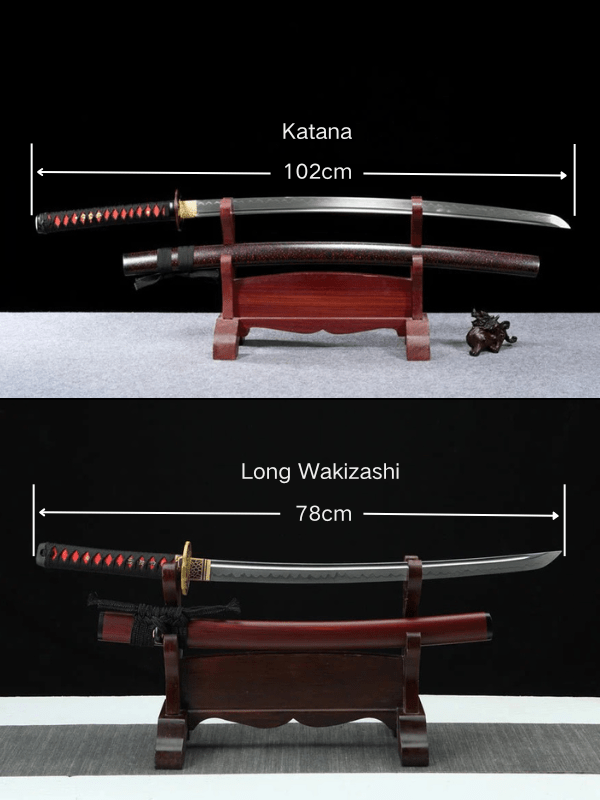
A) Blade Length and Cutting Arc
-
Katana: Longer blade means a larger cutting arc, more reach, and more “follow-through” potential in diagonal cuts.
-
Long wakizashi: Slightly shorter blade reduces arc size and makes transitions faster—especially in tight movement patterns.
A longer blade can be an advantage, but it also demands more space and cleaner technique. A slightly shorter blade can feel quicker and more forgiving in confined practice areas.
B) Handle Length and Leverage
-
Katana: Usually a longer handle intended for two-handed leverage. This supports stable edge alignment and powerful cuts.
-
Long wakizashi: Often has a shorter handle. Some long wakizashi are still comfortable with two hands, but the leverage and spacing typically differ from a katana.
This affects how the sword “loads” during cutting: katana handling often feels more anchored and stable, while long wakizashi can feel more nimble and responsive.
C) Weight and Balance
Even when steel and fittings are similar, the overall balance changes with length.
-
Katana: Tends to feel more “committed” in the cut—excellent for decisive, full-body swings.
-
Long wakizashi: Often feels lighter and faster in changes of direction and recovery.
D) Where They Excel
-
Katana: Open-space movement, longer-distance exchanges, powerful cutting practice, classic two-handed mechanics.
-
Long wakizashi: Tight-space handling, quick engagement, compact display, and training where speed and control matter more than maximum reach.
3) Functional Context Through Time (Neutral, Practical History)
Sword designs evolve when real-world needs evolve. Over long periods, changes in armor, personal equipment, and fighting environments influenced what people carried and how they used it.
-
A longer sword generally supports stronger cutting lines and better reach in open engagements.
-
A shorter sword becomes more convenient for daily carry, close-range movement, and situations where space is limited.
The wakizashi category, including longer examples, fits into a practical pattern seen in many weapon traditions: a secondary blade that remains useful when a longer weapon is inconvenient. The long wakizashi version simply shifts the balance closer to “primary weapon capability” while still staying more compact than a full-length katana.
For modern readers, the key takeaway is simple:
katana and wakizashi are not “better vs worse”—they’re different solutions to different constraints.
4) Handling and Technique: What You’ll Feel in the Hand
Even without advanced training, most people can feel the difference quickly.
Katana: The “Stable Power Tool”
A katana rewards:
-
Good posture and hip-driven mechanics
-
Clean edge alignment through the cut
-
Two-handed control in transitions
It often feels best when you let it do what it’s built for: long, confident lines and decisive movement.
Long Wakizashi: The “Compact Control Tool”
A long wakizashi rewards:
-
Quick control in close range
-
Faster recovery after swings
-
Smaller, tighter movement patterns
It often feels more manageable for people who:
-
Train indoors with limited space
-
Prefer a lighter feel
-
Want a blade that’s easier to store and display
5) Modern Use Cases: Who Should Consider Which?
Today, most owners fall into three broad groups: martial arts practice, collecting/display, and enthusiast ownership. Here’s how the choice usually plays out.
A) Martial Arts Practice (Training-Oriented)
Choose a katana if you want:
-
The classic two-handed training experience
-
Longer reach and a fuller cutting arc
-
A sword that highlights full-body mechanics
Choose a long wakizashi if you want:
-
More control in tight spaces
-
A faster-feeling blade for technique refinement
-
A practical “bridge” size—less intimidating than a full katana, but more substantial than a short wakizashi
Many practitioners use a shorter blade to build fundamentals such as grip pressure, edge alignment, and safe drawing mechanics before moving up to longer lengths.
B) Collecting and Display
Katana display strengths:
-
Strong visual presence on a stand or wall mount
-
Iconic profile and proportions
Long wakizashi display strengths:
-
Easier to fit in smaller spaces
-
Looks great as a “paired” display next to a katana
-
Offers variety in a collection without feeling “too small”
If your goal is a balanced display setup, a katana plus a wakizashi-length blade often creates a visually complete presentation.
C) Practical Enthusiast Ownership (No Formal Training Yet)
If you’re buying mainly for appreciation and occasional handling:
-
A katana gives you the classic experience and presence.
-
A long wakizashi can be more approachable, easier to manage, and less demanding in storage and movement.
6) Which One Cuts Better?
This is a common question, but the honest answer is:
Cutting performance depends more on geometry, heat treatment, and technique than on the name.
That said:
-
A katana’s length and two-handed leverage can make it easier to generate power.
-
A long wakizashi can be easier to control and align—especially for beginners—because the blade is slightly shorter and often lighter.
If your priority is clean cuts in controlled practice, “easy to align” can matter just as much as “more reach.”
7) How to Choose: A Simple Decision Checklist
Pick a Katana if…
-
You want the classic long-sword feel
-
You have enough space to practice safely
-
You prefer two-handed leverage and longer cutting lines
-
Your display area can accommodate a longer sword
Pick a Long Wakizashi if…
-
You have limited indoor space
-
You want a faster, more compact sword
-
You’re building fundamentals and want something manageable
-
You’re creating a paired display and want a strong companion piece
If you’re unsure, a long wakizashi is often the “safe” choice for first-time owners who want something practical and easy to handle—without going too short.
8) Safety and Responsible Ownership (Neutral, Universal)
Regardless of sword type:
-
Follow local laws and regulations regarding ownership, transport, and use.
-
Store securely, especially around children and visitors.
-
For training, consider non-sharp practice options unless you have proper instruction and safety setup.
A well-made sword is both beautiful and serious equipment—treat it accordingly.
9) FAQ: Quick Answers
Is a long wakizashi basically a short katana?
Not exactly. It may overlap in length with shorter long swords, but the category reflects design intention and handling feel. The difference often shows up in handle proportions and how the sword is meant to be used.
Can you train with a long wakizashi?
Yes. Many people find it excellent for technique refinement, indoor practice, and control-focused drills.
Do I need both?
You don’t need both, but many collectors enjoy having a complementary pair: one longer, one shorter. It creates variety in handling and display.
Final Takeaway
A katana is the choice when you want classic long-sword reach, stable two-handed leverage, and strong cutting lines.
A long wakizashi is the choice when you want a compact, agile blade that still feels substantial—often easier to handle, easier to store, and highly versatile for modern training and display.
If you choose based on space, handling preference, and your purpose (training vs display vs collecting), you’ll end up with a sword that fits your life—not just a famous name.