
Open vs. Closed Habaki: How That Small Brass Collar Changes Fit, Feel, and Long-Term Stability
If you’re into katana-style swords—whether you train with them, collect them, or simply enjoy learning how they’re built—you’ve probably noticed the small brass (or copper) collar sitting right in front of the guard. In many communities it’s casually called a “habaki,” and that’s the most common term in English as well.
It’s a small component, but it has a big job. A well-fitted habaki makes a sword feel quiet, solid, and “locked in.” A poorly fitted one can make the entire mount feel loose and distracting—even when the blade itself is excellent.
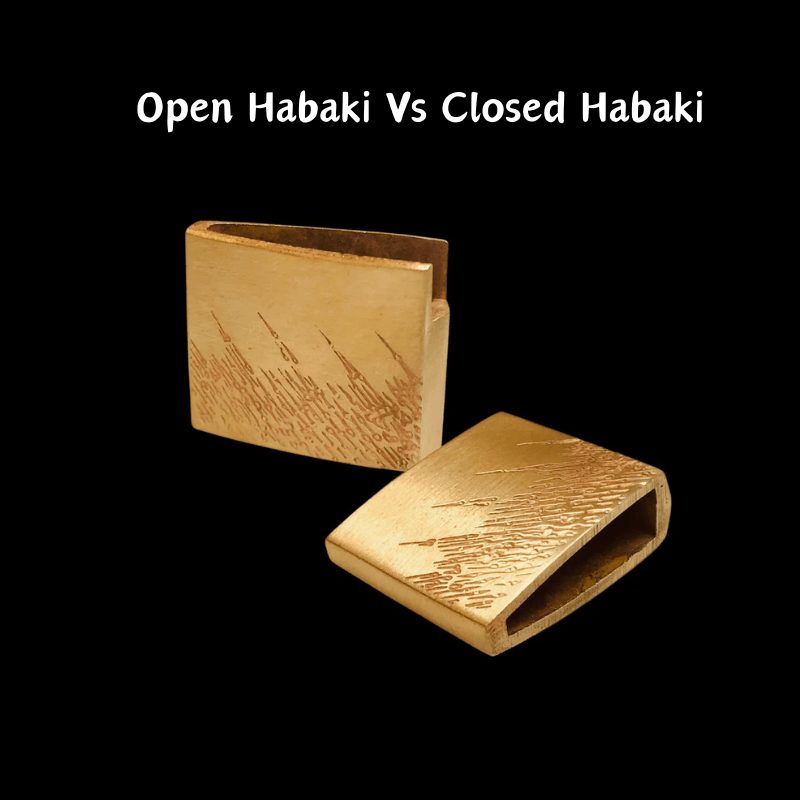
You may also hear people compare “open” vs. “closed” habaki styles. The exact labels can vary by maker, but the idea is consistent: some habaki designs look more “open” around the mouth/seam area, while others look more “closed” and fully wrapped. This isn’t just cosmetic. It can affect:
-
how securely the sword seats at the scabbard mouth (koiguchi)
-
how tight and stable the guard and spacer stack feels
-
how the mount tolerates wear over time
-
how easy it is to inspect and fine-tune the fit
This article breaks the difference down in plain, practical language—focused on function and training, with a few collector-friendly notes for display and long-term care.
1) What the Habaki Actually Does (In Plain Terms)
Before we talk “open” vs. “closed,” it helps to understand what the habaki is responsible for.
The habaki is the metal collar fitted around the base of the blade, directly in front of the guard (tsuba). Its main roles are:
A) It’s the part that “locks” the sword into the scabbard
On most katana-style mounts, retention is primarily created by the habaki seating firmly into the scabbard mouth (koiguchi). A good fit gives you:
-
a smooth draw
-
a clean, confident stop when sheathing
-
minimal rattle when the sword is carried
B) It stabilizes the whole mounting stack
The habaki works together with the guard (tsuba) and spacers (seppa). When everything is fitted correctly, the entire assembly compresses into a stable unit—no clicking, no shifting, no “loose hardware” feeling.
C) It protects contact surfaces
The habaki also acts as a wear interface. Instead of the blade shoulders taking repeated contact and pressure from the mount, the habaki absorbs and distributes that load.
Bottom line: the habaki is a precision fit part. Small differences in design and tolerance can create big differences in feel.
2) What “Open” vs. “Closed” Habaki Usually Means
There isn’t a single universal definition across all sellers, so it’s best to think of “open” and “closed” as describing how the habaki’s mouth/seam area is constructed and presented.
Open-style habaki (more “open” seam/mouth presentation)
Often described by one or more of these traits:
-
a more visible seam line or “mouth” area
-
a front profile that looks less fully enclosed
-
edges or folds that are more exposed and easier to see
Open-style habaki often looks lighter and more “technical,” and it can make visual inspection easier.
Closed-style habaki (more enclosed, fully wrapped profile)
Often described by one or more of these traits:
-
a more continuous, enclosed front profile
-
seam/join lines that are less visually open
-
a shape that looks more fully sleeved around the blade base
Closed-style habaki often looks cleaner and more unified, and many people associate it with a more “solid” build.
Important reminder: we’re talking about the habaki at the base of the blade, not the blade tip.
3) What Changes in Real Use (Fit, Retention, and “Quietness”)
3.1 Seating and retention: the “click-in” feel at the scabbard mouth
A good habaki fit creates a predictable, repeatable seat at the koiguchi.
In many builds, a closed-style habaki tends to feel a bit more consistent because the contact surfaces often read as more continuous and uniform. The seating experience is frequently described as:
-
smooth entry
-
firm final stop
-
stable retention over time
An open-style habaki can seat just as well—but in some setups it can be more sensitive to:
-
minor scabbard mouth irregularities
-
gradual wear at key contact points
-
slight angle differences during sheathing
That doesn’t make open-style “worse.” It simply means the “perfect fit window” can be narrower depending on how it’s made.
Training takeaway: if you practice frequent draw and re-sheath cycles, you’ll notice habaki fit immediately. Consistency reduces distraction and helps you focus on movement instead of hardware.
3.2 Mount stability: guard tightness and rattle control
If a sword ever develops guard movement, the habaki is one of the first components to check.
A properly fitted habaki helps:
-
prevent micro-movement at the guard stack
-
reduce clicking sounds
-
keep spacer compression consistent
In some mounts, closed-style habaki can feel slightly more tolerant of long-term tolerance drift simply because the structure appears more contained and the pressure distribution can feel more even.
Open-style habaki can be extremely stable as well—especially when the fitting work is precise—but if the design relies on very specific contact points, you may notice looseness sooner if the scabbard mouth wears unevenly.
3.3 Wear behavior: what happens after months of handling
Wear happens mainly where:
-
the habaki contacts the koiguchi, and
-
the habaki compresses the guard/spacer stack.
In general, closed-style habaki often stays “stable-feeling” longer as the mount wears in. Open-style habaki may show edge rounding or contact marks sooner if certain surfaces are more exposed.
That said, craftsmanship and fit matter more than the label. A well-fitted open-style habaki will outperform a poorly fitted closed-style habaki every time.
3.4 The most noticeable difference: how “quiet” the sword feels
This is the part many people don’t expect.
A sword that:
-
seats cleanly,
-
doesn’t rattle,
-
doesn’t shift at the guard,
…feels more trustworthy. That trust reduces tension, and less tension usually improves technique.
Many practitioners find that once their mount feels “quiet,” their movement gets smoother—because they stop subconsciously bracing for looseness.
4) Pros and Cons (Training-Focused)
Open-style habaki: pros
-
Easy visual inspection: seams and transitions are clearer.
-
A crisp, technical look: many enthusiasts prefer the sharper presentation.
-
Potentially easier to diagnose fit issues: you can often see where contact is happening.
Open-style habaki: cons
-
Can feel more sensitive to small tolerance changes as wear develops.
-
Wear marks may appear sooner on exposed edges.
-
Less forgiving if the fitting work is average: small issues become obvious quickly.
Closed-style habaki: pros
-
Stable, predictable seating feel in many builds.
-
Often feels solid and unified in the guard stack.
-
Can tolerate gradual wear well, maintaining a consistent “lock-in” sensation longer.
Closed-style habaki: cons
-
Less immediate visual feedback: early wear patterns can be harder to spot.
-
May hide minor fit issues until you feel them.
-
Less “crisp” visually for those who like visible seam detail.
5) Collector and Display Notes (Practical, Not Overly Technical)
From a display perspective, habaki style changes the character of the whole mount.
-
Open-style often reads as sharper and more engineered, especially in close-up photos.
-
Closed-style often reads as cleaner and more unified, giving a premium “finished” look.
For collectors, the biggest takeaway is simple:
a clean, well-fitted habaki is a strong indicator of overall build quality.
6) How to Choose the Right Style for Your Goals
Choose an open-style habaki if you:
-
like crisp seam detail and a technical look
-
want easier visual inspection
-
don’t mind a fit that may feel more “tuned” and sensitive
-
enjoy the idea of dialing in retention over time
Choose a closed-style habaki if you:
-
want maximum stability and a “quiet” mount
-
practice frequent draw/re-sheath cycles
-
care about long-term tolerance to wear
-
prefer a unified, fully wrapped appearance
If you’re unsure: fit beats style
A perfectly fitted open-style habaki will outperform a sloppy closed-style habaki every day of the week.
7) Simple At-Home Checks (Quick and Useful)
A) Draw and seat test
Sheath the sword slowly and pay attention to the final seat.
Good signs:
-
smooth entry
-
a clear final stop
-
minimal rattle when the sword is sheathed
B) Guard stack test
With the sword assembled, gently test whether the guard shifts or clicks.
Good signs:
-
the guard feels like part of the sword, not an attachment
C) Scabbard mouth wear check
Look for uneven rub marks at the koiguchi. Uneven wear can indicate uneven contact pressure or alignment issues.
8) Easy Maintenance Tips
-
Keep the habaki clean and dry.
-
Avoid constant sweaty handling (brass and copper show fingerprints quickly).
-
If retention suddenly changes, check for debris or wear at the koiguchi.
-
Don’t force the sword into the scabbard if it suddenly feels “wrong.”
Good habits prevent small fit issues from becoming big ones.
Final Thoughts: “Open vs. Closed” Matters—But Fit Matters Most
Open-style and closed-style habaki designs can both work extremely well. In practice, the difference often shows up as:
-
Open-style: crisp detail, easier inspection, sometimes more sensitivity to tiny tolerance changes
-
Closed-style: stable feel, unified mount, often more forgiving over time
But the rule that matters most is simple:
The best habaki is the one that fits correctly.