
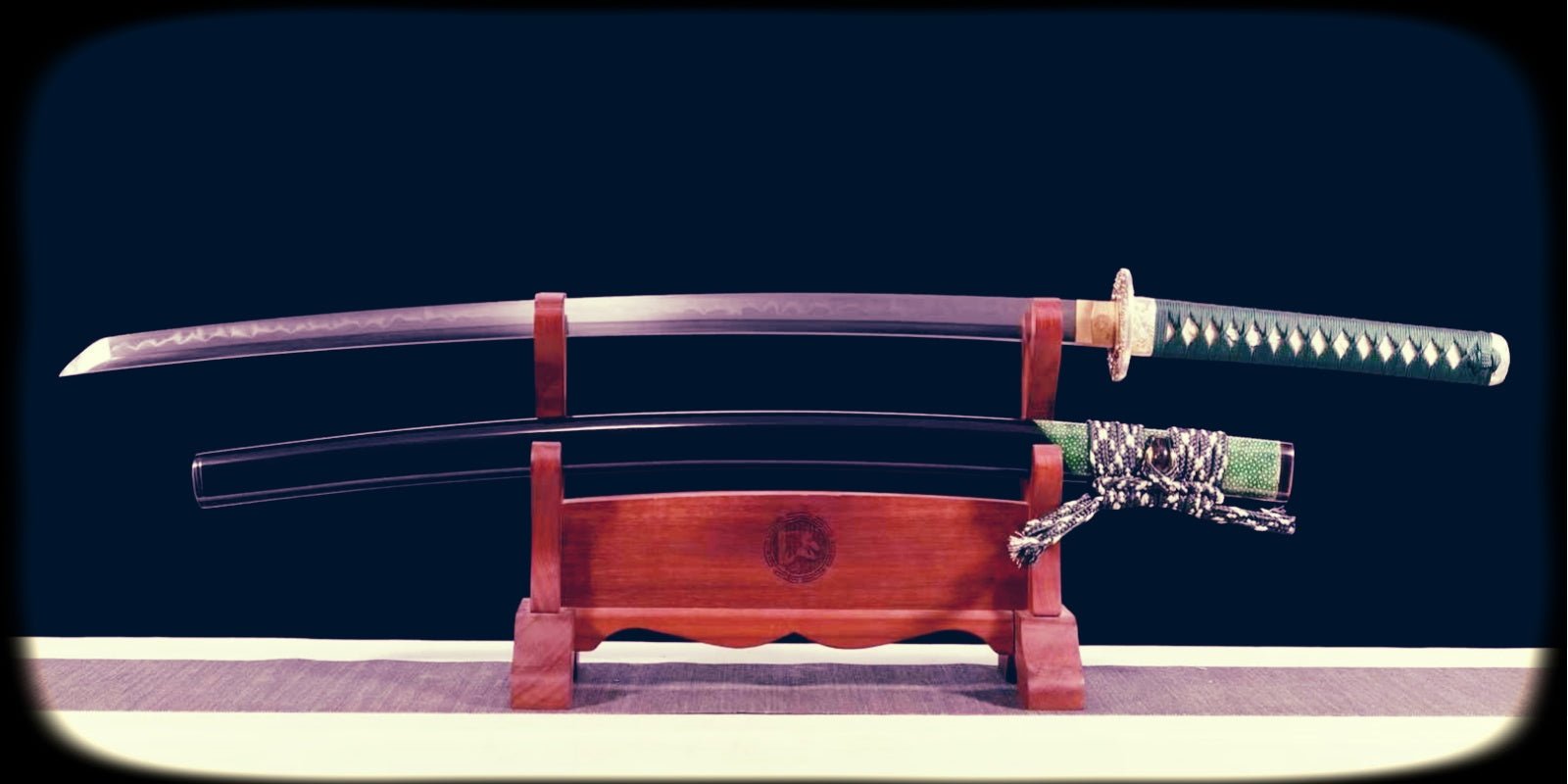
Unveiling the Hamon: How Heat Treatment Shapes the Katana’s Signature Edge
That faint, shimmering line running along the katana’s edge—the hamon—is more than just decoration. It is a visible record of heat, steel, and craftsmanship, embodying both the functionality and artistry that make this sword so admired.
The Science Behind the Hamon
The hamon is created through differential heat treatment, a process designed to give the blade both strength and resilience. The entire blade is heated and quenched, but the cooling rate differs between the edge and the spine.
To achieve this, swordsmiths apply a special clay mixture before quenching. The edge receives only a thin coat, while the spine is covered more thickly. When the blade is plunged into water, the edge cools almost instantly, transforming into hard martensite. The spine, shielded by the thicker clay, cools more slowly and remains softer, retaining pearlitic steel.
The boundary between these two zones is what we see as the hamon. Functionally, it provides the best of both worlds: a razor-sharp edge that holds its bite, and a flexible spine that can absorb shock without breaking.
Clay Tempering: An Art as Much as a Science
The hamon’s beauty begins with the careful application of clay. Swordsmiths may add charcoal ash, stone powder, or other materials to control insulation. The clay is applied in deliberate patterns—thin near the edge, thick along the spine, and shaped according to the smith’s design.
After heating and quenching, the hamon is not immediately visible. It is revealed through skilled polishing, which highlights the subtle transition in the steel’s microstructure. Under light, it shimmers like mist drifting along the blade.
Even today, when modern technology could simplify the process, many artisans remain devoted to clay tempering. The technique ensures the blade achieves both performance and personality, with every hamon a unique creation.
Patterns in Steel: Variations of the Hamon
The hamon comes in many forms, each determined by how the clay is applied.
-
Straight hamon (sugaha): a clean, unbroken line that conveys simplicity and precision.
-
Irregular hamon (midare): flowing waves, jagged peaks, or sawtooth edges, often bold and dramatic.
-
Choji (clove bud) hamon: rounded, flower-like clusters, reminiscent of blossoms along the edge.
-
Gunome (zigzag) hamon: alternating semicircles, like a row of teeth or rippling waves.
No two hamons are alike. Even within the same pattern type, slight variations in clay thickness, placement, and cooling will produce subtle differences. Each is a signature of the smith’s hand and vision.
More Than Just Looks: Function Meets Beauty
The hamon is both practical and poetic.
-
Performance marker: It shows where the blade transitions from hard to soft steel—a genuine indicator of proper heat treatment. A true hamon guarantees a sharp edge with a supportive spine.
-
Artistic expression: The line itself is captivating, shimmering under the light like silver smoke. Collectors and enthusiasts value each hamon as a one-of-a-kind expression of craftsmanship.
Whereas artificial, acid-etched “hamons” may mimic the look, they lack the depth, complexity, and meaning of a genuine one.
Tradition and Modernity
In mass production, many blades are heat-treated uniformly. These blades can be durable, but they lack a natural hamon. To compensate, manufacturers sometimes add etched or polished “decorative hamons.” They may look convincing from afar, but they do not carry the structural authenticity of the real thing.
By contrast, blades made with traditional clay tempering combine function and beauty. The hamon is not just for show—it is the visible result of careful control over steel, heat, and timing.
Conclusion
The hamon is far more than a surface pattern. It is the steel itself, transformed by fire and revealed through patience and skill. Every hamon tells a story of balance—between hardness and flexibility, between utility and beauty.
Whether you admire it as a marvel of metallurgy or as a work of living art, the hamon remains one of the katana’s most enduring symbols. It is proof of what human hands and fire can achieve together: a blade that is as expressive as it is effective.