
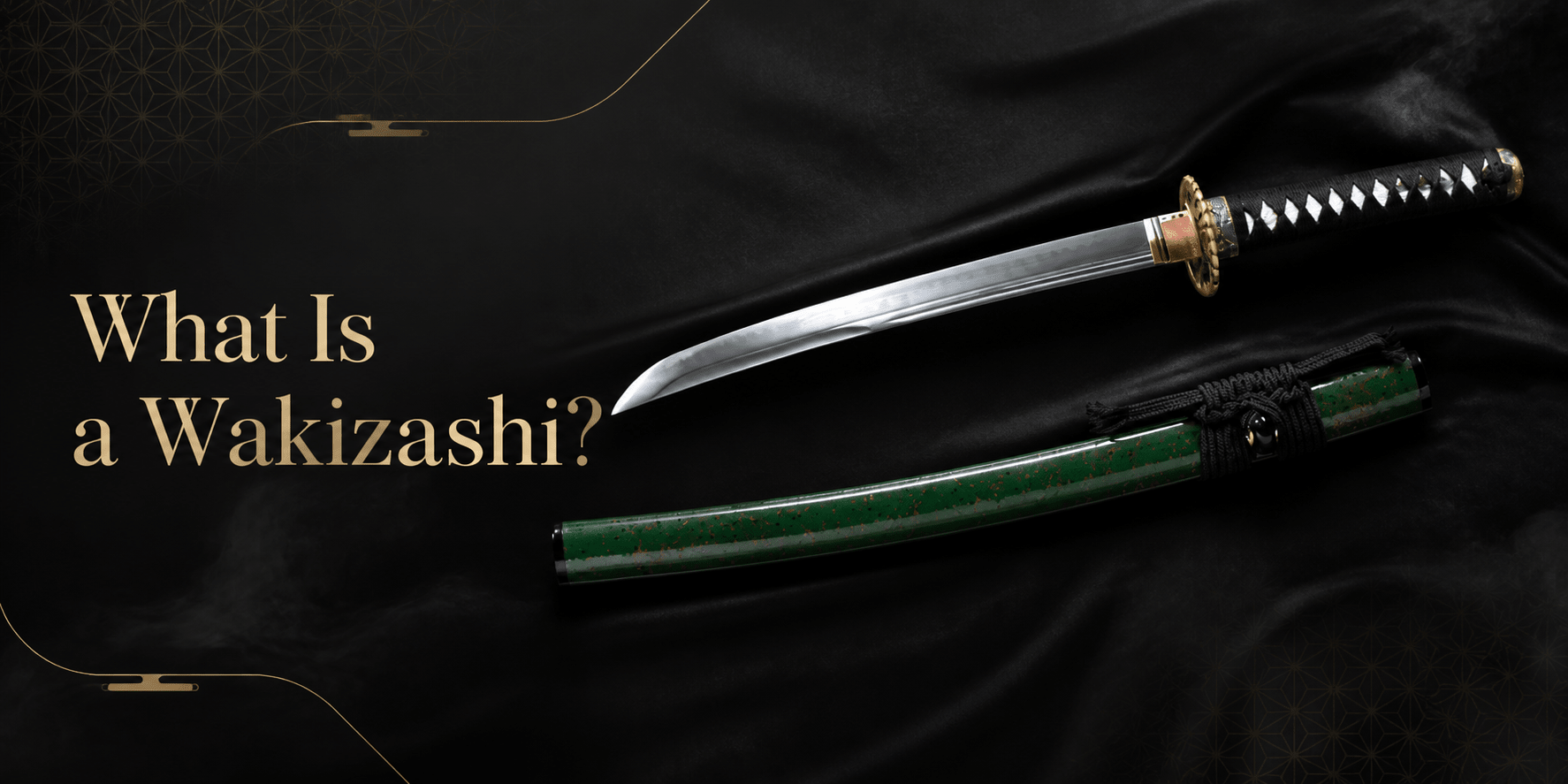
What Is a Wakizashi?
For someone new to Japanese swords, the categories can look pretty straightforward at first: the katana is long, the tanto is short, and the wakizashi seems to sit somewhere in the middle.
That is true in terms of length, but it does not tell the whole story.
A wakizashi is not simply a scaled-down katana. It is a distinct sword category with its own typical dimensions, proportions, mountings, and historical examples. Some wakizashi are only slightly longer than a tanto, while others come surprisingly close to the length of a katana.
Traditionally, a wakizashi has a blade measuring one shaku or more but less than two shaku, or roughly 30 to 60 cm. Within that range, there can be a great deal of variation in blade shape, curvature, fittings, hamon, and overall construction.
For beginners, that variety can make the category seem confusing. The easiest way to understand it is to start with length, then look at shape, mountings, and the history of the individual blade.
This guide walks through the basics in a clear, practical way.
What Defines a Wakizashi?
The simplest place to start is blade length.
Traditional Japanese sword measurements use the shaku, with one shaku measuring approximately 30.3 cm. A wakizashi generally falls between:
-
1 shaku or more: about 30 cm
-
Less than 2 shaku: about 60 cm
That places it between the tanto and the katana.
A basic comparison looks like this:
| Sword Type | Typical Blade-Length Category |
|---|---|
| Tanto | Under about 30 cm |
| Wakizashi | About 30–60 cm |
| Katana | Generally 60 cm and above |
For a beginner, this is the most useful rule of thumb.
That said, historical swords do not always fit neatly into modern-looking boxes. Some blades sit very close to a category boundary, while others were shortened, reshaped, or remounted at different points in their history.
So, while blade length is the best starting point, it is not always the end of the story.
Why Is It Called a Wakizashi?
There are several explanations for the origin of the word wakizashi, so it is best not to treat any one theory as completely certain.
A commonly cited explanation connects the name with the sword being worn at the side of the body.
For most beginners, though, the exact origin of the word is less important than what the term came to describe: a recognised category of Japanese sword that sits between the tanto and katana in blade length.
This also leads naturally to another term you will often see: daisho.
Wakizashi and Daisho
A wakizashi was commonly paired with a longer katana. Together, the long and short swords are known as a daisho, meaning a large-and-small sword pairing.
From a design point of view, this is especially interesting because the two swords could be made to look like a coordinated set.
Their koshirae, or external mountings, might share similar:
-
saya designs
-
tsuka styling
-
fittings
-
colours
-
decorative themes
This does not mean that every surviving katana and wakizashi pair was perfectly matched. Earlier combinations could vary, and individual swords could also be remounted over time.
The important takeaway is simple: a wakizashi was not necessarily treated as an afterthought or a lesser companion piece. Its fittings and presentation could receive just as much attention as those of a longer sword.
Wakizashi vs Katana
The most obvious difference between a wakizashi and a katana is length.
A wakizashi generally has a blade under about 60 cm, while a katana usually begins around or above that point.
That difference affects the overall proportions of the sword.
A shorter blade generally means:
-
less reach
-
a more compact overall length
-
different blade-to-handle proportions
-
potentially different balance
It is important not to overstate what that means.
You will sometimes see shorter swords casually described as automatically “faster” or “better in tight spaces.” That is a bit too simple.
Handling depends on many factors, including:
-
blade width
-
thickness
-
curvature
-
taper
-
overall weight
-
handle length
-
fittings
-
balance
Two wakizashi of the same blade length can feel very different in the hand if their geometry and weight distribution are different.
So the safest conclusion is this: a wakizashi is more compact than a typical katana, but its actual handling characteristics depend on the entire sword, not just one measurement.
Wakizashi vs Tanto
The difference between a wakizashi and a tanto can be a little trickier because the two can sit fairly close together in size.
Again, blade length is the easiest guide.
A tanto normally has a blade shorter than one shaku, while a wakizashi begins at around one shaku.
You may also notice differences in mountings.
Wakizashi commonly have a tsuba, or guard, while many tanto do not. However, this is not a hard-and-fast rule. Historical mountings vary, and some swords were remounted later.
So if you are trying to identify a blade category, start with length rather than relying on the tsuba alone.
Three Main Wakizashi Size Groups
Wakizashi can also be divided into three useful size groups:
-
O-wakizashi
-
Chu-wakizashi
-
Ko-wakizashi
These categories make it much easier to understand how broad the wakizashi range really is.
O-Wakizashi: The Large Wakizashi
An o-wakizashi, or large wakizashi, generally measures:
1 shaku 8 sun or more, but under 2 shaku
That works out to roughly:
54.5 cm to under 60.6 cm
At this size, a wakizashi can look surprisingly close to a katana.
This is a good reminder that “wakizashi” does not automatically mean “very short sword.” Some examples sit right near the upper limit of the category.
Historical sources associate several blades in this range with well-known individuals, although ownership and attribution should always be treated cautiously when records are uncertain.
For beginners, the important point is the measurement itself:
A blade can be nearly 60 cm long and still fall within the wakizashi category.
Chu-Wakizashi: The Middle Range
A chu-wakizashi, or medium wakizashi, usually measures:
1 shaku 3 sun or more, but under 1 shaku 8 sun
In modern measurements, that is approximately:
40 to 54.5 cm
This range sits comfortably in the middle of the broader wakizashi category and is useful as a reference point when learning proportions.
One historical example associated with this range is Ishida Sadamune.
The value of such examples is not that they reveal one “perfect” wakizashi length. Rather, they show that recognised wakizashi existed across a fairly wide range of sizes.
Ko-Wakizashi: The Small Wakizashi
A ko-wakizashi, or small wakizashi, measures under approximately:
1 shaku 3 sun, or around 40 cm, while still remaining within the broader wakizashi range.
This is where the line between wakizashi and tanto can start to look a little blurry.
A blade around 38 or 39 cm is much shorter than an o-wakizashi approaching 60 cm, yet both can still belong to the same general category.
A useful historical example is Namazuo Toshiro, with a blade length of approximately 38.6 cm.
It is also a good example of another important concept: some wakizashi were not originally made in the exact form in which they survive today.
Can a Wakizashi Be Made from Another Type of Blade?
Yes.
One term worth learning is naginata-naoshi.
A naginata-naoshi is a blade that originally came from a naginata and was later shortened or reshaped into a form suitable for mounting as another type of sword, including a wakizashi.
This means that the history of an individual blade can be more complicated than its current label suggests.
A sword may be classified as a wakizashi today even if its earlier form was different.
Namazuo Toshiro
Namazuo Toshiro is an example of a naginata-naoshi blade classified as a small wakizashi. Its blade measures about 38.6 cm.
Honebami Toshiro
Another well-known example is Honebami Toshiro, associated with Awataguchi Yoshimitsu.
Its blade is approximately 58.8 cm long, placing it near the upper end of the wakizashi range. It is also a naginata-naoshi blade.
Compare the two:
-
Namazuo Toshiro: about 38.6 cm
-
Honebami Toshiro: about 58.8 cm
That is a difference of roughly 20 cm, yet both can still be discussed as wakizashi.
If that does not show how broad the category can be, nothing will.
What Historical Wakizashi Can Teach Beginners
Historical examples are most useful when they illustrate a specific feature rather than simply becoming a list of famous names.
A few examples make the range of wakizashi much easier to understand.
Nikkari Aoe: Close to the Upper Limit
Nikkari Aoe is associated with the Aoe swordmaking tradition.
Its blade is approximately 60 cm long, placing it very close to the upper end of the wakizashi range.
For a beginner, the lesson is straightforward: not every wakizashi looks especially short.
Some can come remarkably close to katana dimensions.
Honebami Toshiro: A Blade with an Earlier Form
At approximately 58.8 cm, Honebami Toshiro is another relatively large wakizashi.
What makes it particularly useful as an example is its naginata-naoshi form.
It shows that a sword's present-day category does not always tell you the full story of how the blade originally looked.
When studying an older blade, both its current geometry and its history of modification may matter.
Sukehiro Wakizashi: Hamon and Individual Character
A wakizashi by Tsuda Echizen no Kami Sukehiro, dated to 1677, has a blade length of approximately 54.5 cm.
It is known for a toran-midare hamon, a bold temper pattern often compared to rolling or surging waves.
This is a useful example because it shows that wakizashi were not defined simply by being shorter than katana.
They could display highly distinctive forging, polishing, surface, and hamon characteristics.
In other words, shorter does not mean simpler.
Basic Parts of a Wakizashi
A wakizashi shares much of the same basic terminology used for other Japanese swords.
If you are just starting out, these are some of the terms worth knowing.
Ha
The ha is the cutting edge of the blade.
Mune
The mune is the back, or spine, of the blade.
Kissaki
The kissaki is the point section.
Nakago
The nakago is the tang that extends into the handle.
Tsuba
The tsuba is the guard between the blade and handle.
Its size, shape, and decoration can vary considerably.
Tsuka
The tsuka is the handle.
Its dimensions and construction contribute to the overall feel and proportions of the sword.
Saya
The saya is the scabbard.
A well-fitted saya helps protect the blade and keeps the sword securely housed.
Koshirae
Koshirae refers broadly to the external sword mountings.
When looking at a wakizashi, it is worth studying the complete sword rather than focusing only on the blade.
What Should You Look for in a Modern Wakizashi?
Historical definitions explain what a wakizashi is, but modern buyers are usually looking at newly made swords.
That requires a slightly different checklist.
A modern wakizashi should not be judged by one impressive-sounding term in the product description.
You may see terms such as:
-
T10 steel
-
spring steel
-
folded steel
-
differential hardening
-
through hardening
-
clay tempering
-
hamon
-
polished edge
These terms describe different aspects of construction.
For example, T10 refers to a type of steel, while folding refers to a manufacturing process. Clay tempering relates to heat treatment rather than the steel type itself.
They are not interchangeable, and one feature alone does not tell you whether a sword is well made.
A better approach is to look at the complete package.
Blade Geometry
Blade geometry has a major influence on how a wakizashi looks and behaves.
Important features include:
-
thickness
-
width
-
curvature
-
taper
-
edge geometry
-
point shape
Two blades with the same length can have very different proportions.
That is why judging a sword by blade length alone only gets you so far.
Heat Treatment
Heat treatment plays an important role in determining the final properties of the steel.
Modern wakizashi may use different methods, including differential hardening and through hardening.
Neither should automatically be described as universally superior.
The result depends on the steel, temperature control, geometry, manufacturing quality, and intended design.
Likewise, a visible hamon can be attractive, but it should not be treated as proof that the entire sword is high quality.
A good sword is the sum of many parts.
Balance and Assembly
The blade may get most of the attention, but the rest of the sword matters too.
The relationship between the blade, tsuka, tsuba, fittings, and other components affects the overall feel of the finished sword.
Good assembly should feel secure and coherent.
The saya also matters. A suitable fit helps protect the blade and supports proper storage.
Fancy decoration is nice, but good fit and construction come first.
Caring for a Wakizashi
Many modern functional wakizashi are made from carbon steel.
Carbon steel can develop corrosion when exposed to moisture, fingerprints, salts, or poor storage conditions.
The basic maintenance routine is not complicated:
-
Wipe away fingerprints and moisture after handling.
-
Keep the blade clean and dry.
-
Apply a very thin layer of suitable sword oil when needed.
-
Store the sword in a stable, dry environment.
-
Inspect the blade from time to time.
If the storage environment is humid or close to the coast, corrosion prevention deserves extra attention.
For collectors in Australia, especially in coastal areas, the actual conditions inside the room matter more than the city name itself.
A sword stored in a dry, climate-controlled room is in a very different situation from one kept in a damp garage or storage area.
The golden rule is simple: keep moisture under control and check the blade regularly.
Final Thoughts
The wakizashi makes much more sense once you stop thinking of it as nothing more than a “short katana.”
Its basic definition starts with blade length: generally about 30 cm to under 60 cm, placing it between the tanto and katana.
Within that range, however, there is plenty of variation.
Large wakizashi can approach katana dimensions. Small wakizashi can sit close to tanto size. Some historical blades were reshaped from earlier forms through processes such as naginata-naoshi. Others are notable for distinctive hamon, surface characteristics, mountings, and craftsmanship.
For a beginner, the easiest way to study a wakizashi is to keep the order simple:
Start with length. Then look at blade form, construction, mountings, and individual history.
That way, you are not judging the sword by a single feature or getting distracted by marketing terms.
Once those basics click into place, the wakizashi stops looking like the awkward middle child between the tanto and katana and starts to make sense as a distinct and surprisingly varied sword category in its own right.