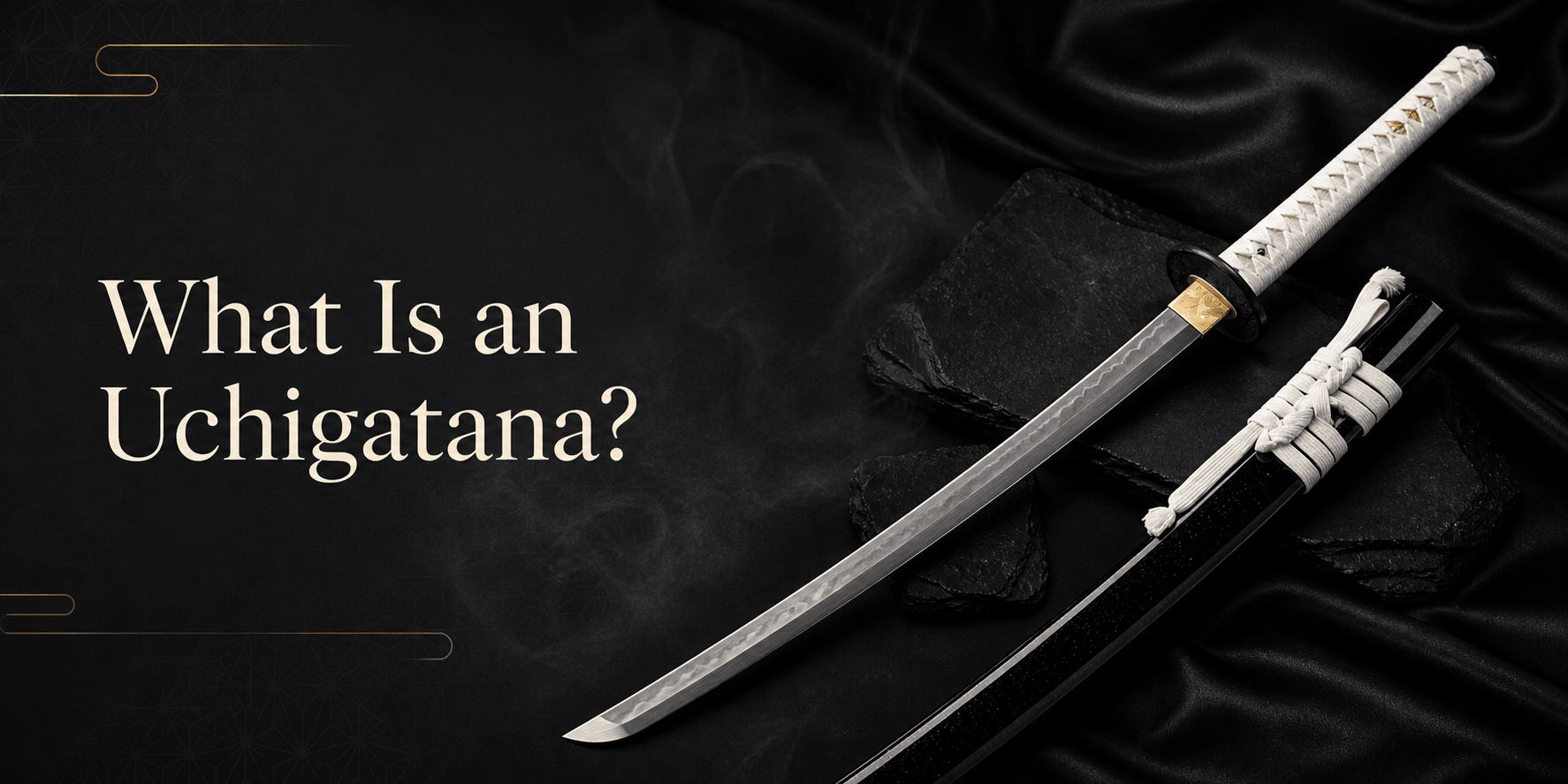
What Is an Uchigatana?
If you’re new to Japanese swords, you’ve probably heard the word katana long before you came across uchigatana.
That’s hardly surprising. In English, katana has become the familiar catch-all term for the curved Japanese sword most people recognise. But once you start digging into museum catalogues, historical blades, or specialist sword terminology, another name keeps popping up:
Uchigatana (打刀).
So, what exactly is an uchigatana, and how is it different from a tachi or what we commonly call a katana today?
In simple terms, the uchigatana is a type of Japanese sword that became increasingly widespread during the Muromachi period. It is generally associated with a curved, single-edged blade, relatively shallow curvature, and—most importantly—an edge-up method of wearing the sword through the waist belt.
That last detail is one of the easiest places for a beginner to start.
A tachi was traditionally suspended from the waist with its cutting edge facing down. An uchigatana, by contrast, was normally slipped through the belt with its cutting edge facing up.
It sounds like a small difference. It isn’t.
The way a sword was worn is one of the most useful clues to understanding how the uchigatana fits into the wider development of Japanese swords.
Whether you’re researching Japanese swords from Sydney, Melbourne, Brisbane, Perth, or elsewhere in Australia, understanding the uchigatana gives you a solid foundation for making sense of the sword types you’re likely to encounter.
What Exactly Is an Uchigatana?
The term uchigatana (打刀) refers to a long Japanese sword form that became widely used from the Muromachi period onwards.
A typical uchigatana is associated with several features:
-
a curved, single-edged blade;
-
a blade length of around two shaku—roughly 60 cm—or more;
-
generally shallower curvature than many earlier tachi;
-
relatively compact proportions compared with some earlier long swords;
-
and an edge-up wearing style, with the sword carried through the waist belt.
But here’s the catch: historical swords rarely fit neatly into modern checklists.
Blades could be shortened. Mountings could be replaced. A sword made in one period might be remounted centuries later. The fittings you see on a sword today may not be the fittings it originally had.
So rather than treating one feature as definitive, it’s better to think of these characteristics as pieces of evidence.
A useful beginner definition would be:
An uchigatana is a Japanese sword form strongly associated with being worn edge-up through the belt and with the later development of the long Japanese sword tradition.
That wording matters because no single feature tells the whole story.
Before the Uchigatana Came the Tachi
To understand why the uchigatana matters, it helps to know what came before it.
One of the most important earlier long-sword forms was the tachi (太刀).
Tachi are particularly associated with earlier periods of Japanese sword history and were traditionally worn suspended from the waist with the cutting edge facing down.
The uchigatana was normally worn differently: it was passed through the belt with the cutting edge facing up.
For beginners, that gives us a very handy rule of thumb:
Tachi: edge down.
Uchigatana: edge up.
Easy enough.
Just don’t turn that rule of thumb into an absolute rule.
A historical blade may have been remounted, shortened, or otherwise altered during its lifetime. That means wearing orientation is an excellent clue, but it shouldn’t be the only thing you look at.
Why Did the Uchigatana Become More Common?
The rise of the uchigatana is often discussed alongside changes in how swords were carried and used.
Earlier tachi traditions were closely associated with mounted use. Over time, fighting on foot became increasingly important, and sword forms and carrying methods also evolved.
Compared with many earlier tachi, the uchigatana was generally:
-
somewhat shorter;
-
lighter;
-
less deeply curved;
-
and worn edge-up through the belt.
These characteristics suited the practical environment in which the sword became increasingly common.
However, there’s an important distinction to make here.
It would be misleading to say:
“Fighting moved from horseback to foot, so the tachi was replaced by the uchigatana.”
History is rarely that tidy.
Older sword forms didn’t suddenly disappear, and the uchigatana didn’t appear overnight as a direct replacement. Different sword forms overlapped, older blades continued to be used, and some were modified for new mountings.
A better way to understand the transition is this:
Changes in fighting conditions, sword proportions, carrying methods, and practical requirements developed alongside one another over time.
The uchigatana became increasingly important as part of that broader process.
Uchigatana vs Tachi: What’s the Difference?
At a glance, the two can look similar. Both are curved, single-edged Japanese swords.
Look a little closer, though, and the differences become easier to understand.
| Feature | Typical Tachi | Typical Uchigatana |
|---|---|---|
| Wearing orientation | Cutting edge down | Cutting edge up |
| Carrying method | Suspended from fittings | Worn through the waist belt |
| Curvature | Often deeper | Generally shallower |
| General proportions | Often longer | Generally more compact |
| Historical association | Earlier mounted use | Increasing use on foot |
| Later history | Some were shortened and remounted | Could be newly made or adapted from older blades |
The word typical is doing a lot of work here.
These are general tendencies, not hard-and-fast rules.
That’s why specialists don’t identify a historical sword simply by asking, “How long is it?” or “Which way does the edge face?”
They look at the blade as a whole.
Some Uchigatana Started Life as Tachi
Here’s where things get particularly interesting.
A sword’s present form doesn’t necessarily tell you what it looked like when it was first made.
Some older tachi were shortened through a process known as suriage (磨上).
To understand how that works, you need one more term:
Nakago (茎) — the tang, or the section of the blade that extends into the handle.
When a blade was shortened, material could be removed from the tang end and the nakago reshaped. This allowed an older, longer blade to continue being used in a shorter configuration.
Some former tachi were later mounted and used in an uchigatana style.
But there’s an important point here:
Not every uchigatana started life as a tachi.
Many were made as uchigatana from the outset.
So rather than imagining a simple progression—
Tachi → shortened → Uchigatana
—it’s more accurate to picture two things happening at the same time: older blades were sometimes adapted, while new uchigatana were also being made.
What Does Ō-suriage Mean?
When a blade was shortened substantially, the modification may be described as ō-suriage (大磨上).
Why does that matter?
Because the tang is also where you may find the swordsmith’s inscription, known as the mei (銘).
A mei can contain information such as the maker’s name and, in some cases, a date or other details relating to the blade.
If a substantial part of the original tang was removed during shortening, some—or all—of the original inscription could disappear with it.
That brings us to another term you’ll often encounter:
Mumei (無銘) — literally, “without a signature”.
For beginners, the key takeaway is simple:
No signature doesn’t automatically mean no history.
An unsigned blade isn’t necessarily fake, unimportant, or poorly made. In some cases, the original signature may simply have been lost when the sword was shortened.
That’s why the condition and history of the nakago matter.
If the Signature Is Gone, What Can the Blade Tell Us?
Quite a lot, actually.
Even when a blade no longer has its original mei, specialists can examine other physical characteristics for clues.
These may include:
-
the overall shape of the blade;
-
curvature;
-
proportions;
-
the hardened-edge pattern;
-
the appearance of the forged steel;
-
and signs that the blade has been altered.
Two terms you’ll come across again and again are hamon and jihada.
Hamon
The hamon (刃文) is the visible pattern associated with the hardened area along the cutting edge.
Hamon can vary considerably from one blade to another.
If you’re just starting out, there’s no need to memorise every pattern. What matters is understanding that the hamon isn’t simply decoration—it’s one of the features specialists examine when studying a blade.
Jihada
The jihada (地肌) is the visible surface texture or grain of the forged steel.
Again, it’s more than a visual effect.
Its appearance can provide information about the way the blade was forged.
When considered alongside the blade’s shape, proportions, hamon, nakago, and other characteristics, these features may help specialists assess its approximate period, school, or possible maker.
That doesn’t mean you can reliably identify a centuries-old sword from a couple of online photos.
Far from it.
The point is that the blade itself contains evidence beyond whatever may—or may not—be written on its tang.
Where Does the Wakizashi Fit In?
The uchigatana is also connected to another sword type you’ll often encounter: the wakizashi (脇差).
A wakizashi is a shorter Japanese sword.
In later periods, a longer sword and a shorter wakizashi could be worn together as a pair known as daishō (大小), literally “large and small”.
If you’ve seen the familiar image of someone wearing one long sword and one shorter sword, that’s the basic arrangement you’re looking at.
But it’s worth keeping the timeline in mind.
The daishō belongs to a later part of Japanese sword history. It shouldn’t be projected backwards onto every earlier period or every type of sword.
That’s a common beginner mistake, especially when modern films, games, and illustrations blend several historical periods into a single visual style.
Was the Uchigatana Always the Main Battlefield Weapon?
Not necessarily.
Popular entertainment tends to put the sword front and centre, but historical warfare involved a much wider range of weapons.
Bows, spears, and other weapons also played important roles. A sword might become particularly useful at close range or when another weapon was no longer practical.
So it’s better not to think of the uchigatana as a do-everything battlefield weapon.
It was one part of a broader weapon system.
That distinction matters because it helps separate the historical sword from the almost superhuman reputation Japanese swords sometimes receive in films, games, and online discussions.
Uchigatana vs Katana: Are They the Same Thing?
This is where terminology can get messy.
In modern English, katana is often used as a broad term for the familiar curved Japanese sword associated with later sword traditions.
As a result, you’ll sometimes see katana used in situations where a more specific historical discussion might use uchigatana.
For beginners, there’s no need to get bogged down in terminology straight away.
Instead, ask better questions:
How long is the blade?
How pronounced is the curvature?
How was the sword traditionally mounted?
Was it worn edge-up or edge-down?
Has the nakago been shortened?
Does it still have a mei?
What period is the blade associated with?
Those questions will usually tell you far more than simply asking:
“Is this a katana?”
What Famous Uchigatana Can Teach Beginners
You don’t need to memorise a long list of swordsmiths to understand the uchigatana.
Still, well-known surviving blades can teach us one important lesson: uchigatana were not all made to one standard design.
Blade shape, workmanship, steel appearance, hamon, and other characteristics could vary according to period, school, maker, and individual blade.
Muramasa
Muramasa is one of the best-known names associated with Japanese swords.
You may have heard stories describing Muramasa blades as “cursed”. These stories belong to later legend and shouldn’t be treated as literal properties of the swords themselves.
From a historical perspective, the blades are better studied through their surviving physical characteristics and workmanship.
Nagasone Kotetsu
Nagasone Kotetsu is another well-known swordsmith.
His reputation became strong enough that false signatures and questionable attributions became an issue.
That gives beginners a useful lesson:
A famous name on a tang does not, by itself, prove who made the blade.
A mei is evidence, but it isn’t the whole case.
Horikawa Kunihiro
Horikawa Kunihiro is associated with another important swordmaking tradition.
For a beginner, the broader lesson matters more than memorising individual biographies:
There was never one universal “uchigatana specification”.
Individual swords vary.
A Blade May Have Had More Than One Life
Tachi weren’t the only older blade forms that could be modified.
You may also come across the term nagamaki-naoshi (長巻直し).
A nagamaki was a bladed weapon with a long blade and an extended handle. Some nagamaki blades were later shortened or reshaped and preserved in forms resembling uchigatana or wakizashi.
A modified blade of this kind may be described as nagamaki-naoshi.
Again, you don’t need to memorise the terminology on day one.
The bigger idea is far more important:
The sword you see today may not look exactly as it did when it was first made.
Once you understand that, many apparently confusing Japanese sword classifications begin to make more sense.
How Can a Beginner Identify an Uchigatana?
If you’re looking at an uchigatana in a museum catalogue, collection, auction listing, or online database, don’t jump straight to the swordsmith.
Start with the basics.
1. Look at the overall shape
Check the blade’s:
-
length;
-
curvature;
-
proportions;
-
and general profile.
Uchigatana are generally associated with shallower curvature than many earlier tachi, although individual blades vary.
2. Look at the mounting
If an appropriate historical mounting survives, ask how the sword was intended to be worn.
Uchigatana mounting is strongly associated with edge-up wearing through the belt.
3. Examine the nakago
The tang may preserve:
-
a mei;
-
file marks;
-
evidence of shortening;
-
or later inscriptions.
For historical study, the nakago can tell you a surprising amount.
4. Check for modification
Has the blade been shortened?
Could the present shape differ from its original form?
This is particularly important because judging a sword by its current length alone can lead you down the wrong track.
5. Check the documentation
Museum records, recognised sword organisations, specialist references, and professional documentation are generally more useful than marketing language.
Terms such as “authentic”, “museum grade”, “traditional”, or “masterpiece” may sound impressive, but they aren’t evidence on their own.
That’s particularly worth remembering if you’re researching Japanese swords online from Australia, where you may encounter listings using historical terminology rather loosely.
Common Uchigatana Myths
Before we wrap up, let’s clear up a few common misconceptions.
“Every curved Japanese sword is an uchigatana.”
No. Tachi, uchigatana, wakizashi, and other sword forms can all be curved.
“The uchigatana replaced the tachi overnight.”
No. The transition happened over time, with different forms overlapping and some older blades being reused or remounted.
“Every uchigatana is a shortened tachi.”
Again, no. Some older blades were adapted, but many uchigatana were made in that form from the beginning.
“No signature means the sword isn’t valuable or authentic.”
Not necessarily. A blade may have lost its original mei when it was shortened.
“A famous signature proves a famous swordsmith made it.”
No. Signatures need to be evaluated alongside the rest of the blade and its documentation.
“Movies are a good guide to how these swords were historically used.”
They can be entertaining, but they shouldn’t be your primary historical reference. Real warfare involved far more than swords alone.
Final Thoughts
So, what is an uchigatana?
At its simplest, it’s a Japanese sword form that became increasingly widespread during the Muromachi period and is strongly associated with a curved, single-edged blade and an edge-up method of wearing the sword through the belt.
But once you move beyond that basic definition, things become more interesting.
Understanding an uchigatana means looking at several clues together:
shape, curvature, mounting, nakago, mei, evidence of shortening, and historical context.
Some uchigatana were made in that form from the beginning.
Others may preserve older blades that were shortened and adapted.
Some still carry clear inscriptions.
Others became mumei after modification.
And that’s why Japanese sword study becomes much more rewarding once you stop treating every curved blade as simply “a katana”.
If you’re a beginner, don’t worry about memorising dozens of Japanese terms or swordsmiths straight away.
Start with four simple questions:
What shape is the blade?
How was the sword meant to be worn?
What does the tang tell me?
Has the blade been altered during its lifetime?
Get those basics right, and you’ll already be looking at an uchigatana very differently.
It’s no longer just a curved sword.
It’s a historical object whose present form can preserve clues from several different stages of its life.