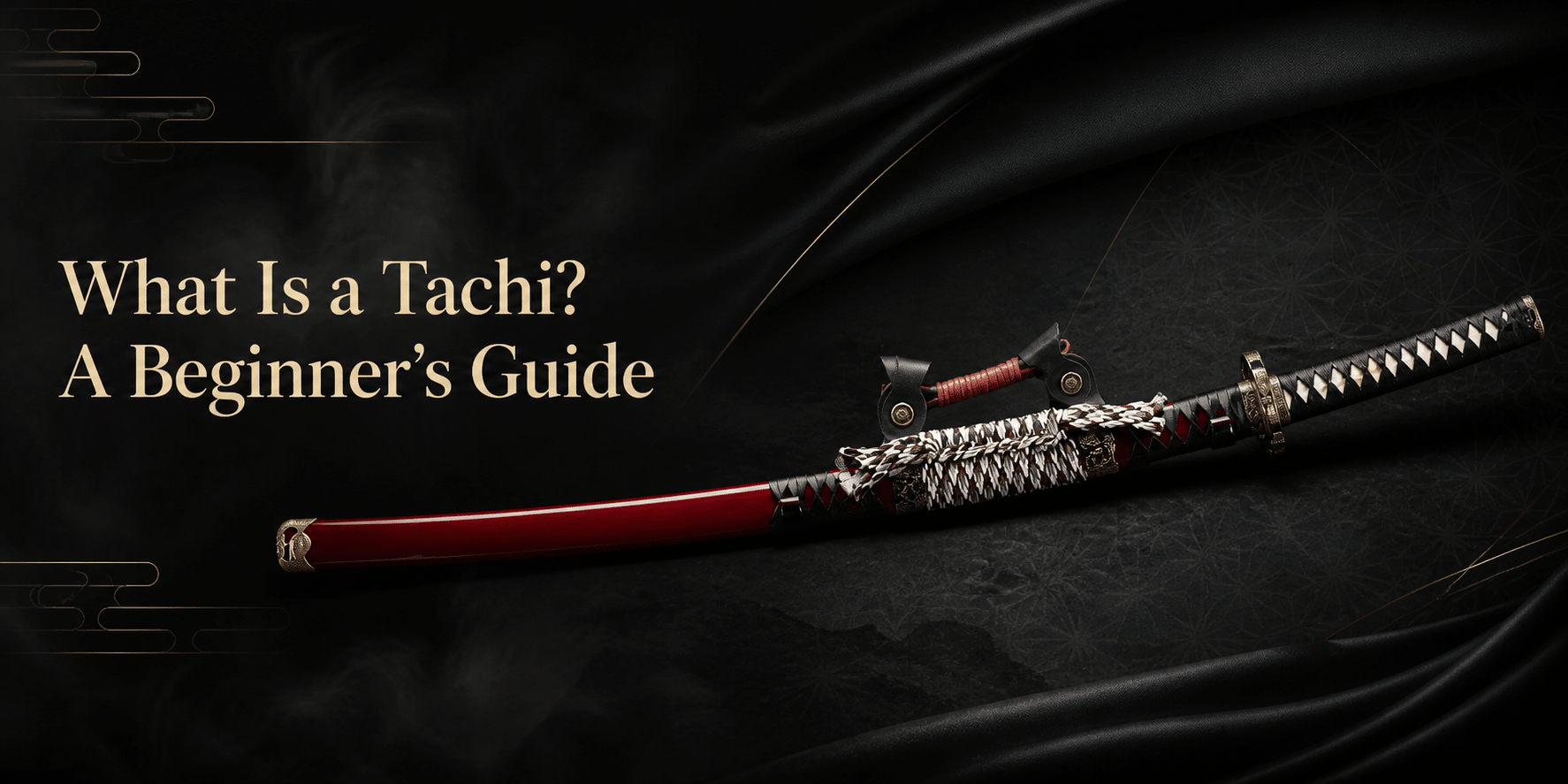
What Is a Tachi? A Beginner’s Guide
If you’re just getting into Japanese swords, chances are the first name you came across was katana. Then, sooner or later, you see another long, curved sword labelled tachi and think, Hang on—aren’t these basically the same thing?
It’s a fair question.
To an untrained eye, a tachi and a katana can look remarkably similar. Both can have long, curved, single-edged blades, and their dimensions can overlap. That’s why simple explanations such as “a tachi is longer” or “a tachi has more curve” only get you so far.
A better way to understand a tachi is to look at the sword as a complete design: its blade shape, curvature, proportions, mounting, wearing orientation, tang, and historical context.
For beginners in Sydney, Melbourne, Brisbane, or elsewhere in Australia, this approach also makes Japanese sword terminology much easier to follow. Instead of memorising a long list of names, you start to understand why different swords look and function the way they do.
So, what exactly is a tachi?
What Is a Tachi?
A tachi (太刀) is a type of traditional Japanese sword, typically characterised by a long, curved, single-edged blade and a mounting designed to suspend the sword from the waist with the cutting edge facing downward.
That last detail is especially useful.
A traditionally mounted tachi is normally worn edge-down, hanging from suspension fittings by cords or straps. A katana, by contrast, is typically worn edge-up, tucked through the waist sash.
For a beginner, that gives us a handy rule of thumb:
Tachi: traditionally suspended edge-down.
Katana: traditionally worn edge-up through the sash.
It’s one of the clearest visual differences between the two sword forms.
But it’s still only a starting point.
Japanese swords could be shortened, altered, remounted, or paired with fittings made at a different time from the blade itself. Because of that, specialists do not normally identify an old sword from wearing orientation alone.
They look at the whole picture.
How Long Is a Tachi?
You’ll sometimes see a tachi described as having a blade around 80 centimetres long.
That’s a useful mental image, but it should not be treated as a strict definition.
Many surviving historical tachi have cutting-edge lengths somewhere in the 70–80 cm range, while individual examples may be shorter or considerably longer.
More importantly, blade length overlaps with other Japanese sword types.
A katana can also have a blade longer than two shaku—roughly 60.6 cm—so measuring the blade does not automatically tell you whether you’re looking at a tachi or a katana.
That leads to one of the most useful principles in Japanese sword study:
Length describes a sword. It does not necessarily identify it.
To get closer to an answer, you need to look at the blade’s overall shape.
Understanding the Shape of a Tachi
The overall form or silhouette of a Japanese sword is often discussed using the term sugata.
When looking at a tachi, several features can provide useful clues:
-
overall blade length;
-
curvature;
-
where the curvature is strongest;
-
width near the base and closer to the point;
-
the amount of taper;
-
the size and shape of the point.
These features are especially helpful when studying early tachi.
However, they should be understood as historical tendencies, not fixed requirements that every tachi must meet. Tachi were produced over long periods, and their proportions changed over time.
That distinction matters.
Otherwise, a useful description of an early tachi can easily turn into an inaccurate rule for every tachi.
What Is Sori?
The curvature of a Japanese sword is called sori.
Look at a tachi from the side and you’ll notice that the blade does not usually follow a straight line from base to tip. Instead, it curves away from that line.
Many early tachi display fairly pronounced curvature.
But here’s the more useful question:
Where is the curve strongest?
In many early examples, the curvature is more pronounced closer to the base of the blade. This is commonly described as koshi-zori, or “waist curvature.”
Visually, the lower section of the blade sweeps away strongly before the curve becomes gentler toward the point.
That can give an early tachi a very distinctive, flowing profile.
Still, koshi-zori is not a pass-or-fail test. Later tachi can show different patterns of curvature.
Think of it as an important clue rather than a final answer.
Does a Curved Tachi Cut Better?
This is where things can get oversimplified very quickly.
It’s tempting to say:
“Tachi are curved because curved swords cut better.”
The reality is more complicated.
Curvature can support a smoother slicing action during a cut, but cutting performance depends on the entire blade geometry, not curvature alone.
Other factors include blade thickness, cross-section, edge geometry, mass distribution, material properties, heat treatment, and the way the blade is used.
So when studying the curve of a tachi, it makes more sense to see it as one part of a complete design.
The same principle applies to almost every feature of a sword:
one measurement rarely explains everything.
Blade Width, Taper, and Funbari
Curvature is only part of what gives many early tachi their distinctive appearance.
Blade width matters too.
Two terms worth knowing are:
Moto-haba — the width of the blade near the base.
Saki-haba — the width farther forward, closer to the point.
In many early tachi, the blade begins noticeably broader near the base and becomes narrower toward the tip.
This strong visual taper is often discussed in connection with funbari.
You do not need to memorise every Japanese term on day one. The basic idea is straightforward:
The blade does not stay the same width from handle to point.
When pronounced base curvature, taper, and blade proportions work together, they create the classic silhouette associated with many early tachi.
That tells you far more than simply saying the sword is “long and curved.”
What About the Kissaki?
The kissaki is the point section of a Japanese sword.
Some early tachi are known for relatively small points, often described as ko-kissaki.
Combined with a broad base and strong taper, a smaller point can contribute to the refined proportions seen in surviving early examples.
But this is another place where beginners should avoid hard-and-fast rules.
Not every tachi has a small kissaki.
Blade proportions evolved, and later tachi can have different point shapes and sizes.
By now, a pattern should be clear:
A tachi is not identified by one feature.
You build an understanding from several clues working together.
Why Is the Tachi Associated With Mounted Use?
The classic tachi form is strongly associated with mounted use, and that context helps explain parts of its design.
Its suspension-style mounting allowed the sword to hang from the waist with the edge facing downward. Longer blade forms could offer additional reach in some mounted situations, while curvature formed part of the sword’s overall cutting geometry.
Even so, we should avoid turning that into a simplistic formula:
horseback combat = tachi
Historical weapons rarely develop because of one factor alone.
Mounted use was an important influence on classic tachi design, but manufacturing methods, changing practical requirements, blade-making traditions, and differences between individual swords also played a role.
A more accurate way to put it is this:
The tachi developed in an environment where mounted use was significant.
That is much safer than claiming every feature exists solely because the sword was used from horseback.
Tachi vs Katana: What Is the Difference?
Now we can return to the question most beginners actually want answered.
How is a tachi different from a katana?
Here’s a useful comparison:
| Feature | Typical Tachi | Typical Katana |
|---|---|---|
| Wearing orientation | Cutting edge down | Cutting edge up |
| Carrying method | Suspended from fittings | Inserted through the waist sash |
| Curvature | Often deeper in early examples | Often shallower or distributed differently |
| Taper | Can be pronounced in early examples | Varies by period and blade |
| Historical association | Earlier forms strongly linked with mounted use | Later forms strongly linked with edge-up carrying and use on foot |
| Signature orientation | Often associated with the haki-omote side | Often associated with the sashi-omote side |
The word typical matters.
This is not a checklist where five ticks automatically prove that a blade is a tachi.
There are exceptions, especially with older swords that have been shortened or remounted.
That’s where things get interesting—and where beginners often make mistakes. Trying to identify a Japanese sword from a single feature usually leads to oversimplification.
The Nakago Can Tell You More Than You Think
One of the most informative parts of a Japanese sword is normally hidden inside the handle.
It is called the nakago, or tang.
The nakago is the section of the blade that extends into the handle. On historical swords, it can preserve useful evidence such as a maker’s inscription, file marks, the original shape of the tang, and signs of later alteration.
The inscription is called a mei.
When the tang remains reasonably close to its original form, the orientation of the mei can help indicate how the sword was originally intended to be worn.
On a traditionally worn tachi, the outward-facing side is commonly called haki-omote.
On a katana worn edge-up, the corresponding outward-facing side is known as sashi-omote.
That gives specialists another useful clue.
But again, it is only a clue.
Old tangs may have been shortened, altered, or otherwise modified over the life of the blade.
What Is Suriage?
This is one of the reasons tachi and katana identification can become surprisingly complicated.
Some older tachi blades were shortened.
The process is known as suriage.
Rather than simply cutting material from the point, shortening is generally carried out from the tang end. The tang is reduced and reshaped, which shortens the overall blade while preserving the working end.
When the shortening is extensive, it may be described as ō-suriage. In some cases, the original signature can be lost.
An older tachi blade that was shortened could later be mounted and used in katana form.
But here’s the important part:
Not every katana started life as a tachi.
Many katana or uchigatana-form blades were made that way from the beginning.
So the history of Japanese sword design should not be imagined as:
Tachi → Katana → Tachi disappears.
Reality is less tidy. Sword forms overlap, blades survive for long periods, mountings change, and older swords may be adapted to new requirements.
How Can a Beginner Identify a Tachi?
If you’re looking at a museum photograph or a documented antique, it is better to ask a group of questions rather than hunt for one “magic” feature.
-
How is the sword mounted?
Is it suspended edge-down or mounted for edge-up carrying? -
What does the overall blade shape look like?
Consider length, curvature, and proportions together. -
Where is the curvature strongest?
Strong curvature near the base can be characteristic of some early tachi. -
How much does the blade taper?
Compare the width near the base with the width closer to the point. -
What does the kissaki look like?
A relatively small point can appear on some early tachi, but it is not universal. -
What does the nakago tell us?
Tang shape, inscription orientation, and evidence of shortening can all provide useful information. -
Has the sword been remounted or shortened?
The blade and its current fittings may not necessarily come from the same stage of its life.
This approach takes a little longer than saying “deep curve equals tachi,” but it is far more reliable.
Are There Different Forms of Tachi?
Yes, although the categories need to be handled carefully.
Some terms describe blade size or form, while others describe mounting style, or koshirae.
Mixing those together can make things unnecessarily confusing.
Tachi-Related Forms by Blade Size
One term you may come across is ōdachi, sometimes called nodachi depending on context.
It generally refers to an exceptionally large Japanese sword, often associated with blades around three shaku—roughly 90 cm—or more.
Rather than assuming every ōdachi is simply an oversized standard tachi, it is better for beginners to treat it as a related large-sword category whose terminology and classification can vary by context.
At the other end of the scale is the kodachi, a comparatively short tachi-form sword.
Kodachi are especially useful for understanding why blade length alone cannot define everything.
A shorter blade can still belong to a tachi-related form because of its overall construction and characteristics.
The exact historical function of the kodachi is not firmly established, so it is better not to assign every example a specific role without stronger evidence.
Sometimes, “we don’t know for certain” is the most accurate answer.
Tachi Mounting Styles
Other tachi terms describe koshirae, the sword’s external mounting, rather than the blade itself.
An itomaki-tachi, for example, is associated with a mounting in which portions of the hilt and upper scabbard are wrapped with matching cord.
These mountings could become highly elaborate and were used in formal, ceremonial, and presentation settings in later periods.
Another category found in historical sources is the black-lacquered tachi mounting. Depending on the individual example, lacquer may cover parts of the scabbard, hilt, or associated fittings.
Lacquer could help protect surfaces while also contributing to the finished appearance.
The key distinction is simple:
Blade classification and mounting classification are not the same thing.
Once you understand that, museum catalogues and specialist descriptions become much easier to read.
What Should Beginners Look for in a Tachi Today?
If you’re researching a tachi from Sydney, Melbourne, Brisbane, or anywhere else in Australia, start by working out what kind of object you are actually looking at.
Is it:
-
an antique Japanese blade;
-
a documented modern-made sword;
-
a functional reproduction;
-
or a decorative replica?
Those objects should not all be judged by the same standards.
For a documented historical sword, details such as blade measurements, nakago condition, signature, attribution, evidence of shortening, mounting history, and provenance can be important.
For a modern tachi-style reproduction, the questions are different. You may want to look at dimensions, curvature, blade geometry, construction, materials, mounting quality, and whether the suspension system actually reflects a tachi-style mounting.
In either case, do not rely too heavily on marketing language.
Words such as “traditional,” “authentic,” or “museum grade” do not automatically tell you anything measurable about a sword’s construction or historical accuracy.
Look for information you can verify.
Australian readers considering ownership should also check the current laws in their own state or territory, as sword regulations can vary depending on where you live.
Common Tachi Myths
Before wrapping up, it’s worth clearing up a few common misconceptions.
“Every tachi is longer than a katana.”
No. Their blade-length ranges can overlap considerably.
“Every tachi has very deep curvature.”
No. Pronounced curvature is common in many examples, particularly some early forms, but tachi proportions changed over time.
“A small kissaki proves it is a tachi.”
No. A small point can be useful when studying certain early forms, but it is not universal.
“Every katana was originally a tachi.”
No. Some older tachi were shortened and later used in katana form, while many katana were made as katana from the beginning.
“Edge-down means it must be a tachi.”
Not necessarily. Mountings can change, so the current koshirae needs to be considered alongside the blade itself.
Once you understand these exceptions, identifying Japanese sword forms becomes less about memorising rigid rules and more about reading the evidence in front of you.
Final Thoughts
So, what is a tachi?
The simple answer is that it is a traditional Japanese sword form commonly associated with a long, curved, single-edged blade and an edge-down suspension-style mounting.
But the more useful answer goes deeper.
A tachi is best understood through the relationship between its sugata, sori, blade proportions, kissaki, nakago, mounting, and historical context.
Many early examples show pronounced curvature near the base, noticeable taper toward the point, and relatively small kissaki. Those features are useful for understanding classic early tachi forms, but none of them should be treated as universal requirements.
The same goes for length.
Or mounting.
Or signature orientation.
No single measurement tells the whole story.
That is probably the most useful lesson for anyone beginning to study Japanese swords. At first, two curved blades may look almost identical. Then you start noticing where the curve begins, how the width changes, how the sword is mounted, what the tang reveals, and whether the blade has been altered.
You stop asking:
“Does this look like a tachi?”
And start asking:
“What does the complete structure of this sword tell me?”
Whether you’re browsing a museum collection in Melbourne, researching Japanese swords from home in Brisbane, or comparing documented examples online from Sydney, that shift in thinking is what turns a list of sword names into a genuine understanding of blade design.