
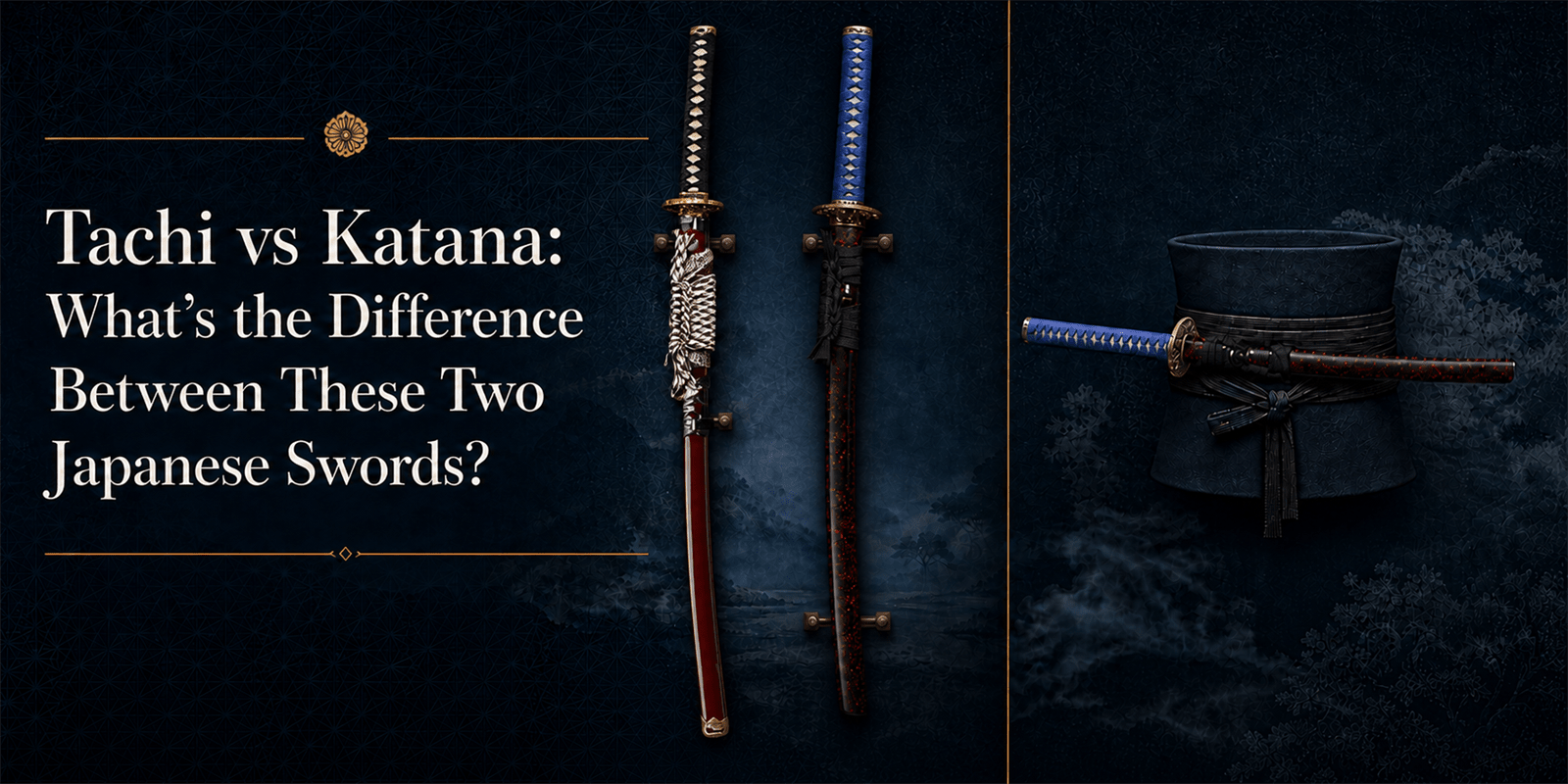
Tachi vs Katana: What’s the Difference Between These Two Japanese Swords?
A Beginner-Friendly Guide to Understanding Their History, Design, and Purpose
When people first start exploring Japanese swords, one question comes up again and again:
“What’s the difference between a Tachi and a Katana?”
At first glance, they may look almost identical. Both feature curved blades, traditional fittings, and the unmistakable craftsmanship associated with Japanese sword making.
So, what sets them apart?
The answer lies in their design, wearing style, historical purpose, and the way warriors used them.
While the Tachi and Katana are closely related, they were created during different periods and reflected the changing needs of Japanese warriors.
Understanding the difference between them is not only helpful for collectors and sword enthusiasts — it also gives beginners a deeper appreciation of how Japanese sword design evolved over centuries.
The Main Difference Between Tachi and Katana
Simply put:
The Tachi was designed for earlier battlefield situations, especially mounted combat, while the Katana evolved into a more practical and versatile sword for later warriors.
However, the relationship between them is not as simple as saying:
“Tachi is old, Katana is new.”
Japanese sword development was a gradual process. The Katana was not created from nothing; instead, it represented an evolution of sword design as fighting styles, armor, and daily needs changed.
Here is a quick comparison:
| Feature | Tachi | Katana |
|---|---|---|
| Development period | Earlier Japanese sword tradition | Later sword development |
| Main use | Often associated with mounted warriors | More versatile close-range combat |
| Wearing style | Suspended from the waist, edge facing downward | Worn through the belt, edge facing upward |
| Blade shape | Generally deeper curvature | Usually a more balanced curve |
| Historical role | Designed around earlier battlefield needs | Designed for speed, control, and practicality |
Blade Shape: How to Tell a Tachi From a Katana
One of the first things collectors look at is the shape of the blade.
The curve of a Japanese sword is not just for appearance — it was carefully designed to match how the sword would be used.
Tachi: A Deeper Curve for Mounted Combat
Traditional Tachi often has a style of curvature known as koshi-zori, where the strongest curve appears closer to the lower section of the blade.
This design helped create a powerful cutting motion, especially when used from horseback.
A typical Tachi often has:
- A longer blade
- A more pronounced curve
- An elegant and flowing shape
The design reflects the needs of warriors who fought in earlier battlefield environments.
Katana: A More Balanced and Practical Design
The Katana developed with a different purpose in mind.
Instead of focusing mainly on mounted combat, sword makers created a design that offered greater balance and easier handling.
Compared with many Tachi examples, Katana often features:
- A more balanced curvature
- A slightly more compact shape
- Faster drawing and handling characteristics
That said, there are exceptions. Japanese swords changed constantly throughout history, so identification is never based on one single feature.
Why Was the Tachi Created?
The development of the Tachi was closely connected to the role of mounted warriors in early Japanese warfare.
During this period, fighting from horseback was an important part of samurai combat.
A sword used in this environment needed to:
- Deliver powerful cuts
- Work effectively from a higher position
- Match the movement of a mounted warrior
Because of these requirements, swordsmiths developed longer blades with stronger curves.
The Tachi was not simply an “older version” of the Katana.
It was a sword designed for a different time and a different battlefield.
Why Did the Katana Become More Popular?
As Japanese warfare changed, sword designs changed with it.
Warriors increasingly needed swords that were easier to carry, draw, and control in closer combat situations.
This led to the rise of the Katana.
The Katana became popular because of its:
- Balanced proportions
- Efficient drawing technique
- Practical handling
The famous image of the samurai wearing a Katana through the belt became one of the most recognizable symbols of Japanese sword culture.
But here’s the important part:
The Katana did not replace the Tachi overnight.
The two existed within a long process of development, with different styles appearing depending on the period and purpose.
The Biggest Difference: How They Were Worn
For beginners, this is probably the easiest way to remember the difference.
How Tachi Was Worn
A Tachi was traditionally worn suspended from the waist.
The sword hung with:
- The cutting edge facing downward
- The curve following the natural hanging position
This style worked well for warriors who needed to draw the sword while mounted.
How Katana Was Worn
A Katana was worn through the belt, known as the obi.
The blade was positioned with:
- The cutting edge facing upward
- The handle positioned for a quick draw
This wearing method allowed warriors to draw the sword smoothly while standing.
A simple memory trick:
Tachi hangs down.
Katana slides through the belt.
Can a Tachi Become a Katana?
This is where Japanese sword history gets really interesting.
Some older Tachi blades were later shortened and modified. This process is called suriage.
When a sword was shortened:
- The original tang could be reduced
- The signature might be lost
- The blade proportions could change
- The sword could be mounted in a Katana style
Because of this, some historical blades that appear today as Katana may have originally started their lives as Tachi.
However, not every Katana came from a modified Tachi.
Many Katana were made as Katana from the beginning.
The relationship between the two is better understood as evolution rather than replacement.
How Experts Identify a Tachi or Katana
Identifying a Japanese sword is not as simple as looking at the curve and making a quick guess.
Experts usually examine several factors together:
1. Blade Shape
The length, curvature, and overall proportions provide important clues.
2. Nakago (Tang)
The tang, the part of the blade hidden inside the handle, can reveal information about the sword’s age and history.
3. Mounting Style
The fittings and mounting method can show how the sword was intended to be used.
4. Historical Period
Sword styles changed significantly throughout Japanese history, so understanding the time period is essential.
A proper identification requires looking at the sword as a whole.
Why Understanding Tachi and Katana Matters
Learning the difference between Tachi and Katana is about more than memorising two names.
It helps you understand:
- How Japanese warfare changed
- How swordsmiths adapted their designs
- How practical needs influenced craftsmanship
Japanese swords are not only weapons. They are also historical objects that reflect technology, culture, and the skills of generations of craftsmen.
Final Thoughts: Two Swords, Two Different Eras
The Tachi and Katana are closely connected, but they represent different stages in Japanese sword development.
The Tachi reflects an earlier era, with a design influenced by mounted combat and powerful cutting techniques.
The Katana represents a later evolution, focusing on balance, practicality, and efficient handling.
For beginners, the easiest way to remember the difference is:
Tachi: an earlier Japanese sword typically worn edge-down.
Katana: a later sword style typically worn edge-up through the belt.
Once you understand this basic difference, you’ll have a much clearer foundation for exploring the fascinating world of Japanese swords.