
What Is the Mune on a Japanese Sword? A Beginner’s Guide to Katana Structure
Introduction: A Katana Is More Than Just a Sharp Edge
When most people first look at a Japanese sword, their attention naturally goes straight to the cutting edge.
The polished surface, elegant blade shape, and sharp point are usually the first details that catch the eye. However, the true performance of a sword is not created by the edge alone.
A well-designed blade is the result of many elements working together, including steel selection, heat treatment, blade geometry, weight distribution, and overall craftsmanship.
One often overlooked part of a Japanese sword is the mune, also known as the spine of the blade.
Located on the opposite side of the cutting edge, the mune does not directly perform the cutting action. Instead, it provides structural support and plays an important role in balancing strength, flexibility, and durability.
For beginners, understanding the mune is an important step toward looking beyond appearance and learning what actually makes one sword different from another.
A beautiful blade may attract attention at first glance, but the details hidden within its construction often determine its true quality.
What Is the Mune of a Japanese Sword?
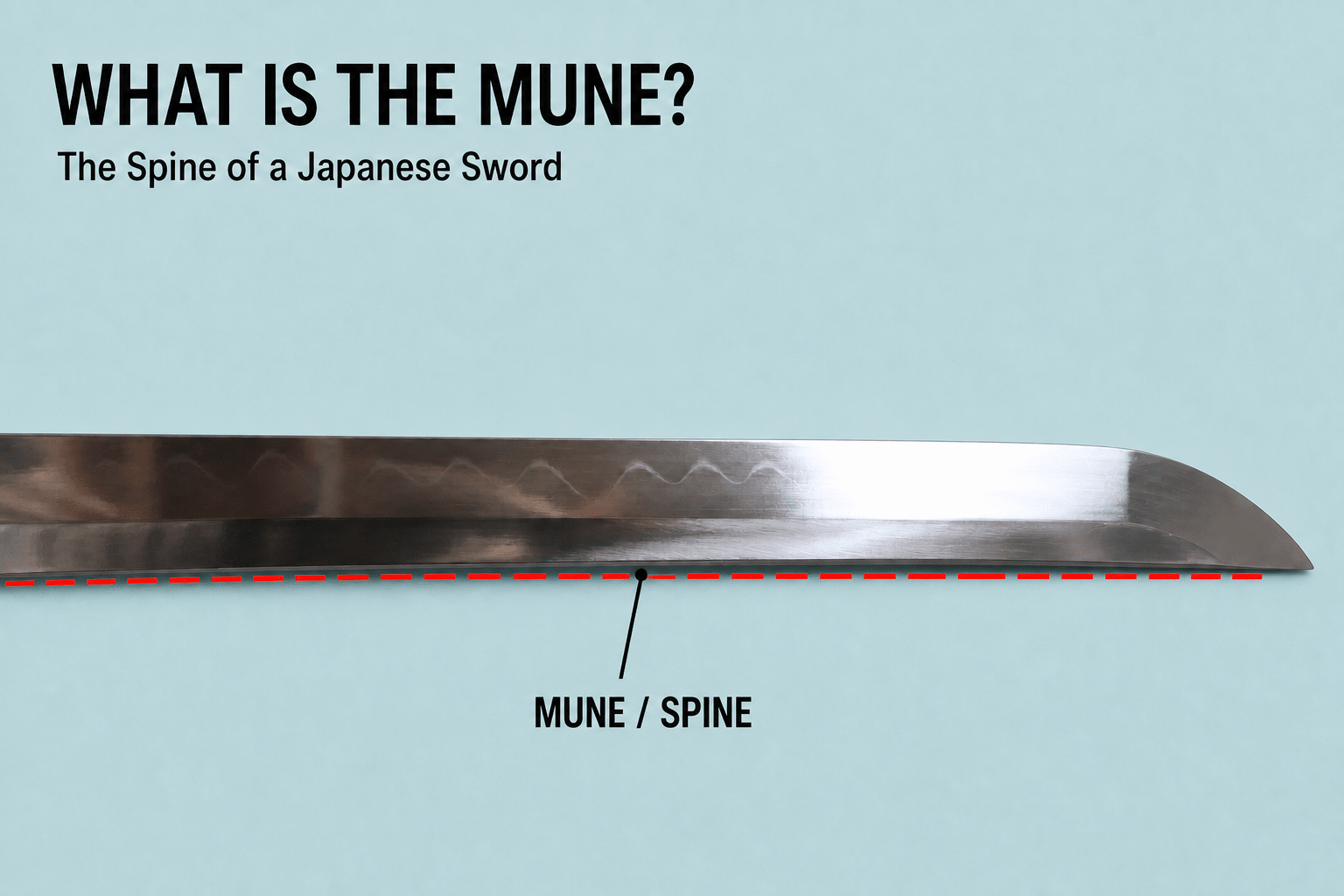
The mune is the back or spine section of a Japanese sword blade.
Simply explained:
- Ha — the sharpened cutting edge of the blade
- Mune — the thicker back section of the blade
The ha is designed for cutting, while the mune helps support the blade structure and maintain its overall shape.
When viewing a sword from the side, the mune is the area opposite the sharp edge. Depending on the blade design, the shape and thickness of the mune can vary, creating different visual characteristics and structural properties.
For someone new to Japanese swords, the easiest way to understand the mune is to think of it as the backbone of the blade.
Just like the frame of a well-built structure provides stability, the mune helps the sword maintain a balance between strength, flexibility, and durability.
Why Does the Mune Matter?
One of the most common misunderstandings among beginners is believing that a sword’s quality depends only on how sharp the edge is.
Sharpness is certainly an important factor, but a functional blade requires much more than a sharp cutting surface.
A well-designed Japanese sword is a combination of different characteristics working together, and the mune contributes in several key areas.
1. Structural Support: The Foundation Behind the Edge
A sword blade experiences different types of stress, and the mune helps provide structural support behind the cutting edge.
The spine adds stability to the blade while allowing the edge area to maintain its intended geometry.
However, this does not mean that a thicker mune automatically creates a better sword.
This is where many beginners misunderstand blade construction.
A high-quality blade is not created simply by adding more material. Instead, performance depends on how different elements work together:
- blade thickness
- blade width
- edge geometry
- steel properties
- heat treatment
- overall blade design
The mune is only one part of a much larger system.
A properly designed blade needs to achieve the right balance — strong enough to maintain structural integrity while still offering comfortable handling and control.
2. Balance and Handling: How a Sword Feels in Your Hands
A sword is not simply a sharpened piece of metal.
The way a blade feels when held depends greatly on its weight distribution and overall geometry.
The design of the mune can influence:
- balance
- handling comfort
- control
- movement response
This is why two swords with the same length can feel completely different when held.
One blade may feel quick and well-balanced, while another may feel heavier or more difficult to control.
The difference comes from the relationship between every part of the blade, including:
- the mune
- the cutting edge
- blade thickness
- curvature
- weight distribution
Good blade design is about creating harmony between all these elements.
3. Durability: Finding the Right Balance Between Hardness and Toughness
Durability is not created by a single feature.
A well-designed sword needs a balance between hardness and toughness.
Hardness helps a blade maintain its edge, while toughness helps it resist stress and damage.
However, excessive hardness without proper structural design may reduce resistance to impact. On the other hand, a blade that is too soft may struggle to maintain its cutting performance.
The mune contributes to the overall structure that allows the blade to maintain this balance.
This is why experienced collectors and enthusiasts do not judge a sword based on one feature alone.
The entire construction matters.
Different Mune Designs and Katana Blade Structure
The mune is not always shaped in the same way.
Different blade designs can feature different spine profiles, and these variations influence the appearance and overall geometry of the sword.
Understanding these differences helps beginners recognize that sword construction involves many design choices rather than a single “perfect” formula.
Rounded Mune
A rounded mune is one of the commonly seen spine designs found on Japanese sword blades.
This shape creates a smooth transition between the back of the blade and its sides, contributing to a balanced and refined blade profile.
Angular Mune
Some blades feature a more defined or angled spine.
This creates clearer transitions between different surfaces of the blade and gives the sword a different visual character.
Flat Mune
A flatter spine creates a simpler and more straightforward blade profile.
Each mune style represents a different approach to blade geometry.
There is no single mune shape that automatically makes every sword superior.
The quality of a blade comes from how all elements work together, including materials, construction methods, and overall design.
How Does the Mune Affect Sword Performance?
When discussing sword performance, it is important not to focus on a single feature.
A common mistake among beginners is trying to find one factor that determines whether a sword is “good” or “bad”.
In reality, the performance of a Japanese sword comes from the interaction between many different elements.
The relationship can be understood as:
Steel Selection
↓
Heat Treatment
↓
Blade Geometry
↓
Mune and Structural Design
↓
Overall Balance and Performance
Each stage influences the final characteristics of the blade.
The mune is an important part of this system, but it works together with every other component rather than acting alone.
The Role of Steel and Heat Treatment
Steel: The Foundation of a Blade
The steel used in a sword provides the foundation for its physical properties.
Different steels can offer different combinations of characteristics, including:
- hardness
- toughness
- edge retention
- maintenance requirements
However, steel alone does not determine the final quality of a blade.
A common misconception is that choosing a certain type of steel automatically creates a superior sword.
The reality is more complex.
The way the steel is processed, shaped, and treated has a significant influence on the final result.
Heat Treatment: Changing the Properties of Steel
Heat treatment is one of the most important steps in blade production.
Through controlled heating and cooling processes, the internal structure of the steel can be changed, influencing properties such as:
- hardness
- flexibility
- resistance to stress
A blade needs the right balance.
If the steel is too hard, it may become more vulnerable to impact. If it is too soft, it may struggle to maintain its edge.
This balance is one reason why two blades made from similar materials can perform differently.
The difference often comes from the manufacturing process, including how the steel was treated and how the blade geometry was developed.
Blade Geometry: The Relationship Between Edge and Spine
When people talk about a sword’s cutting ability, they often focus only on sharpness.
However, cutting performance depends on the complete geometry of the blade.
Important factors include:
- blade thickness
- blade width
- edge angle
- curvature
- weight distribution
- spine design
The mune works together with these elements to create the overall structure of the blade.
For example, increasing thickness in one area may provide additional support, but it can also affect weight and handling.
This is why good blade design is not about making every part thicker, heavier, or stronger.
Instead, it is about creating the right relationship between different characteristics.
A well-balanced sword is designed as a complete system.
What Should Beginners Look for When Choosing a Japanese Sword?
If you are buying your first Japanese sword, focusing only on appearance can be misleading.
A visually impressive blade does not always mean it has the construction quality you expect.
For beginners, understanding the basics of blade construction can help you make a more informed decision.
1. Understand the Blade Information
Before purchasing a sword, look for clear information about:
- steel type
- manufacturing method
- heat treatment process
- blade construction
A trustworthy seller should be able to explain the basic specifications of the blade.
Clear information helps buyers understand what they are actually purchasing instead of making a decision based only on appearance.
2. Pay Attention to Overall Blade Design
A sword should be evaluated as a complete structure.
Important factors include:
- blade proportions
- balance
- thickness
- geometry
- overall shape
A well-designed blade usually shows consistency between its different parts.
The relationship between the edge, spine, and body of the blade should feel intentional rather than random.
3. Look at Craftsmanship and Details
Small details can often reveal the quality of construction.
When examining a sword, pay attention to:
- blade finishing
- fitting quality
- surface condition
- overall assembly
A sword is not made from a single component.
It is a complete object where the blade, fittings, and construction details all contribute to the final result.
4. Understand Maintenance Requirements
A Japanese sword is not a completely maintenance-free product.
Like many metal objects, it requires proper care to maintain its condition.
Basic maintenance includes:
- proper storage
- keeping the blade clean
- avoiding unnecessary moisture exposure
Environmental conditions can affect metal products, especially in areas where humidity changes throughout the year.
For collectors in Australia, understanding storage conditions is an important part of long-term ownership.
Whether you live in Sydney, Melbourne, Brisbane, or another region, keeping your sword in a suitable environment helps protect its condition over time.
Common Misunderstandings About the Mune
Understanding what the mune does is important, but it is equally important to understand what it does not do.
Many beginner misconceptions come from focusing too much on one specific feature.
Myth 1: A Thicker Spine Always Means a Better Sword
This is one of the most common misunderstandings.
A thicker mune does not automatically mean a stronger or higher-quality sword.
Thickness is only one design factor.
A well-balanced blade requires the correct relationship between:
- thickness
- weight
- flexibility
- edge design
- overall geometry
A sword that is too heavy or poorly balanced may not perform well, even if certain parts appear stronger.
Myth 2: The Sharpest Edge Creates the Best Sword
Sharpness is only one aspect of blade performance.
A high-quality sword also requires:
- structural stability
- proper balance
- suitable material properties
- careful construction
A sharp edge without proper support and balance does not create a complete blade.
Myth 3: The Mune Determines Everything
The mune is an important part of Japanese sword anatomy, but it is only one component.
The final quality of a sword comes from the combination of:
- materials
- craftsmanship
- engineering principles
- manufacturing techniques
- overall design
A sword is a system where every part works together.
Final Thoughts: Understanding the Whole Blade
The mune, or spine of a Japanese sword, may not be the most noticeable part of the blade, but it plays an important role in understanding how a sword is designed and constructed.
When most people think about a katana, they naturally focus on the sharp edge.
However, a well-made blade is never defined by one feature alone.
A sword is the result of many elements working together:
- the cutting edge
- the mune (spine)
- blade geometry
- steel selection
- heat treatment
- weight distribution
- overall craftsmanship
Each part contributes to the final balance between performance, durability, and handling.
Understanding the mune allows beginners and collectors to look beyond surface appearance and develop a deeper understanding of Japanese sword anatomy.
Instead of asking:
“Is this sword sharp?”
A better question is:
“How do all the different parts of this sword work together?”
That mindset helps buyers make better decisions and appreciate the engineering behind a carefully designed blade.
Conclusion: The Mune Reveals the Balance Behind the Blade
The mune is one of the less obvious parts of a Japanese sword, but it represents an important principle in blade design:
A great sword is created through balance, not through one single feature.
The cutting edge may be the part that performs the action, but the spine, structure, materials, and craftsmanship all contribute to the final result.
For beginners exploring Japanese swords, learning about the mune is an excellent starting point.
It helps you understand that the quality of a blade comes from the relationship between many carefully considered elements.
Whether you are a new collector in Sydney, Melbourne, Brisbane, or anywhere else in Australia, understanding the structure behind a katana allows you to make more informed choices and appreciate the craftsmanship behind every blade.
A well-designed Japanese sword is not simply about being sharp.
It is about how every part works together to create balance, stability, and lasting quality.