
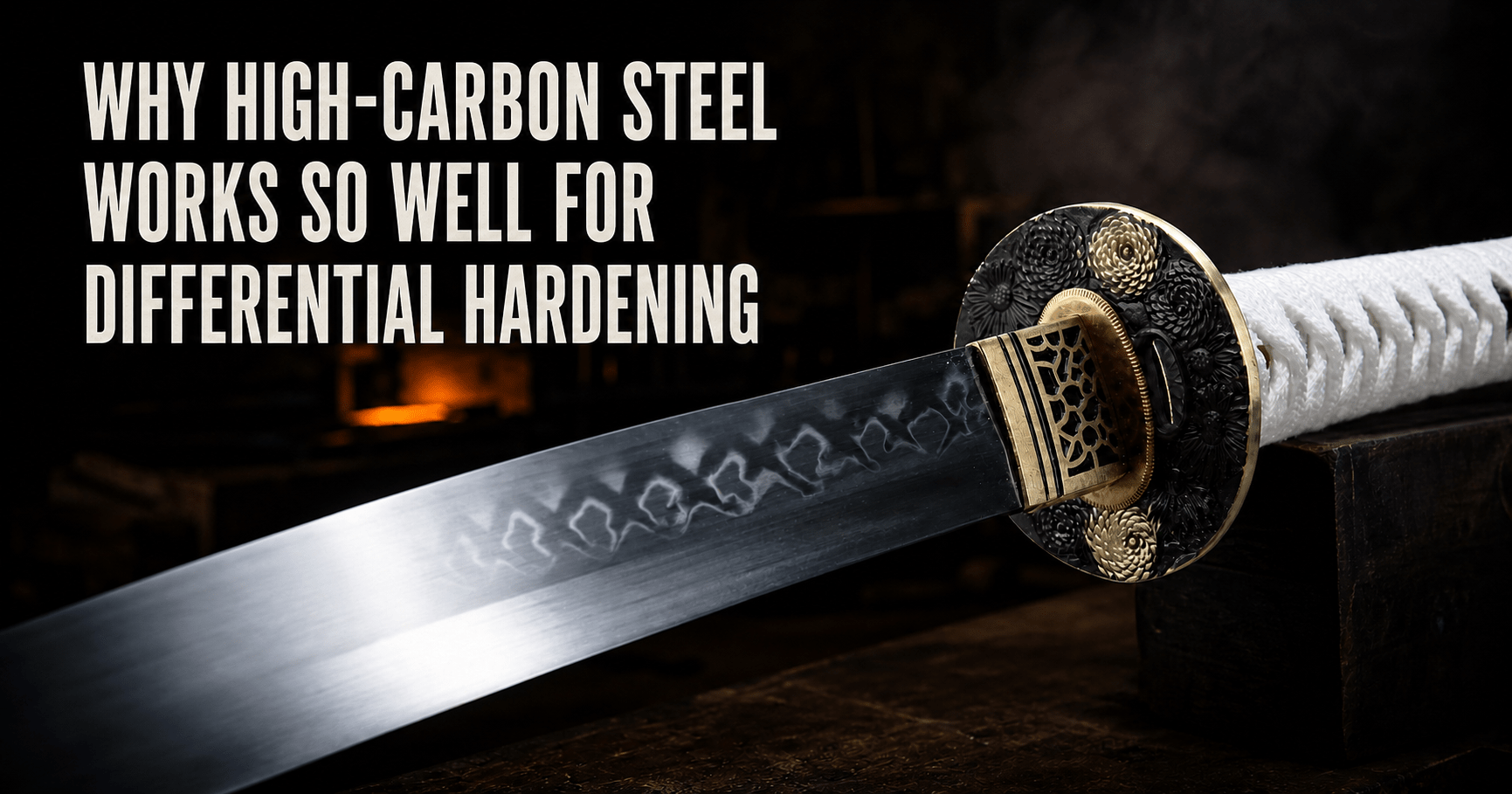
Why High-Carbon Steel Works So Well for Differential Hardening
When beginners shop for a katana-style sword, they often notice the obvious details first: the curve of the blade, the polish, the guard, the handle wrapping, and the overall finish.
That makes sense. Those are the features you can actually see.
However, a blade’s real performance depends heavily on something hidden beneath the surface: the relationship between its steel and its heat treatment.
This is where high-carbon steel and differential hardening come into the picture.
High-carbon steel is often used for differentially hardened blades because it can develop a very hard cutting edge when properly heat-treated. At the same time, the rest of the blade can be kept comparatively tougher and less brittle.
Put simply, the process allows one blade to do two different jobs.
The edge needs to stay hard enough to hold its shape. The body and spine need to handle stress without cracking too easily. Differential hardening is one way of balancing those requirements.
That does not mean every high-carbon steel blade is automatically excellent. The steel grade matters, but so do the heat treatment, blade geometry, grinding, tempering, and overall quality of manufacture.
So, let’s break down what high-carbon steel actually does, how differential hardening works, and what Australian beginners should understand before buying their first blade.
What Is High-Carbon Steel?
Steel is primarily an alloy of iron and carbon, often with small amounts of other elements added to adjust its properties.
The carbon content plays a major role in determining how the steel responds to heat treatment. In general, steel with more carbon has greater potential to become hard after it has been heated and rapidly cooled.
That is why high-carbon steel is widely used for cutting tools and blades.
For a sword, greater hardness can improve:
-
edge retention;
-
resistance to wear;
-
the ability of the edge to resist rolling or deforming.
However, there is a catch.
Hardness is not the same thing as overall durability.
A blade that is made extremely hard from edge to spine may hold an edge well, but it may also become less tolerant of shock, poor alignment, or accidental impact. In extreme cases, excessive hardness can make steel more likely to chip or crack.
A functional blade therefore needs more than maximum hardness. It needs a sensible balance between hardness, strength, and toughness.
That balance is largely created through heat treatment.
Why Heat Treatment Matters More Than the Steel Name
Steel names get a lot of attention in product listings.
You may see labels such as:
-
1095 high-carbon steel;
-
1084 carbon steel;
-
5160 spring steel;
-
clay-tempered steel.
These terms can be useful, but they do not tell the whole story.
A steel grade is the raw material. Heat treatment determines how much of that material’s potential is actually realised.
Two blades made from the same steel can perform very differently if one is carefully heat-treated and the other is not.
During heat treatment, the blade is heated to a controlled temperature so that its internal structure changes. It is then cooled, or quenched, at a carefully chosen rate. After quenching, it is normally tempered to reduce excessive brittleness.
Each stage matters.
Heating the steel incorrectly can lead to poor grain structure. Quenching too slowly may prevent the edge from reaching the intended hardness. Quenching too aggressively can increase the risk of warping or cracking. Failing to temper properly can leave the blade too brittle for practical use.
In other words, a premium steel with poor heat treatment can still make a disappointing blade.
A simpler steel with well-controlled heat treatment may perform far better.
That is why experienced buyers pay attention not only to what the blade is made from, but also to how it was hardened and tempered.
What Is Differential Hardening?
Differential hardening is a heat-treatment method that creates different hardness levels in different parts of the same blade.
The cutting edge is cooled quickly enough to become very hard. The spine and thicker body of the blade cool more slowly and remain softer or develop a mixed microstructure.
The result is a blade with:
-
a hard cutting edge;
-
a tougher, more forgiving spine;
-
a visible transition between the differently treated areas in some polished blades.
This approach makes sense because the edge and spine have different responsibilities.
The edge must resist wear and deformation. If it is too soft, it may dull quickly or roll under pressure.
The spine does not need the same level of edge hardness. Instead, it benefits from greater toughness and an improved ability to tolerate stress.
Think of it this way: the edge is the business end of the blade, while the spine provides support.
Trying to give both areas exactly the same properties is not always the best approach.
Differential hardening allows the maker to use a single piece of steel while giving different sections of the blade different performance characteristics.
How Does the Process Work?
In a commonly used method, an insulating coating is applied more thickly to the spine and more thinly, or not at all, near the cutting edge.
When the heated blade is quenched, the exposed edge cools more rapidly than the insulated spine.
That difference in cooling rate changes the steel’s internal structure.
The fast-cooled edge can form martensite, a very hard steel microstructure. The slower-cooled spine may form pearlite or a mixture of structures, depending on the steel, the blade geometry, the coating, and the quenching process.
You do not need a degree in metallurgy to understand the basic idea:
Fast cooling creates a harder edge. Slower cooling leaves the spine tougher and less brittle.
After quenching, the blade still needs to be tempered.
Freshly quenched martensite can be extremely hard, but it is also brittle. Tempering reheats the blade to a lower temperature, reducing brittleness while retaining useful hardness.
This step is essential. Skipping it would be a bit like building a powerful engine and forgetting the cooling system. It may look impressive on paper, but it will not be dependable.
Why High-Carbon Steel Is Well Suited to the Process
High-carbon steel works well for differential hardening because it can undergo strong structural changes during heat treatment.
There are several reasons for this.
1. It Can Develop a Hard Cutting Edge
The most obvious advantage is that high-carbon steel can form a hard martensitic edge after a suitable quench.
That hardness helps the cutting edge resist wear and maintain its shape.
This does not mean that harder is always better. An edge can be pushed too far and become overly brittle. However, high-carbon steel gives the maker enough hardening potential to aim for an effective working range.
Without sufficient carbon, the steel may not reach the hardness required for a durable cutting edge.
This is one reason low-carbon mild steel is generally unsuitable for a functional sword edge. It may be easy to shape, but it cannot normally be heat-treated to deliver the same edge performance.
2. Some High-Carbon Steels Have Relatively Low Hardenability
This is where beginners often get tripped up.
Hardness and hardenability are not the same thing.
Hardness describes how resistant the finished steel is to indentation, wear, or deformation.
Hardenability describes how easily and how deeply the steel hardens during cooling.
A steel can be capable of high hardness while still having relatively low hardenability.
That is useful for differential hardening.
A lower-hardenability steel may harden strongly at the thin, rapidly cooled edge while failing to harden to the same degree in the thicker, insulated spine.
This helps create a clear difference between the two areas.
Steels such as 1095 are often associated with this type of treatment because they can achieve a hard edge while responding noticeably to differences in cooling rate.
By contrast, deeper-hardening alloy steels may harden more thoroughly through the blade, even when cooling conditions vary. They can still make excellent swords, but they may be less cooperative when the goal is a pronounced edge-to-spine hardness transition.
3. It Supports a Useful Balance of Edge Retention and Toughness
A sword blade is not simply a giant knife.
Its length gives stress more leverage, and even a small problem with cutting alignment can place substantial force on the blade.
A very soft blade may bend too easily or lose its edge. A very hard blade may become less forgiving when subjected to sideways stress.
Differential hardening aims for a middle ground.
The hardened edge provides wear resistance and edge stability. The softer or mixed-structure spine offers greater tolerance for stress and permanent deformation before fracture.
That balance does not make the blade indestructible. No steel and no heat treatment can do that.
It simply gives the blade a more carefully distributed set of properties.
Hardness Is Not the Same as Flexibility
The word “flexibility” is often used loosely in sword marketing, but it can create confusion.
Heat treatment does not dramatically change the basic elastic stiffness of steel. A hard steel blade and a softer steel blade of the same dimensions will initially flex by roughly similar amounts under the same load.
What changes more significantly is how the blade behaves when the stress becomes severe.
A harder and more brittle area may crack sooner. A softer or tougher area may tolerate more stress or bend permanently before breaking.
Therefore, it is more accurate to say that a differentially hardened spine is generally intended to be tougher and more forgiving, rather than simply “more flexible.”
Blade geometry also plays a major role.
Thickness, taper, width, curvature, and cross-sectional shape all influence how much a blade bends and where stress is concentrated. Steel and heat treatment matter, but geometry is just as important.
Does More Carbon Always Mean a Better Blade?
No.
This is one of the most common misconceptions in beginner discussions.
A higher carbon percentage may increase hardness potential, but it can also make heat treatment more demanding and reduce toughness if the steel is pushed too hard.
The final performance of a blade depends on several connected factors:
-
steel composition;
-
heat-treatment accuracy;
-
tempering;
-
grain structure;
-
edge geometry;
-
blade thickness and taper;
-
surface finish;
-
quality control.
A poorly heat-treated 1095 blade is not automatically better than a well-made blade in 1084 or 5160.
Likewise, a product page that advertises an impressive Rockwell hardness number does not necessarily prove that the sword is well designed.
An edge can be hard and still be too thin, badly ground, unevenly treated, or poorly supported by the blade geometry.
The smartest question is not:
Which steel has the highest carbon content?
It is:
Has this steel been matched with the right heat treatment and blade design?
That is where the real quality lies.
1095, 1084, and 5160: What Is the Difference?
Beginners shopping for katana-style blades in Australia are likely to encounter several common steel names.
1095 High-Carbon Steel
1095 is a simple high-carbon steel with roughly 0.95 per cent carbon, although exact composition ranges vary by specification and supplier.
It can achieve high hardness and is often chosen when a maker wants a clear differential-hardening response.
Its relatively low hardenability makes it suitable for producing a distinct hardened edge and a softer spine.
The downside is that 1095 can be less forgiving during heat treatment. It generally requires careful temperature control and an appropriate quench. An overly aggressive process can increase the risk of distortion or cracking.
For buyers, 1095 should not be judged by the steel name alone. A properly treated 1095 blade can be very capable. A poorly treated one may be brittle, uneven, or unreliable.
1084 Carbon Steel
1084 contains slightly less carbon than 1095 and is often regarded as easier to heat-treat consistently.
It can still achieve strong edge hardness, but its heat-treatment window is generally considered more manageable.
For this reason, it is popular among beginner bladesmiths and makers working with relatively simple equipment.
A differentially hardened 1084 blade may not always produce the same dramatic contrast associated with lower-hardenability steels such as 1095, but it can offer a practical combination of hardness, toughness, and processing consistency.
5160 Spring Steel
5160 is a chromium-bearing spring steel known for toughness.
It contains less carbon than 1095 but includes alloying elements that increase its hardenability and improve its ability to handle shock.
Because it hardens more deeply, 5160 is commonly associated with through-hardened or uniformly heat-treated working swords rather than highly dramatic differential hardening.
That does not make it inferior. It simply means it serves a different priority.
A well-made 5160 sword may be an excellent choice for buyers who value toughness and forgiveness over a strong visual hardening line.
The key point is that steel grades should not be ranked in a simple best-to-worst list. Each steel needs to be judged according to the job it is being asked to do.
What About the Hamon?
Differentially hardened blades may display a visible line separating the harder edge from the softer area above it.
This line is commonly called a hamon.
It is produced by differences in microstructure, although polishing and surface finishing determine how clearly it can be seen.
For beginners, it is important to distinguish between a genuine heat-treatment boundary and a purely decorative pattern.
Some blades use acid etching, wire brushing, polishing, or other surface techniques to create a visible line that imitates the appearance of differential hardening.
A visible line alone does not prove that the blade has a genuinely hardened edge and softer spine.
At the same time, a genuine differentially hardened blade may have a subtle line rather than an extremely bold one.
A dramatic appearance is not necessarily evidence of better performance.
When assessing a product, look for a clear explanation of the heat-treatment process rather than relying entirely on photographs.
Common Marketing Claims to Treat Carefully
Blade listings can be full of bold language.
Terms such as “battle-ready,” “razor-sharp,” “unbreakable,” and “master-grade” may sound impressive, but they are not technical standards.
Be cautious when a seller claims that a blade is:
-
impossible to break;
-
the strongest type of katana;
-
superior simply because it has more carbon;
-
suitable for cutting anything;
-
authentic purely because it has a visible hardening line.
No functional blade is unbreakable.
Even a well-made sword can be damaged by poor technique, hard targets, edge misalignment, corrosion, impact against metal, or defects in manufacturing.
A trustworthy product description should provide specific information about the steel, heat treatment, construction, dimensions, intended purpose, and maintenance requirements.
The less detail a seller provides, the more carefully the buyer should proceed.
What Australian Beginners Should Check Before Buying
For Australian customers, buying a katana-style blade involves more than choosing a steel grade.
Decide What the Sword Is For
Before comparing steels, decide whether you want:
-
a decorative display piece;
-
a collector’s item;
-
a blunt training sword;
-
a sharpened functional blade.
A display sword does not need the same performance characteristics as a cutting blade.
Likewise, a beginner who has no supervised training may be better served by a blunt or non-functional training option rather than a sharpened sword.
Buying the most aggressive-looking blade on the page is not automatically the smartest move.
Read the Heat-Treatment Description
Look for clear terms such as:
-
differentially hardened;
-
clay-hardened;
-
through-hardened;
-
quenched and tempered;
-
edge hardness;
-
spine hardness.
Be wary of vague descriptions that list only the steel grade.
A seller who cannot explain how the blade was treated may not be able to provide meaningful information about its performance.
Check the Blade Construction
Steel and heat treatment are only part of the picture.
Also consider:
-
whether the tang construction is clearly described;
-
whether the fittings are secure;
-
whether the blade has proper taper;
-
whether the edge geometry suits the intended use;
-
whether the sword is sold sharp or blunt;
-
whether the seller provides handling and care instructions.
A high-quality steel label cannot compensate for poor assembly.
Understand the Maintenance
High-carbon steel is not stainless.
It can rust if exposed to moisture, fingerprints, salt, or humid storage conditions.
This matters across Australia, but it can be especially relevant in coastal environments such as Sydney, Brisbane, Perth, and the Gold Coast.
Melbourne’s changing weather is not a free pass either. Indoor condensation, damp storage, and fingerprints can still lead to surface corrosion.
Basic maintenance includes:
-
keeping the blade dry;
-
wiping away fingerprints;
-
applying a thin, suitable protective oil;
-
inspecting the blade regularly;
-
storing it in a clean, dry environment.
Avoid using thick layers of oil, as they can attract dust and grime. A light, even film is usually enough.
Check the Law Where You Live
Sword laws differ between Australian states and territories.
The legal position in Sydney may not be the same as the legal position in Melbourne, Brisbane, Adelaide, Perth, or Hobart.
Ownership, transport, public possession, importation, sale, display, and use may be regulated differently.
Do not assume that an item is legal simply because an Australian website sells it or ships it to your postcode.
Check current official guidance for your state or territory before purchasing, transporting, or displaying a sword.
Legal information changes, so retailer summaries and forum comments should not be treated as a substitute for official sources.
Is Differential Hardening Always Better?
Not necessarily.
Differential hardening is one valid approach, not a universal upgrade.
A properly through-hardened spring-steel blade may offer greater overall toughness and be more forgiving in hard-use conditions.
A differentially hardened high-carbon blade may offer a harder edge, a visible transition line, and a particular balance of properties.
Neither design is automatically superior in every situation.
The right choice depends on:
-
the steel;
-
the maker’s process;
-
the blade geometry;
-
the intended use;
-
the owner’s maintenance habits.
For a collector who values the visible effects of differential hardening, a 1095 clay-hardened blade may be appealing.
For a beginner who values durability and lower risk of damage from minor mistakes, a well-made 5160 through-hardened sword may be the more practical option.
The steel should fit the purpose—not the other way around.
Final Thoughts
High-carbon steel is well suited to differential hardening because it can develop a hard cutting edge while allowing other parts of the blade to remain comparatively tougher.
The process works by controlling how quickly different areas cool during quenching. The thinner, exposed edge cools quickly and forms hard martensite. The insulated or thicker spine cools more slowly and develops a softer or mixed structure.
Tempering then reduces excessive brittleness and brings the blade into a more practical working range.
That is the core logic behind the process.
Still, the steel name is only the beginning.
A good blade depends on the complete system: material, heat treatment, geometry, grinding, tempering, assembly, maintenance, and responsible ownership.
So, when you see terms such as “1095 high-carbon steel,” “clay-hardened,” or “differentially tempered” on an Australian product page, do not take them at face value.
Look for evidence that the maker understands how those elements work together.
Because at the end of the day, a good sword is not created by chasing the highest carbon number or the flashiest marketing claim.
It is created by balance.
A hard edge without toughness is fragile. Toughness without sufficient edge hardness limits cutting performance. Steel without proper heat treatment is simply unrealised potential.
Once you understand that relationship, blade specifications stop looking like a jumble of technical buzzwords.
They start telling a story—and that story can help you make a far better buying decision.