
What Is the Mune on a Japanese Sword?
When people first look at a Japanese sword, their eyes naturally go straight to the cutting edge. The sharp edge, known as the ha, is one of the blade’s most recognisable features.
But shift your attention to the other side of the blade, and you’ll find another feature that can tell us a great deal about its construction: the mune (棟), sometimes read as mine.
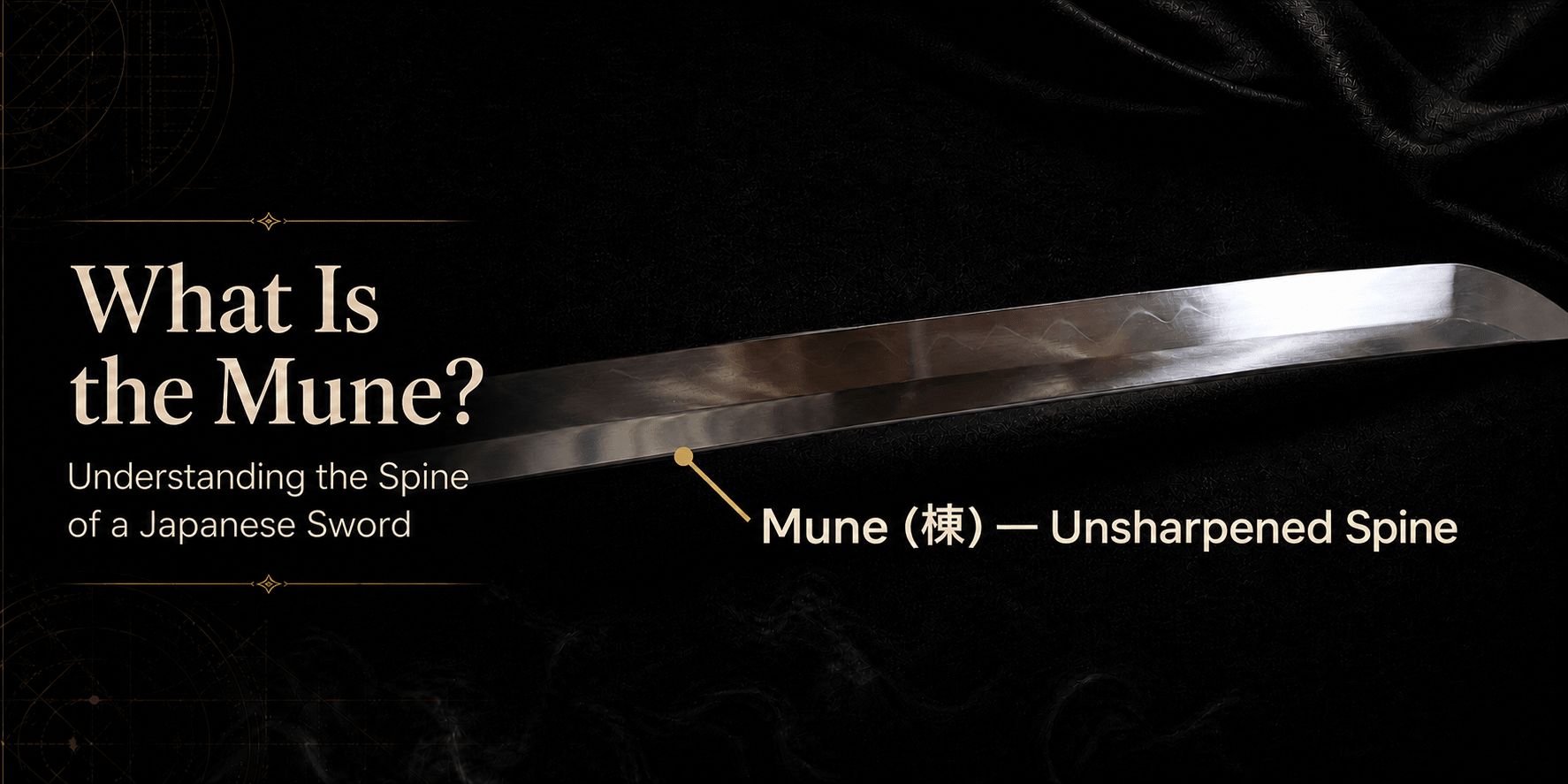
The mune is the unsharpened spine running along the back of the blade. At first glance, it might seem fairly simple. In reality, its shape, thickness and relationship with the rest of the blade can help us better understand Japanese sword geometry.
For beginners studying Japanese swords in Australia, the mune is a particularly useful place to start because it highlights one of the most important principles in sword study:
No single feature should be examined in isolation.
The mune, shinogi, blade thickness, width and overall profile all work together to create the blade’s three-dimensional form.
So, what exactly is the mune? What different shapes can it take, and what can it actually tell us about a Japanese sword?
Let’s take a closer look.
What Is the Mune?
The mune is the unsharpened back, or spine, of a Japanese sword blade. It runs along the side opposite the sharpened cutting edge.
For beginners, the easiest way to remember the basic terminology is:
- Ha — the sharpened cutting edge
- Mune — the unsharpened spine
Simple enough.
But here’s where things get more interesting.
The mune is not just “the blunt side” of the sword. It has its own cross-sectional shape, and its thickness can vary in relation to other parts of the blade.
One particularly important feature is the shinogi, the raised ridge running along the side of many Japanese sword blades. The relationship between the mune, shinogi and other surfaces contributes to the blade’s overall geometry.
That geometry can provide useful clues when studying a sword.
However, there is one important rule to keep in mind:
The shape of the mune alone cannot reliably tell you the exact age, origin or maker of a Japanese sword.
Think of it as one piece of the puzzle rather than the whole picture.
The Four Main Types of Mune
Japanese sword blades can have several different spine profiles. Four important forms are mitsu-mune, maru-mune, kaku-mune and iori-mune.
Learning to recognise these basic shapes is a practical first step for anyone interested in Japanese sword geometry.
Mitsu-Mune
Mitsu-mune (三ツ棟) has a three-surface profile.
Instead of forming a single ridge or rounded surface, the spine is divided into three distinct planes, giving it a more complex cross-section.
Mitsu-mune is associated with certain swordmaking traditions, including Yamashiro and Sōshū, and can also be seen on some shorter blades.
There is an important distinction here, though:
An association is not the same thing as proof.
Finding a mitsu-mune does not automatically mean that a blade came from a particular school, region or period. It can contribute to an assessment, but it should always be considered alongside other characteristics.
Maru-Mune
Maru-mune (丸棟) has a rounded spine.
When viewed in cross-section, the back of the blade appears curved rather than sharply ridged or divided into flat surfaces.
Maru-mune is historically associated with some blades produced in areas including Kyushu and Hokuriku.
Once again, these are historical tendencies rather than hard-and-fast identification rules.
A rounded mune is an observable feature. What that feature means depends on the rest of the blade.
Kaku-Mune
Kaku-mune (角棟) has a relatively flat and angular profile.
Compared with more complex forms, its cross-section is fairly straightforward. This type of mune is associated particularly with some very early Japanese blades and became much less common as curved sword forms developed.
For beginners, this is a good example of why sword terminology always needs context.
It would be too simplistic to look at an angular spine and immediately conclude:
“This must be an early sword.”
Instead, the mune should be studied together with the blade’s overall shape, construction and other surviving characteristics.
Iori-Mune
Iori-mune (庵棟) forms a raised ridge that resembles the peak of a roof when viewed in cross-section.
The two sides meet at an angle rather than forming a rounded or flat top. The steepness of this roof-like profile can also vary.
Iori-mune is one of the more familiar spine profiles found on Japanese swords and is also seen on some larger blade forms.
Because it is widely encountered, recognising an iori-mune is only the first step. Its presence alone does not provide a reliable date or attribution.
That gives us a useful rule of thumb:
Mune shape is evidence, not a verdict.
Mune Shape and Blade Thickness Are Different Things
This distinction can trip up beginners, so it is worth getting right from the start.
Mune refers to a physical part of the blade. Kasane refers to thickness.
The two are related, but they do not mean the same thing.
The Japanese term kasane (重ね) is used when discussing the thickness of a sword blade. Depending on where that thickness is measured or observed, you may come across more specific terms.
For example:
Mune-kasane refers to thickness measured in relation to the mune.
Shinogi-kasane concerns thickness around the shinogi area.
You may also encounter:
- Motokasane — thickness closer to the base of the blade
- Sakikasane — thickness farther towards the point
These measurements help describe how the blade changes from its base towards the tip.
And that matters because a Japanese sword is not simply a uniform strip of steel. Its dimensions and proportions can change along its length.
How Thick Is a Japanese Sword?
This sounds like a straightforward question, but there is no single measurement that applies to every Japanese sword.
As a general reference, blade thickness may be around 7 mm near the base and approximately 5 mm farther forward in some examples.
These figures are useful for understanding proportions, but they should not be treated as universal specifications.
Individual blades vary.
Their dimensions can differ according to blade form, construction, period and other characteristics. Antique blades may also have changed over time through repeated polishing or later modification.
So rather than asking:
“How thick should a Japanese sword be?”
a more useful question is:
“How does the thickness change along this particular blade?”
That tells you far more, especially when thickness is considered alongside the shinogi, blade width and overall shape.
How Does the Mune Relate to the Shinogi?
On many Japanese swords, a prominent ridge called the shinogi runs along the side of the blade.
The line formed by this ridge is known as the shinogi-suji, while the area between the shinogi and the mune is called the shinogi-ji.
A simplified way to picture the relationship is:
Cutting edge → blade surface → shinogi → shinogi-ji → mune
These are not random features sitting next to one another. Together, they form the blade’s cross-sectional geometry.
That is why looking at the mune alone can be misleading.
A relatively thick or thin spine needs to be understood in relation to the position of the shinogi, the width of the blade and the distribution of material throughout the cross-section.
These relationships can affect the blade’s overall weight, proportions and physical characteristics. However, it would be misleading to claim that the mune alone determines qualities such as cutting performance or resilience.
A better way to understand it is:
The mune is one part of a larger geometric system.
For beginners, that is far more useful than trying to assign one simple function to each part of the blade.
What Is Nusumi-Mune?
Once you understand the basic mune profiles and the idea of kasane, another term becomes easier to place: nusumi-mune.
At first, it is easy to assume that nusumi-mune is simply another spine shape alongside mitsu-mune, maru-mune, kaku-mune and iori-mune.
That is not the most useful way to understand it.
Nusumi-mune refers to a particular treatment in which the mune area is made relatively thin compared with the thickness around the shinogi.
In other words, the term is concerned with how material is distributed through the blade rather than simply describing the outline of the spine.
Nusumi-mune is associated with the Yamato swordmaking tradition, and similar approaches to reducing material around the spine can also appear in certain blade constructions.
For a beginner, memorising every historical association is less important than understanding the basic idea:
Two swords can have broadly similar mune profiles while differing considerably in how their thickness is distributed.
That is precisely why relying on a single visible characteristic can lead you down the wrong track.
Mune, Mihaba and Fumbari
Thickness is only part of the story. Blade width matters too.
The width of a Japanese sword blade is known as mihaba.
More specifically:
- Motohaba refers to the width closer to the base.
- Sakihaba refers to the width farther towards the tip.
Comparing these dimensions helps us understand how much the blade narrows as it approaches the point.
This brings us to another useful term: fumbari.
Fumbari describes the visual effect created when a blade is noticeably broader near the base and becomes narrower towards the tip. It contributes to the sword’s overall silhouette, or sugata.
Pronounced fumbari can be seen in some earlier Japanese sword forms. Over time, however, blade proportions varied, and the difference between the width near the base and farther forward was not always equally pronounced.
Here again, context matters.
Strong fumbari does not automatically prove that a sword is old.
Nor should fumbari alone be used to judge the condition or history of a blade.
Repeated polishing and other changes over time can alter a sword’s original proportions. Material may gradually be removed, changing its width, thickness and overall visual balance.
For that reason, fumbari is best treated as one feature among many when examining a blade.
Why Does the Mune Matter to the Saya?
Blade geometry also matters when we look at the saya, or scabbard.
A saya needs to accommodate the actual dimensions and shape of the blade it holds. Curvature, width and thickness all affect the fit, and the mune forms part of that three-dimensional geometry.
This highlights something beginners can easily overlook.
A Japanese sword blade is not simply a flat cutting object that slides into a generic case. Its precise form influences how the surrounding components need to fit.
For collectors and enthusiasts, this is another reason why apparently small differences in blade geometry can matter.
What Can the Mune Actually Tell You?
By now, it might sound as though the mune can reveal almost everything about a Japanese sword.
It cannot—and that is an important point.
What the mune provides is supporting evidence.
When examining a blade, researchers may consider several features together:
- Mune profile — Is the spine rounded, angular, ridged or divided into multiple surfaces?
- Kasane — How thick is the blade, and how does that thickness change?
- Shinogi geometry — How is the ridge positioned and formed?
- Mihaba — How wide is the blade at different points?
- Fumbari — How strongly does the blade narrow from base to tip?
- Sugata — What are the blade’s overall shape and proportions?
Looking at these characteristics together gives us far more useful information than trying to identify a sword from a single feature.
This is especially important with antique blades, where repeated polishing, modification and preservation may have altered the original geometry.
For beginners, these features are excellent tools for learning how to observe a sword.
They are not, however, a substitute for professional examination when identifying or authenticating an antique blade.
Was Mune-Uchi Really Safe?
The mune also appears in a well-known idea sometimes called mune-uchi or mine-uchi: striking with the back of the sword rather than with its sharpened edge.
Popular entertainment sometimes portrays this as a convenient way to stop someone without causing serious injury.
The historical evidence is more limited.
A small number of historical writings contain episodes that have been interpreted as strikes made with the mune. This suggests that the idea was not purely a modern fictional invention.
But here’s the catch:
A handful of historical references does not prove that mune-uchi was a universal, standardised or commonly practised technique.
Nor does an unsharpened surface mean a harmless one.
A sword is still a solid object. A forceful strike with its spine could cause serious injury even if the cutting edge were not used.
So the simple equation—
blunt = safe
—does not hold up.
The more careful conclusion is that historical references to strikes with the mune do exist, but they should not be treated as evidence of a standard or harmless “non-lethal” sword technique.
For a modern beginner, this is best understood as a historical question rather than something to experiment with.
What Should Beginners Look For?
If you are new to Japanese swords, there is no need to memorise every technical term in one sitting.
A better approach is to build a simple observation routine.
Start by identifying the ha and mune. That gives you the basic orientation of the blade.
Next, examine the mune profile where possible. Does it look rounded, flat, roof-shaped or divided into several surfaces?
Then look at thickness. Compare the blade near its base with areas farther towards the tip.
After that, examine the shinogi and its relationship with the shinogi-ji and mune.
Finally, step back and look at the blade as a whole. Consider its width, taper, curvature and overall sugata.
In other words:
Mune → thickness → shinogi → width → taper → overall geometry
This is a much better learning process than trying to identify an entire sword from one unusual feature.
Whether you are studying photographs online, researching a documented antique or learning Japanese sword terminology from Sydney, Melbourne or elsewhere in Australia, the goal is the same:
Learn to see the blade as a complete three-dimensional object.
Common Mistakes Beginners Make
One common mistake is treating the mune as nothing more than the “blunt side” of the sword.
Its profile and relationship with the rest of the blade can provide useful information about sword geometry.
Another is confusing mune with kasane.
The distinction is straightforward once you know it:
Mune is a part of the blade; kasane describes thickness.
It is also easy to assume that a particular mune shape automatically identifies a period, region or swordmaking tradition.
Historical associations can be useful clues, but they are not proof on their own.
The same applies to fumbari, thickness and other proportions. No single measurement tells the whole story.
Finally, historical references to mune-uchi should not be taken as proof that striking with the spine was either common or safe.
A good rule of thumb is simple:
Observe first. Compare second. Draw conclusions last.
Final Thoughts
The mune may look like one of the simplest parts of a Japanese sword.
In basic terms, it is the unsharpened spine opposite the cutting edge.
Once you look more closely, however, it becomes a useful doorway into understanding the blade as a whole.
Its profile can take several forms, including mitsu-mune, maru-mune, kaku-mune and iori-mune. Its relationship with kasane helps us discuss blade thickness, while its position relative to the shinogi contributes to the sword’s cross-sectional geometry.
When these features are studied alongside mihaba, fumbari and sugata, a much clearer picture begins to emerge.
The key question is not:
“What does the mune prove?”
It is:
“How does the mune relate to the rest of the blade?”
That shift in perspective makes a big difference.
For beginners in Australia—or anyone starting to study Japanese swords—it is far more useful than simply memorising terminology. Whether you are examining museum photographs, researching a documented antique or comparing different blade forms, understanding the mune helps you see a Japanese sword as a carefully shaped, three-dimensional blade whose individual features only make sense when viewed as part of the whole.