
The Marvel of Blade and Steel: Understanding the Katana’s Structure and Craftsmanship
The katana is far more than a curved sword with a legendary edge. It is a feat of metallurgy and design that balances strength, flexibility, and beauty. Behind its elegant silhouette lies a carefully engineered blade whose structure and treatment give it extraordinary cutting power and resilience. This article explores the katana’s anatomy, the unique materials and forging methods that define it, and how modern blades compare with traditional masterpieces.
Anatomy of the Blade
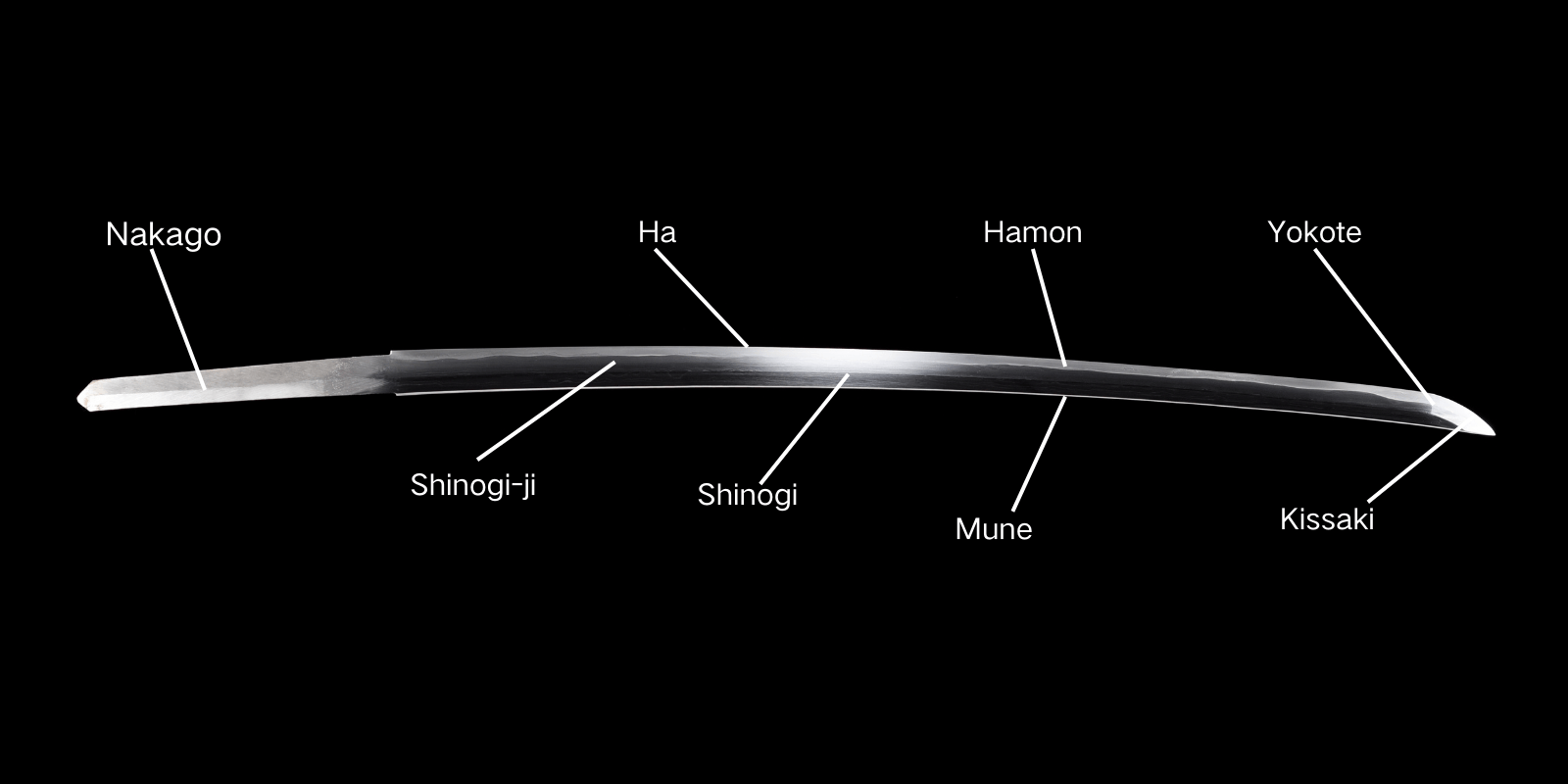
To appreciate a katana, it helps to understand its key components, each serving a distinct function:

-
Ha (Edge) – The sharpened cutting edge running from the base to the tip. This section is hardened to hold a razor-like sharpness.
-
Kissaki (Tip) – The pointed end of the blade, designed for piercing and precise slicing.
-
Yokote – The line that separates the tip from the rest of the blade, shaping and reinforcing the kissaki.
-
Hamon – A visible temper line along the edge, created by the heat-treating process and prized both for function and artistry.
-
Mune (Spine) – The unsharpened back of the blade, slightly softer to absorb shock and provide overall flexibility.
-
Shinogi (Ridge Line) – A raised line running lengthwise that strengthens the blade and influences its slicing motion.
-
Shinogi-ji (Blade Face) – The flat area between the ridge and the spine, often revealing the layered grain of the steel.
-
Nakago (Tang) – The hidden section that extends into the handle. A strong tang ensures stability and often carries the smith’s signature.
Each element reflects a deliberate choice in geometry and metallurgy, creating a blade that is light, strong, and balanced.
Traditional Steel: Tamahagane
At the heart of a classical katana is tamahagane, or “jewel steel,” produced by smelting iron sand with charcoal in a clay furnace called a tatara. This steel ranges from about 0.5 to 1.5 percent carbon, giving smiths a spectrum from low-carbon, more ductile metal to high-carbon steel ideal for hard edges.
Tamahagane’s relatively pure composition and soft non-metallic inclusions allow a finished blade to flex slightly without cracking. Smiths carefully sort and select pieces of different carbon content, using harder steel for the edge and softer steel for the core or spine. This combination ensures a cutting edge that stays sharp while the rest of the blade remains resilient.
Folding and Forge Welding
One hallmark of traditional katana making is the repeated folding of the steel. The smith heats, hammers, and folds the billet many times, doubling the layers with each pass. This process:
-
Purifies the steel – Repeated heating and hammering burn off impurities and expel slag.
-
Evens out carbon content – Folding blends high- and low-carbon layers, reducing weak or brittle spots.
-
Creates distinctive grain – The layered steel produces subtle patterns, known as hada, visible after polishing and valued for their natural beauty.
While legends speak of “thousands of folds,” the real benefit lies in refining the material, not chasing a mystical number of layers.
Differential Hardening
Perhaps the most remarkable step is differential hardening, which gives the katana its trademark combination of hardness and flexibility. Before quenching, the smith coats the blade with a clay mixture, applying a thin layer near the edge and a thicker layer on the spine. When the heated blade is plunged into water, the exposed edge cools rapidly, transforming into hard martensite, while the spine cools more slowly and retains a softer, tougher structure.
This technique produces two striking effects. First, it causes the blade to curve slightly as the edge contracts more quickly than the spine. Second, it reveals the hamon—the visible boundary between hard and soft steel. Each smith’s clay pattern yields a unique hamon, from gentle waves to complex floral motifs, turning functional heat treatment into a signature of artistry.
Strength, Sharpness, and Beauty
The interplay of materials and methods gives a traditional katana a rare blend of qualities:
-
Exceptional sharpness – The high-carbon edge hardens to a level that maintains a razor finish through repeated use.
-
Toughness and flexibility – A softer core and spine absorb shock, preventing catastrophic failure during heavy strikes.
-
Aesthetic richness – The folded grain and glowing hamon provide a visual depth that no modern etching can replicate.
This balance—hard where it must cut, resilient where it must endure—is what sets the katana apart from many other historical blades.
Modern Versus Traditional Blades
Today’s metallurgy offers steels that are cleaner and more uniform than anything available centuries ago. Modern smiths can achieve remarkable results with high-carbon tool steels or spring steels without the need for labor-intensive folding. Some employ advanced heat treatment to produce a true hamon, while others etch decorative patterns to mimic traditional grain.
These methods can match or exceed the mechanical performance of classic blades. Yet, collectors and enthusiasts often prize traditional katanas for the craftsmanship itself: the layered steel, the natural hamon born of clay and water, and the subtle variations that come only from hand forging.
Care and Appreciation
Owning a fine blade requires proper care. Keep the surface clean and lightly oiled to prevent rust. Avoid touching the polished steel with bare fingers, as oils and salts can stain or corrode. Sharpening or polishing should be left to experienced professionals to preserve the geometry and the hamon’s delicate appearance.
Collectors look for clear, genuine hamon lines, visible grain, and precise geometry—especially a well-defined yokote and a cleanly shaped kissaki. A signed tang can add historical value but is not the sole measure of quality.
Conclusion
The katana’s enduring mystique is rooted in its perfect union of art and engineering. From selecting tamahagane to folding it into countless layers, from careful clay application to the final polish that reveals grain and hamon, every step reflects centuries of accumulated skill. Understanding the blade’s structure—edge, spine, ridge, and tip—deepens appreciation for a weapon that is also a masterpiece of human ingenuity.
Whether forged in a traditional tatara or shaped from modern high-grade steel, a well-made katana remains a testament to what happens when science and artistry meet at the edge of a blade.