
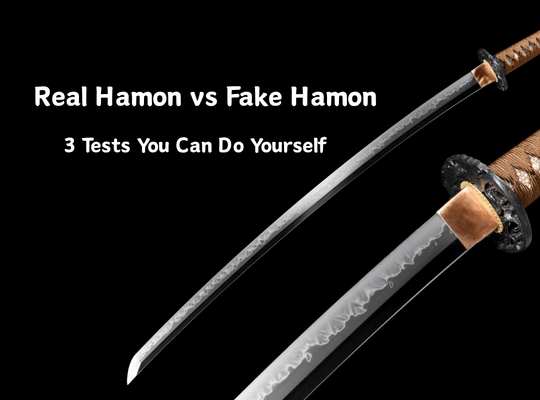
Real Hamon vs Fake Hamon: 3 Tests You Can Do Yourself
A Beginner-Friendly Guide Before Buying Your First Katana
If you are new to samurai swords, the hamon is probably one of the first details that catches your eye.
It is that cloudy, wavy, mist-like line running along the blade. It looks beautiful. It looks technical. It makes the sword feel more handcrafted, more serious, and honestly, a lot more interesting than a plain polished blade.
But here is the catch:
Not every visible hamon is a real hamon.
Some hamon are formed through real differential hardening. Some are made more visible through polishing. Some are enhanced with acid. And some are simply etched, brushed, or added to the blade surface to create a hamon-style look.
So before you buy a katana just because the line looks cool, slow down for a second.
The real question is not
“Does this sword have a hamon?”
The better question is
“Is this hamon part of the blade’s heat treatment, or is it just a surface effect?”
That difference matters. A real hamon is connected to the steel structure and heat-treatment process. A fake or cosmetic hamon is mainly about appearance. For collectors, that affects authenticity and value. For beginners, it affects what you are actually learning. For anyone buying a functional blade, it also affects whether the seller is being clear and honest.
Now, let’s be clear from the start: these three tests will not turn you into a professional sword appraiser overnight. They are not laboratory tests. They cannot confirm the exact steel type, exact hardness, or every detail of the heat treatment.
But they can help you avoid the most obvious beginner mistakes.
Think of them as simple screening tools. They help you spot red flags, ask better questions, and avoid buying only the shine.
Let’s break it down.
First, What Is a Real Hamon?
A real hamon is the visible result of differential hardening.
In plain English, this means the cutting edge of the blade is hardened more than the body and spine. During heat treatment, the blade is heated and then quenched. The edge cools faster and becomes harder, while the upper body and spine cool more slowly and stay tougher.
That difference creates a visible boundary along the blade.
That boundary is the hamon.
So a real hamon is not just a decorative line. It is connected to the blade’s internal structure. It shows where the harder edge zone and the softer body zone meet.
This is why a real hamon can look different under different lighting. It may appear cloudy, misty, bright, soft, or almost hidden depending on the angle. It is not simply sitting on top of the steel like paint.
A real hamon should feel like it belongs inside the blade.
What Is a Fake or Cosmetic Hamon?
A fake hamon, also called a cosmetic hamon, is a hamon-style line added mainly for appearance.
It may be created by:
- Acid etching
- Wire brushing
- Sanding or polishing contrast
- Surface frosting
- Decorative finishing
A cosmetic hamon can still look attractive. It may even look dramatic in product photos. But it does not prove that the blade was differentially hardened.
That does not mean every cosmetic hamon is automatically bad.
For a display sword, a decorative hamon can be perfectly acceptable if the seller describes it honestly. The problem begins when a cosmetic hamon is marketed as a real heat-treated hamon.
In other words, decoration is not the issue.
Misrepresentation is the issue.
So instead of thinking “fake hamon equals bad sword,” think more carefully:
Is the seller clear about what the hamon really is?
That is the smarter buying mindset.
Test 1: The Grazing-Light Tilt Test
This is the easiest test for beginners because you do not need special tools.
All you need is a controlled light source and a bit of patience.
The idea is simple: a real hamon usually changes as the light angle changes. A cosmetic hamon often looks flatter and more static.
What You Need
Use a small lamp, flashlight, or strong natural light from one direction. Avoid bright overhead room lighting because it can wash out the blade surface and make everything harder to read.
If you are handling a polished blade, wear clean gloves or avoid touching the blade directly. Fingerprints can stain or mark polished steel if left there.
Most importantly, do not swing the sword around.
This is a looking test, not a heroic moment.
Place the sword on a stable padded surface if possible. Keep the edge away from your hands and body.
How to Do It
Set the light at a low angle so it skims across the blade surface. Then slowly tilt the blade a few degrees at a time. You can also keep the blade still and move the light slightly.
Watch the hamon carefully.
Start near the base of the blade, then follow the line toward the middle and the tip. Repeat the same process on the other side.
Do not rush. The whole point is to observe how the hamon behaves.
What a Real Hamon May Look Like
A real hamon often appears alive under angled light.
It may brighten, fade, shift, or become clearer as you change the angle. Sometimes it looks like mist inside the steel. Sometimes it appears soft and cloudy. Sometimes it almost disappears until the light catches it just right.
That changing quality is important.
A real hamon usually does not look like a perfectly flat white stripe from every angle.
It has depth.
It has movement.
It reacts to light.
What a Fake Hamon May Look Like
A cosmetic hamon often behaves more like a surface stripe.
It may stay equally visible from too many angles. It may look flat, chalky, brushed, or painted on. It may seem too bright and too uniform, almost like a graphic effect rather than a natural steel feature.
If the line looks exactly the same no matter how you move the light, that is a warning sign.
Not final proof.
But definitely a clue.
Important Limitation
This test is useful, but it is not perfect.
A real hamon can look weak if the polish is rough or dull. Some real hamon are also enhanced through polishing or acid treatment, which can make them look brighter than they naturally are.
So do not make your decision from this test alone.
Use it as Test One — not the whole verdict.
Test 2: The Loupe or Phone Macro Test
The second test looks closer.
This test helps you check whether the hamon has depth and internal activity, or whether it looks like a flat surface treatment.
You do not need expensive equipment. A simple jeweler’s loupe or a phone macro lens is enough for a beginner.
What You Need
Use a 5x to 10x loupe, a phone macro lens, or a smartphone with a decent close-up mode.
Do not press the lens against the blade. Do not drag anything across the steel. Do not scratch, rub, polish, or “test” the surface with your fingernail.
You are observing only.
How to Do It
Choose three areas:
- Near the base of the blade
- Around the middle section
- Near the tip area
Look closely at the transition between the hamon and the rest of the blade.
Do this under angled light, not flat overhead light.
If using your phone, take several close-up photos from slightly different angles. A short video can be even better because it shows how the hamon changes as the angle changes.
What a Real Hamon May Show
On a well-polished real hamon, you may see more than just a line.
You may notice a cloudy transition zone. You may see tiny bright particles or a misty band that seems integrated into the steel. In sword terminology, this misty appearance is often linked to "nioi," while larger sparkling particles are called "nie."
Do not worry if those words sound new.
For a beginner, the basic idea is this:
A real hamon often has depth and activity.
It should not look like a simple white band printed onto the surface.
It may look soft, layered, cloudy, or slightly grainy in a natural way.
What a Fake Hamon May Show
A fake or cosmetic hamon may look much flatter under magnification.
You may see:
- A frosted white band
- Repeated brush marks
- A sudden hard edge between white and dark areas
- A mechanically even texture
- Surface scratches following the hamon line
- A line that looks etched rather than formed in the steel
A wire-brushed hamon may show very fine artificial scratch marks. An acid-etched hamon may look pale, cloudy, or too evenly frosted.
Again, this does not prove everything by itself. But it gives you useful evidence.
Important Limitation
This test depends heavily on polish quality.
A real hamon can be hard to read on a rough production polish. A poorly polished blade may hide genuine activity. On the other hand, a cosmetic hamon can look convincing in photos if the lighting is carefully controlled.
So do not panic if you do not see dramatic crystal activity.
A beginner-level sword may not show museum-level detail.
The key question is
Does the hamon look integrated into the steel, or does it look like a surface effect?
That is what you are trying to judge.
Test 3: The Base-to-Tip Continuity Test
The third test is about logic.
A real hamon should make sense as it travels along the blade.
It does not need to be perfectly symmetrical. In fact, perfect mirror-like sameness can sometimes look suspicious. Real heat treatment can create natural variation.
But the hamon should feel connected.
It should not look like random decoration applied section by section.
How to Do It
Follow the hamon from the base of the blade toward the tip.
Look at three main zones:
- The base area
- The middle of the blade
- The tip area
Then check the other side.
You are not looking for perfect sameness. You are looking for a believable relationship.
Ask yourself:
Does the line flow naturally?
Does it suddenly stop?
Does it become too mechanical?
Does the style completely change near the tip?
Does one side look real while the other side looks like a printed copy?
Why the Tip Matters
The tip area is especially important.
The continuation of the hamon into the tip is often called the boshi. For beginners, you do not need to memorize all the technical variations. Just remember this:
The hamon should not suddenly give up near the tip.
If the line looks convincing in the middle of the blade but turns into a vague, scratchy patch near the tip, that is a red flag.
Some cosmetic hamon effects look good in one product photo because the middle section is easy to show. But when you check the base, both sides, and the tip, the illusion can fall apart.
What a Real Hamon May Look Like
A real hamon often has a consistent visual “family.”
It may vary naturally, but the overall character should make sense. If it is gently wavy in the middle, the rest of the line should feel related. If it is straight and quiet, it should not randomly become a wild stencil pattern at the tip.
Natural variation is fine.
Random decoration is not.
What a Fake Hamon May Look Like
A cosmetic hamon may show signs such as the following:
- Repeated stencil-like patterns
- Abrupt starting or stopping points
- A line that looks too perfectly copied
- A middle section that looks good but weak base and tip areas
- A tip area with no logical continuation
- Two sides that look artificially identical
The biggest warning sign is when the hamon looks like a design placed on the blade rather than a feature formed by the blade.
Important Limitation
The tip is difficult to polish and photograph well. Even a real hamon may be hard to read in that area if the blade finish is rough.
So again, do not use one clue as final proof.
Use all three tests together.
What These Tests Cannot Prove
This part is important.
These three tests can help you spot obvious red flags, but they cannot prove everything.
They cannot confirm:
- Exact steel type
- Exact hardness
- Complete heat-treatment quality
- Internal flaws
- Overall cutting performance
- Full authenticity of the sword
- Seller honesty by themselves
A real hamon is valuable information, but it is not a full quality certificate.
A sword still needs good steel, proper heat treatment, solid tang construction, clean assembly, good geometry, and honest product information.
This is where many beginners get confused.
They think:
A real hamon = a great sword.
Not always.
A real hamon tells you something about heat treatment. It does not automatically tell you everything about the sword.
So your goal is not to worship the hamon.
Your goal is to understand it.
What to Ask the Seller Before Buying Online
Most beginners will buy online. That means you may not be able to inspect the blade in person.
So you need to ask for better evidence.
Do not rely on one perfect product photo. A hamon can look completely different depending on lighting, angle, contrast, and editing.
Ask the seller for:
- A slow blade-tilt video under one light source
- Close-up photos of both sides
- A macro photo of the hamon
- A clear photo of the tip area
- A neutral-light photo without heavy editing
- A written answer explaining whether the hamon is real or cosmetic
You can also ask these direct questions:
Is the blade differentially hardened or through-hardened?
Is the hamon formed by heat treatment?
Has the hamon been acid-enhanced?
Is the hamon etched, brushed, or polished onto the surface?
Can you show both sides of the blade under angled light?
Can you show the hamon continuing into the tip area?
A good seller should not be offended by these questions.
A trustworthy seller should be able to answer clearly.
And if the answer is vague, that is useful information too.
Common Beginner Mistakes
Mistake 1: Thinking Bright Means Real
A very bright hamon is not automatically real.
Some real hamon are subtle. Some fake hamon are extremely bright.
Bright photos can be created with lighting, contrast, polishing, or etching.
So do not buy based only on brightness.
Mistake 2: Thinking Subtle Means Fake
The opposite mistake is also common.
A real hamon may look subtle under poor lighting or rough polish. It may only appear clearly at the right angle.
So if the hamon is not loud, that does not automatically mean it is fake.
Mistake 3: Thinking Etched Always Means Fake
This one is tricky.
Some genuine differentially hardened blades may be acid-enhanced to make the hamon more visible. That means acid involvement does not always mean “totally fake.”
The better question is
Is there a real heat-treatment structure underneath the enhancement?
That is more accurate than simply asking, “Was acid used?”
Mistake 4: Damaging the Blade to Test It
Do not scratch the blade.
Do not file the blade.
Do not use acid.
Do not use metal polish.
Do not test it with coins, nails, tape, or sandpaper.
That is not inspection. That is damage.
Your goal is to observe, not to destroy value.
Mistake 5: Ignoring the Rest of the Sword
Even if the hamon is real, the rest of the sword still matters.
Check the steel.
Check the tang.
Check the fittings.
Check the handle wrap.
Check the scabbard fit.
Check the seller’s explanation.
A hamon is one clue, not the whole story.
Quick Comparison: Real Hamon vs Fake Hamon
A real hamon usually
- Changes under angled light
- Looks integrated into the steel
- Shows natural variation
- May reveal misty or crystalline activity
- Continues logically along the blade
- Relates to differential hardening
A fake or cosmetic hamon often:
- Looks flat or overly uniform
- Stays equally visible from many angles
- Appears brushed, frosted, or etched
- Looks like it sits on the surface
- May repeat too perfectly
- May break down near the base or tip
But remember:
No single sign is enough.
You are looking for a pattern of evidence.
Final Thoughts: Don’t Buy the Line — Buy the Evidence
A hamon can be beautiful. It can give a blade depth, character, and technical meaning. A real hamon tells you that something happened during heat treatment, not just after polishing.
But smart buyers do not stop at the line.
They check how it behaves under light.
They inspect it up close.
They follow it from base to tip.
They ask the seller direct questions.
They compare the hamon with the rest of the sword’s construction.
That is how you move from “this looks cool” to “this actually makes sense.”
For a complete beginner, that shift matters.
You do not need to become an expert overnight. You just need to stop trusting one dramatic photo and start asking better questions.
A good sword should not need confusing language to sell itself. The details should line up. The visual evidence should match the seller’s explanation. The blade should make sense as a whole.
So before buying your first katana with a beautiful hamon, run these three tests:
Use angled light.
Look closer.
Follow the line.
And then ask the most important question:
Is this hamon evidence of real heat treatment or just a surface effect?
Once you learn to ask that, you are no longer just shopping with your eyes.
You are buying with judgment.
That is where real collecting begins.