
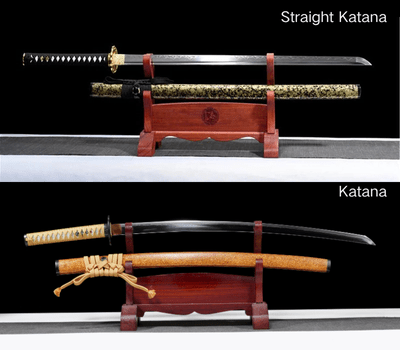
Straight Katana vs. Katana: A Collector’s Guide to Two Legendary Japanese Swords
When people think of Japanese swords, the word “Katana” usually springs to mind. But there’s another blade—steeped in ancient tradition and minimalist design—that deserves more attention: the Straight Katana. As a predecessor to the more familiar curved Katana, it offers a completely different perspective on Japanese sword-making.
In this guide, we’ll explore the key differences between the Straight Katana and the traditional Katana. From design and function to craftsmanship and practical use, this side-by-side comparison will help collectors and enthusiasts understand what sets these two iconic blades apart—and why both are worth owning.
1. What Is a Straight Katana?
The Straight Katana refers to Japan’s early straight-bladed swords, which date back to the 3rd–8th centuries AD. Inspired by Chinese and Korean swords of the time, these blades feature a simple, linear design that prioritizes thrusting and stabbing motions.
Used by early infantry and aristocrats, Straight Katanas were often carried in formal processions or used in ritual contexts. Original historical examples are rare today, but modern replicas and reinterpretations are gaining popularity among collectors who appreciate clean lines and early Japanese aesthetics.
2. What Is a Katana?
The Katana, Japan’s most iconic sword, emerged much later—during the late 14th to early 17th centuries. Known for its graceful curve and cutting precision, the Katana was designed for quick draw-and-strike techniques. It was worn edge-up through the belt (obi), allowing warriors to unsheathe and cut in one motion.
More than just a weapon, the Katana became a symbol of martial discipline and craftsmanship. Today, it remains the centerpiece of many collections and martial arts traditions.
3. Key Differences in Design and Structure
| Feature | Straight Katana | Katana |
|---|---|---|
| Blade Shape | Straight | Curved |
| Blade Length | Typically 50–70 cm | Typically 60–75 cm |
| Primary Use | Thrusting, stabbing | Slicing, cutting |
| Grip Style | Plain or minimal wrapping | Cord-wrapped, often ornate |
| Fittings | Simple or ceremonial | Highly decorative and varied |
While the Straight Katana embodies simplicity and utility, the Katana reflects refinement and ergonomic efficiency, particularly for slicing motions.
4. Forging and Craftsmanship
Straight Katana Crafting
Historically, Straight Katanas were made with basic iron-smelting techniques. They typically had flat blades and lacked features like temper lines (hamon) or folded steel grain patterns (hada). That said, modern versions often incorporate upgraded steel, giving the blade a polished finish and better performance.
Katana Crafting
Katanas are renowned for their complex forging process. Traditional smiths use tamahagane (Japanese high-carbon steel), folded multiple times to enhance strength and aesthetic detail. The blades undergo differential hardening, creating the signature hamon along the edge. These features make each Katana not just functional, but a work of art.
5. Wearing the Blade: Function Meets Form
-
Straight Katanas were traditionally worn edge-down, suspended from the belt—similar to early Chinese-style swords.
-
Katanas are worn edge-up, thrust through the sash. This orientation supports draw-and-cut techniques, offering a clear advantage in fast-paced combat.
This evolution in wear style mirrors the changing needs of Japanese warriors—from ceremonial use to battlefield readiness.
6. Practical Use and Application
-
Straight Katana: Primarily used for thrusting; its straight blade delivers powerful, linear strikes. Less efficient for slicing or curved motion.
-
Katana: Designed for cutting. Its curve allows for smooth slicing action, especially during quick-draw strikes and martial techniques like Iaido.
In modern times, Straight Katanas are mostly used for decorative or historical reenactment purposes. Katanas, however, remain central to many martial arts practices and continue to be made for both training and display.
7. Market Appeal and Modern Collecting
Straight Katana
-
Rarity: Authentic ancient pieces are museum-level rare.
-
Modern Options: Available through custom forges and select artisans.
-
Display Appeal: Loved for their clean lines and minimalist presence.
Katana
-
Accessibility: Available in a wide range of quality—from budget-friendly replicas to museum-grade antiques.
-
Price Range: Entry-level models start around $200; top-tier handcrafted or antique blades can cost $10,000 or more.
-
Versatility: Used in martial arts, decor, film, and as investment pieces.
Pro Tip: For serious collectors, seek out certified blades with provenance or NBTHK authentication from Japan.
8. Which Sword Should You Choose?
| Your Goal | Best Choice |
|---|---|
| Martial arts training | Katana |
| Clean, minimalist display | Straight Katana |
| Historical appreciation | Straight Katana |
| Tactical reenactment | Katana |
| Starting a collection | Either (based on budget and taste) |
Ultimately, the choice depends on what you value—simplicity and historical roots, or refinement and functionality. Many seasoned collectors own both, appreciating each for what it uniquely offers.
Conclusion
The Straight Katana and Katana are not just different swords—they represent different eras, techniques, and philosophies in Japanese sword history.
The Straight Katana speaks to early practicality and sacred form, while the Katana showcases the peak of martial and metallurgical refinement. Whether you're training, displaying, or simply admiring from afar, both blades offer timeless appeal and a story worth preserving.
If you’re building a collection—or starting one—these two blades are ideal companions, each representing a different chapter in the rich narrative of Japanese swordmaking.