
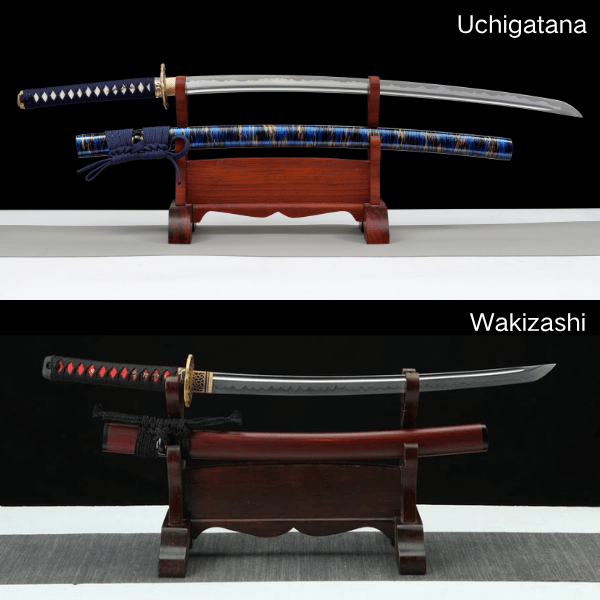
The Key Differences Between Uchigatana and Wakizashi
Among all Japanese swords, few pairs are more iconic than the uchigatana and wakizashi.
Together, they formed the legendary daishō — “the long and the short” — symbolizing both martial readiness and personal discipline.
At first glance they may appear similar, but these two blades differ in far more than just length.
Their design, purpose, structure, and symbolism represent two distinct sides of the warrior’s craft.
1. Function: The Main Sword and the Companion Blade
Uchigatana — The Warrior’s Primary Weapon
The uchigatana served as the samurai’s principal sword, typically featuring a blade over 60 cm long and designed for two-handed use.
It replaced the older tachi, shifting from an edge-down cavalry sword to an edge-up weapon worn through the obi (sash).
This change revolutionized combat: a warrior could draw and cut in a single fluid motion.
Long, slightly curved, and balanced for reach and power, the uchigatana was ideal for open-field combat — a symbol of strength, decisiveness, and duty.
Wakizashi — The Compact, Versatile Sidearm
The wakizashi, by contrast, ranges from 30 to 60 cm in length and served as a secondary weapon.
It excelled in confined environments — indoors, in narrow alleys, or when space was too limited for a long draw.
During the Edo period, samurai were required to surrender their long sword before entering a residence but were permitted to keep the wakizashi.
It became both a defensive weapon and a quiet symbol of vigilance and self-control.
In essence:
The uchigatana represented outward power; the wakizashi embodied inward awareness.
2. Construction: Shared Tradition, Distinct Geometry
Both swords follow the same nihontō tradition of folded-steel forging and differential heat treatment that creates the signature hamon (temper line).
Yet their physical proportions — curvature, weight, and geometry — reflect their unique purposes.
| Feature | Uchigatana | Wakizashi |
|---|---|---|
| Blade Length | 60 cm + | 30–60 cm |
| Grip | Two-handed | One-handed |
| Curvature | Pronounced | Subtler or straighter |
| Weight | Heavier, for power | Lighter, for agility |
| Ideal Use | Open combat | Indoor or close-quarters defense |
Uchigatana Design:
Usually forged in shinogi-zukuri (ridged cross-section), the blade features a central ridge that strengthens the spine and channels cutting force efficiently.
This structure ensures both rigidity and control, allowing the sword to deliver smooth, powerful strikes.
Wakizashi Design:
Commonly crafted in hira-zukuri (flat cross-section) or shōbu-zukuri styles, the wakizashi has a thinner spine and shorter reach, giving it faster draw speed and precision handling.
Put simply:
The uchigatana favors power and reach; the wakizashi values speed and precision.
3. Wearing Style: Strength and Subtlety in Balance
Both swords were worn edge-up, but their positioning revealed their purpose.
-
Uchigatana: Worn at the left hip, angled slightly backward for long, sweeping draws.
-
Wakizashi: Positioned more toward the front for quick, close-range use.
This difference was more than practical — it was social.
Removing the long sword upon entering a home was a sign of trust; retaining the short one showed respect without defenselessness.
Even in modern collections, the uchigatana is displayed above the wakizashi on a katanakake stand — a visual echo of their historical hierarchy and harmony.
4. Technique: Reach Versus Reaction
Uchigatana — Momentum and Power
The longer blade excels in wide-arc strikes and continuous flow.
Its weight distribution enables deep, decisive cuts, ideal for open movement and formal sword arts such as iaidō and tameshigiri (test cutting).
Its effectiveness depends on stance, distance, and rhythm — the mastery of power through precision.
Wakizashi — Speed and Adaptability
The wakizashi thrives in tight quarters where long swings are impossible.
It is the sword of reflexes — drawn in an instant for parries, thrusts, or close-range counters.
Its technique prioritizes agility and control over force, allowing the user to respond fluidly to confined or surprise encounters.
The uchigatana dominates through space and strength; the wakizashi defends through speed and awareness.
5. Symbolism: Power Versus Restraint
Beyond physical form, the two blades express contrasting yet complementary ideals.
-
The uchigatana symbolizes courage, authority, and decisive action — the external strength of the warrior.
-
The wakizashi symbolizes discipline, vigilance, and moral restraint — the internal control that tempers power.
A samurai’s dual swords thus embodied his code:
outer honor and inner mindfulness.
For modern collectors, this duality still defines the daishō’s enduring appeal.
6. Craftsmanship and Aesthetic Appeal
Although forged with the same techniques, the uchigatana and wakizashi present different artistic focal points.
Uchigatana Aesthetics:
-
The longer blade accentuates the hamon and hada (steel grain).
-
Its curvature reflects both strength and elegance.
-
When displayed, it commands attention — a centerpiece of any sword collection.
Wakizashi Aesthetics:
-
Its compact proportions emphasize fine details in the fittings (tsuba, fuchi-kashira, lacquered saya).
-
The simplicity of its form enhances the grace of its decoration.
-
It invites close inspection — subtle, balanced, and deeply personal.
Thus, while the uchigatana impresses through grandeur, the wakizashi captivates through precision.
7. Essence of the Difference: Duality in Harmony
| Aspect | Uchigatana | Wakizashi |
|---|---|---|
| Role | Primary sword | Secondary or defensive sword |
| Ideal Setting | Open field | Indoor or close range |
| Operation | Two-handed | One-handed |
| Symbolism | Strength and command | Control and restraint |
| Aesthetic | Grand and powerful | Refined and intimate |
Together, they form the balance of opposites —
strength and subtlety, action and awareness, power and restraint.
To study their differences is to glimpse the philosophy of the sword itself:
the harmony of outer force and inner calm.
For today’s collectors, owning both isn’t just about completing a set.
It’s about honoring the two halves of mastery —
one that strikes with power, and one that guards with wisdom.