Tachi vs. Uchigatana: Form, Function, and History
When people think of Japanese swords, the katana usually comes to mind—but before the katana’s rise, the tachi was the battlefield standard. These two long swords share the same cultural roots yet diverged in design, purpose, and even the way they’re worn. This guide breaks down every major difference so you can identify and appreciate each style with confidence.
Shape and Balance
Curvature
-
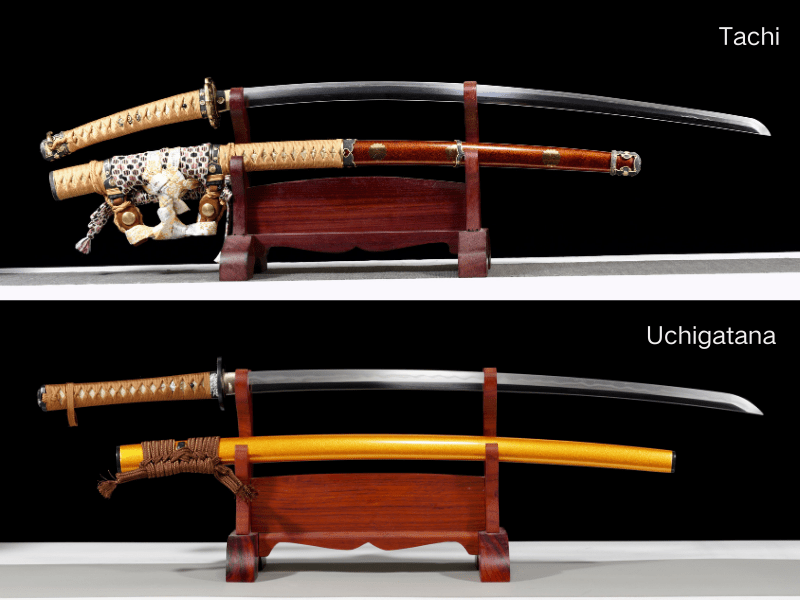
Tachi blades have a deeper, sweeping curve, with the greatest bend often near the hilt. That elegant arc makes powerful cuts from horseback more natural.
-
Uchigatana (the historical term for the katana) shows a shallower curve, better for quick draws and tight, on-foot fighting.
Length
-
Tachi typically run 70–80 cm along the cutting edge.
-
Uchigatana usually measure 60–70 cm, giving them slightly handier proportions for close combat.
Grip Geometry
Tachi hilts often follow the blade’s curve for smooth one-handed cuts on horseback. Uchigatana grips are straighter, designed for controlled two-handed strikes.
Wearing the Blade
The clearest distinction is how each sword is carried.
-
Tachi are suspended edge-down from the belt using a pair of hangers (ashi). This setup keeps the long, curved blade clear of the rider’s legs and ready for sweeping cavalry slashes.
-
Uchigatana are thrust through the belt edge-up, held by a cord (sageo) that passes through a side knob (kurikata). Edge-up carry allows the famous “draw-and-cut” motion in a single fluid action—ideal for sudden, close-quarters encounters.
Because of this difference, museums display tachi edge-down and katana edge-up to match their historic wear.
Combat Roles
-
Tachi excelled in the mounted warfare of the Heian and Kamakura eras. Riders held the reins with one hand and struck with the other, relying on length and curvature for devastating downward cuts.
-
Uchigatana became the blade of choice for infantry combat. Shorter reach and quicker draws made them perfect for urban skirmishes and the fast tempo of late-medieval battles.
Fittings and Mountings
The hardware of the scabbard, or koshirae, reveals the sword’s purpose.
-
Tachi-koshirae include two hangers for edge-down suspension and often feature lavish lacquer or metalwork—especially on ceremonial examples.
-
Uchigatana-koshirae drop the hangers and add the kurikata for belt carry. They frequently include slots for small utility knives (kogatana) or hair ornaments (kogai), reflecting everyday practicality.
Signature Orientation (Mei)
Swordsmiths traditionally sign the outer side of the tang—the side visible when the sword is worn at the left hip. Because tachi are worn edge-down and uchigatana edge-up, their signatures appear on opposite sides. Collectors call these tachi-mei and katana-mei, and the orientation is one of the quickest ways to tell the intended mounting.
Historical Shift
-
Tachi Era: From the late Heian through early Muromachi periods (roughly 10th–14th centuries), the tachi dominated as the weapon of mounted warriors and high-ranking samurai.
-
Rise of the Uchigatana: By the 15th century, battlefield tactics favored infantry. Shorter, edge-up swords with faster draw speed fit the new style of combat. The uchigatana spread rapidly and, by the Edo period, had become the everyday long sword—what most people now simply call the katana.
Symbolism and Status
-
Tachi signified aristocratic prestige and the knightly traditions of early samurai. Even after they faded from practical use, ornate tachi remained important in court ceremonies and temple offerings.
-
Uchigatana evolved into the badge of the warrior class. During the Edo era, the paired long and short swords (daisho)—a katana with a companion short blade—were a legal privilege and the most visible emblem of samurai status.
Quick Identification Checklist
-
Carry style: edge-down with hangers = tachi; edge-up in the belt = uchigatana.
-
Scabbard hardware: two hangers vs. a single kurikata.
-
Signature: mei on the right side for tachi, left side for uchigatana.
-
Blade profile: deeper curve and longer reach for tachi; shallower, handier proportions for uchigatana.
Closing Thoughts
The tachi and the uchigatana are not simply “old” and “new” versions of the same sword. Each was shaped by the combat realities of its time: the sweeping arcs of mounted warfare versus the rapid, close-quarters needs of infantry. From curvature to scabbard fittings to the side of the signature, every detail reflects those different roles.
Whether you’re a collector, martial artist, or just a fan of fine blades, understanding these distinctions adds depth to every encounter with a Japanese sword. You’re not just looking at steel—you’re reading centuries of practical design and battlefield evolution.