
Understanding the Katana Handle
Structure, Materials, and Functional Design
When people talk about a katana, the conversation usually starts with the blade—steel type, edge geometry, polish. Yet from a functional standpoint, the handle is just as critical. A blade can only perform as well as the grip that controls it.
The katana handle is not a decorative grip added at the end of the process. It is a carefully engineered system, designed to secure the blade, manage force, and provide reliable control through repeated use.
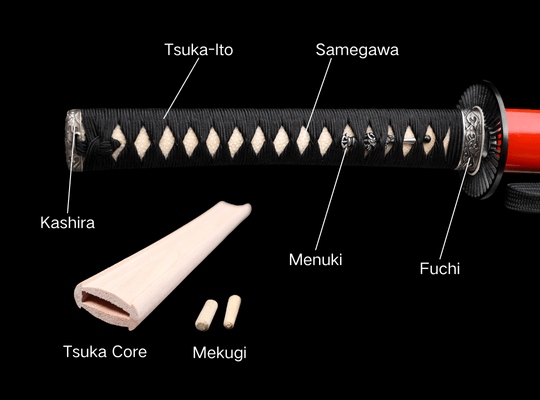
This article focuses on the practical construction of the katana handle—commonly referred to as the tsuka. Rather than discussing symbolism or historical narratives, we will examine how each component functions, why specific materials are used, and how the handle works as a unified mechanical structure.
1. The Tsuka Core: The Structural Foundation
At the center of the handle is the tsuka core, typically carved from lightweight hardwood. Its primary role is to house the tang of the blade and provide a stable framework for all other components.
From a functional design perspective, the tsuka core must achieve three things:
Precise Internal Fit
The internal cavity is shaped to closely match the tang. A tight, accurate fit minimizes movement and ensures that force generated during cutting is transmitted evenly through the handle.
Controlled Flexibility
The wood should not be brittle. A small amount of natural elasticity helps absorb shock, reducing stress on the blade and metal fittings during use.
Ergonomic External Shape
Most katana handles are subtly oval rather than perfectly round. This allows the user to sense blade alignment instinctively, improving consistency and control without visual confirmation.
A well-fitted core is often the difference between a sword that feels solid and one that feels unsafe—even if the blade itself is well made.
2. Samegawa (Ray Skin): Reinforcement and Grip Control
Covering the wooden core is samegawa, traditionally made from ray or shark skin. From a purely functional standpoint, samegawa serves two essential purposes.
Structural Reinforcement
Ray skin has a dense, fibrous texture that resists compression and tearing. When applied to the handle, it helps prevent the wooden core from cracking or deforming over time.
Friction Enhancement
The natural texture increases friction beneath the wrap, helping prevent the outer cord from slipping. Even if the wrap loosens slightly after extended use, the underlying samegawa still provides reliable grip.
Samegawa is commonly applied in two ways:
-
Side panels on the grip (most common in modern production)
-
A full wrap around the core (higher cost, similar function)
When installed correctly, both approaches perform equally well. The difference is primarily visual rather than mechanical.
3. Tsuka-Ito: Compression and Control
The outermost layer of the handle is the tsuka-ito, a tightly wrapped cord that binds the entire structure together.
This wrap is not decorative. It performs several critical functions at once:
-
Applies constant compression to lock internal components in place
-
Creates a textured, non-slip gripping surface
-
Prevents movement of samegawa and ornaments
-
Improves comfort during extended handling
Common materials include cotton, silk, and leather:
-
Cotton offers a softer feel and practical durability
-
Silk holds tension exceptionally well and maintains structure over time
-
Leather provides firm grip and better resistance to moisture
In practice, wrapping technique and tension matter more than material choice. A properly wrapped handle should not twist, shift, or loosen under normal use.
4. Mekugi: The Mechanical Lock
The mekugi is a small peg—traditionally bamboo—that passes through both the handle and the blade tang.
Despite its size, it plays a critical safety role:
-
Prevents the blade from sliding out of the handle
-
Allows controlled disassembly for inspection and maintenance
-
Absorbs shear stress through slight flexibility
Bamboo is used because it combines strength with resilience. Unlike rigid metal pins, it can flex slightly under impact rather than snapping.
In a properly constructed sword, the mekugi is not the primary load-bearing element. Instead, it acts as a secondary lock, supporting a handle that already fits securely.
5. Menuki: Subtle Ergonomic Aids
Menuki are small metal elements placed beneath the wrap. While often decorative, they also influence how the handle feels in use.
Functionally, menuki:
-
Add subtle contours to the grip
-
Improve hand indexing and consistency
-
Slightly increase handle thickness where fingers rest
When positioned correctly, menuki enhance comfort without creating pressure points. For practical swords, low-profile designs are generally preferred.
6. Fuchi and Kashira: Reinforced End Points
At each end of the handle are metal fittings:
-
Fuchi at the front, near the guard
-
Kashira at the base of the handle
These components serve several practical purposes:
-
Reinforce stress-prone areas of the wooden core
-
Secure the ends of the wrap
-
Provide minor balance adjustment
Structurally, they function much like metal collars on tool handles, preventing splitting and long-term wear.
7. The Handle as an Integrated System
What makes the katana handle effective is not any single component, but how all parts work together.
-
The core provides shape and alignment
-
Samegawa reinforces and stabilizes
-
The wrap compresses everything into a single unit
-
The mekugi locks blade and handle together
-
Metal fittings protect high-stress edges
When assembled correctly, the handle behaves as a solid, unified structure, despite being made from multiple materials.
8. Practical Evaluation Tips
When assessing a katana handle, consider these practical indicators:
-
No rattling or movement when shaken
-
Even wrap tension with clean transitions
-
Comfortable grip without sharp pressure points
-
Mekugi seated flush and secure
-
Smooth fit between handle fittings
A well-built handle should inspire confidence before the blade is ever tested.
Conclusion
The katana handle is a study in efficient, practical design. Wood, ray skin, cord, metal, and a single locking peg are combined into a system that prioritizes control, safety, and durability.
By understanding how the handle is constructed, it becomes easier to judge overall quality based on structure rather than surface appearance. This design logic remains effective even by modern standards and offers valuable insight into functional craftsmanship.